Glute Activation Exercises: How to Switch On Your Glutes After Sitting All Day
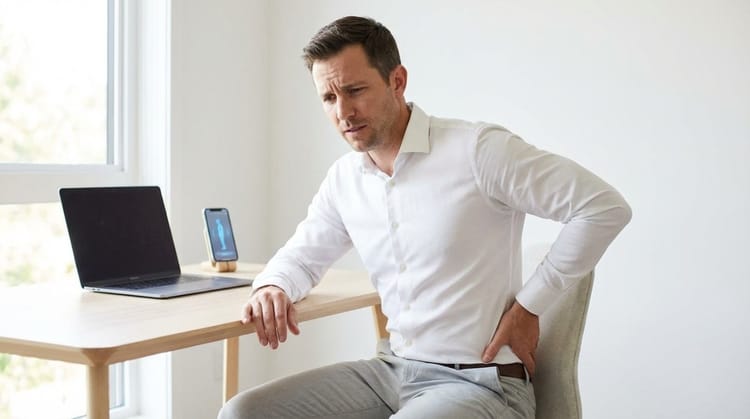
If you sit for most of the day and have lower back pain, hip tightness, or poor posture - your glutes are probably not doing their job. Glute inhibition from prolonged sitting is one of the most common and most underappreciated causes of back pain, hip dysfunction, and postural breakdown. The fix is not complicated. But it requires the right exercises, in the right order, done consistently.
Glute inhibition is a condition where the gluteal muscles become neurologically underactive due to sustained sitting, reducing their ability to fire correctly during movement and leaving the lower back and hip flexors to compensate.
TL;DR
- 🍑 Sitting for long periods switches off the glutes through a process called reciprocal inhibition
- 🔙 Inactive glutes are one of the leading causes of lower back pain in desk workers
- ⚡ Glute activation exercises "wake up" the muscles before they're needed for movement
- 🔢 There is a correct sequence - activation before strength, bodyweight before load
- 🧘 10-15 minutes of daily glute work produces measurable improvement within 2 weeks
- ⚠️ Doing the wrong exercises first (like heavy squats) without activation makes the pattern worse
- 📱 Personalized programs identify which glute exercises your body actually needs
What Is Glute Inhibition - and Why Does Sitting Cause It?
The gluteus maximus, medius, and minimus are the largest and most powerful muscles in the body. Their job is to extend the hip, stabilize the pelvis, and support the lower back during every step you take.
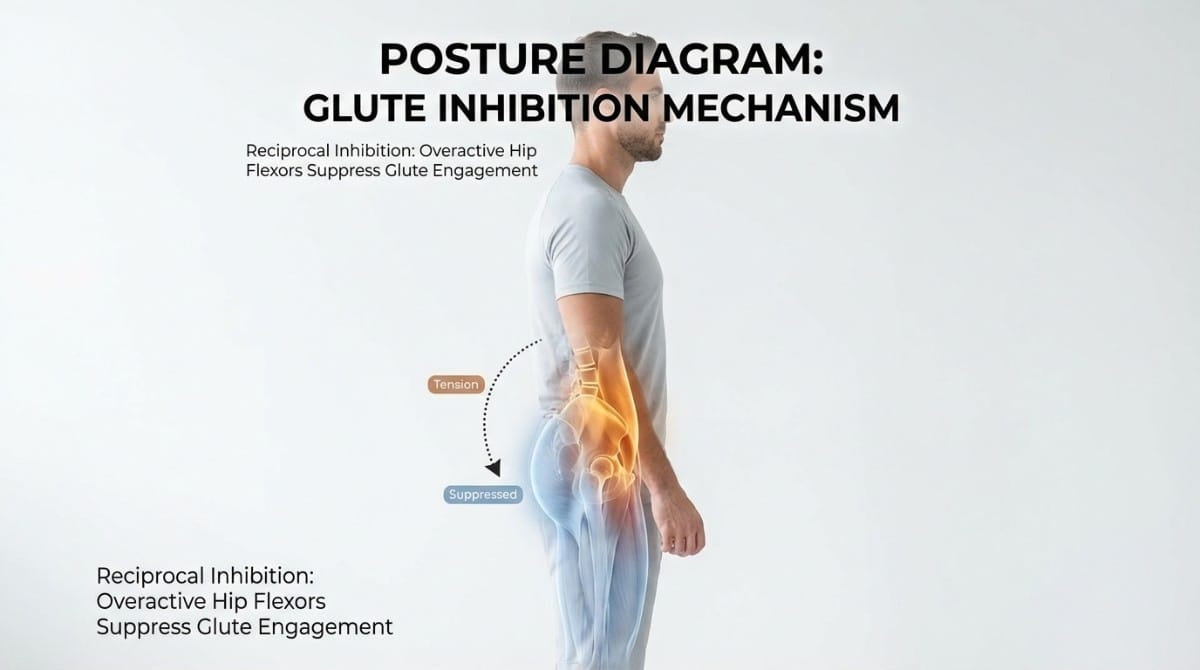
When you sit, the glutes are placed in a lengthened, passive position for hours. They stop receiving the consistent neural signals they need to stay active. Meanwhile, the hip flexors at the front of the hip shorten and tighten - and because the hip flexors and glutes are antagonists, when one group dominates, the other is neurologically suppressed.
This suppression is called reciprocal inhibition.
The result: glutes that don't fire when they should. A lower back that overworks to compensate. Hips that feel perpetually tight. And a postural pattern that compounds daily.
Posture specialists often describe this as the central driver of desk-worker back pain - not the sitting itself, but what the sitting does to the glutes over time. This connects directly to the cycle described in the guide on why lower back pain keeps coming back - inhibited glutes are almost always part of that story.
Key Insight: You can stretch your hip flexors every day and still have lower back pain if your glutes aren't activating properly. The hip flexors and glutes must work in balance. Stretching alone without glute activation is treating half the problem.
Why Do Your Glutes Stop Activating When You Sit?
Understanding the mechanism helps you take it seriously.
Step 1 - You sit down. The hip flexors contract to hold the 90-degree seated position. The glutes lengthen and go passive.
Step 2 - You stay seated for hours. The nervous system learns this pattern. Hip flexors remain chronically shortened. Glutes remain chronically lengthened and underused.
Step 3 - Reciprocal inhibition kicks in. The nervous system actively suppresses the glutes to reduce conflict with the dominant hip flexors. This is a protective reflex - but it creates dysfunction.
Step 4 - You stand up and move. The glutes should now contract to extend the hip and stabilize the pelvis. But they don't fire fully. The lower back and hamstrings take over.
Step 5 - Compensatory pain develops. The lower back overworks. The hip flexors stay dominant. The pelvis tilts forward. Pain becomes the baseline.
This is why people who exercise regularly - including gym-goers who squat and deadlift - can still have glute inhibition. The pattern is set by 8 hours of sitting. A 45-minute workout doesn't fully override it without deliberate activation work first.
How to Tell If Your Glutes Are Inhibited
You don't need a clinical test. These signs are reliable indicators:
Postural signs:
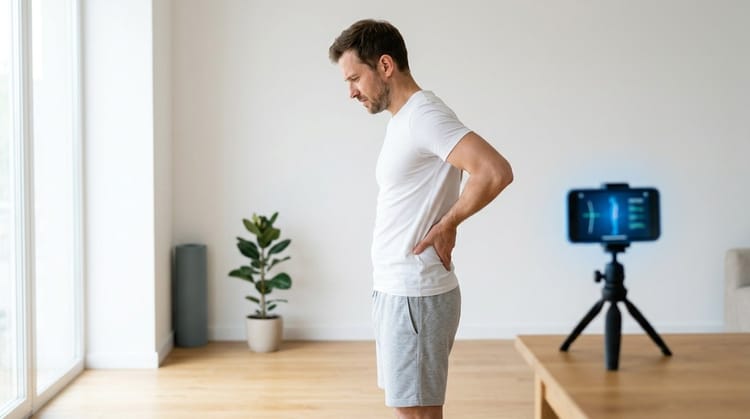
- Visible anterior pelvic tilt when standing (lower back arched, pelvis tilted forward)
- Lower back that feels tight or fatigued after standing for long periods
- Hips that feel chronically tight even after stretching
Movement signs:
- You feel squats or lunges primarily in your lower back or quads - not your glutes
- Difficulty "squeezing" your glutes on command
- One glute fires more than the other (asymmetrical activation)
- Your lower back rounds or compensates when you try to hip hinge
Pain signs:
- Lower back pain that worsens after sitting
- Hip tightness at the front - not the back - of the hip
- Knee pain that appears during leg exercises (often a sign the glutes aren't stabilizing the hip)
If several of these match, your glutes are likely not firing the way they should. The patterns here connect directly to the anterior pelvic tilt and hip tightness discussed in the tight hips and lower back pain guide.
The Correct Glute Activation Sequence
This is where most people go wrong. They jump straight to heavy squats or deadlifts thinking that will fix glute weakness. It won't - not if the glutes aren't activating first.
The correct order is:
- Release - foam roll and stretch the hip flexors to reduce reciprocal inhibition
- Activate - isolated glute activation exercises that force the glutes to fire without compensation
- Strengthen - compound movements that build glute strength once activation is established
- Integrate - functional movements that reinforce glute use in everyday patterns
Skipping straight to step 3 means the squats and lunges are still being driven by the hip flexors and lower back - not the glutes. You're reinforcing the dysfunction, not fixing it.
Best Glute Activation Exercises (Quick List)
Work through these in order. Start with activation before moving to strength. 🍑
🔵 Phase 1 - Activation (Start Here)
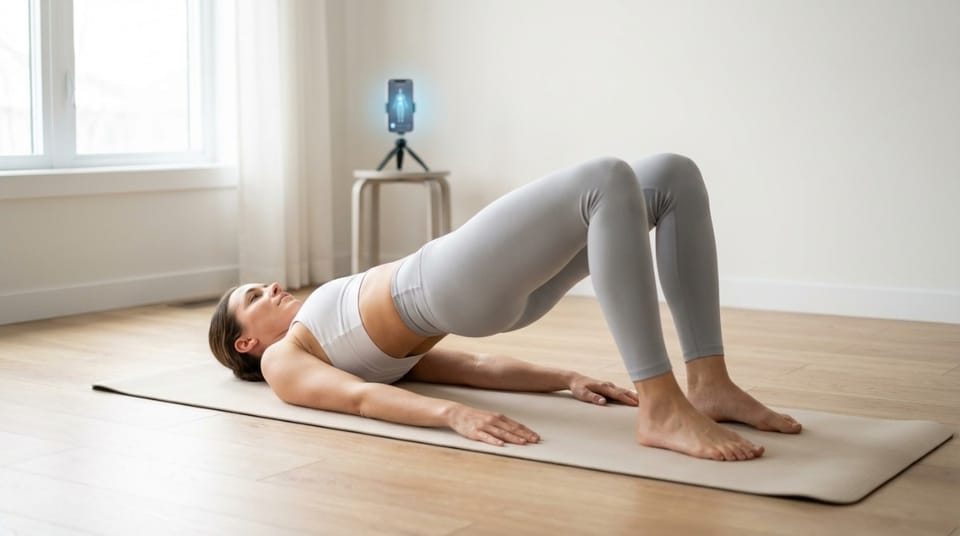
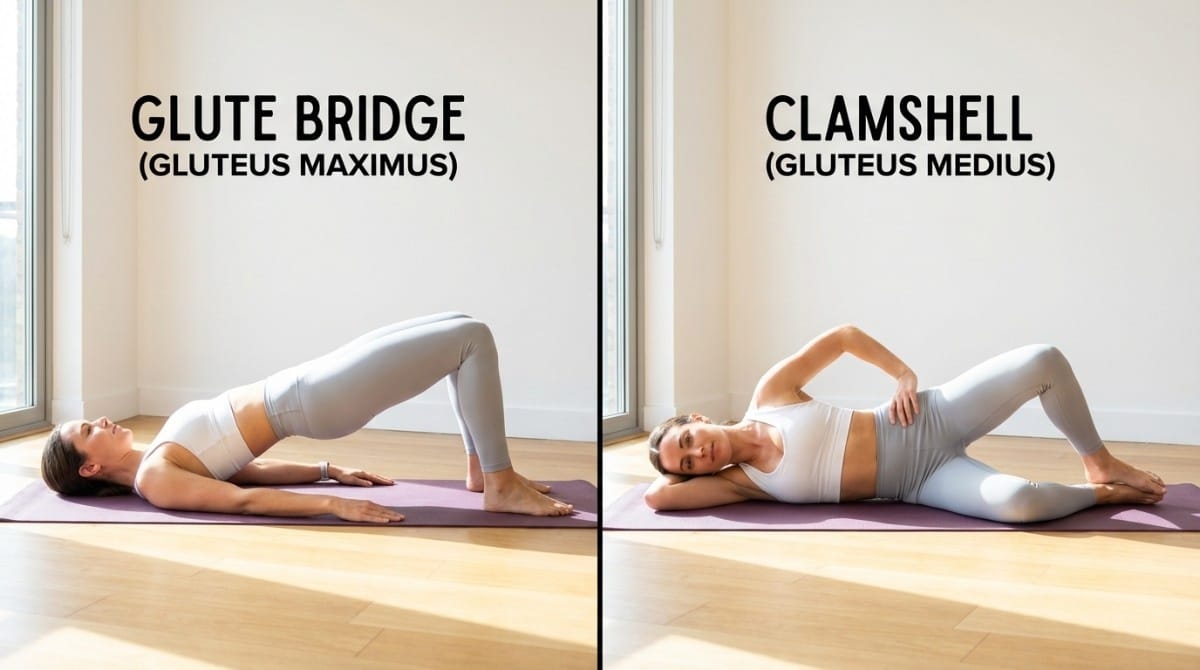
1. Glute Bridge The foundational glute activation exercise. Lying down removes spinal load and forces isolated glute contraction.
- Lie on your back, feet flat, knees bent at 90 degrees
- Press through the heels, drive the hips toward the ceiling
- Squeeze the glutes firmly at the top - hold 2-3 seconds
- Lower slowly - do not drop
- 3 sets of 15 reps
- Focus: Feel the contraction in the glutes - not the lower back or hamstrings
2. Clamshell Targets the gluteus medius - the hip stabilizer that's often the most inhibited. Critical for pelvic stability and knee alignment.
- Lie on your side, hips and knees bent at 45 degrees, feet stacked
- Keep your pelvis still and your feet together
- Rotate the top knee upward like a clamshell opening
- Hold 2 seconds at the top, lower slowly
- 3 sets of 15 reps per side
- Focus: No pelvic rocking - the movement comes entirely from the hip
3. Supine Hip Abduction Isolates the gluteus medius in a gravity-assisted position. Good for people who can't feel the clamshell working.
- Lie on your back, knees bent, feet flat
- Let one knee fall outward toward the floor (hip external rotation)
- Return slowly using only the hip muscles
- 3 sets of 12 reps per side
🔵 Phase 2 - Progressive Strength (After 1 Week of Activation)
Once you can feel the glutes firing during the activation exercises, progress to these movements.
4. Single-Leg Glute Bridge Increases glute maximus demand and exposes left-right activation asymmetry.
- Set up as a standard glute bridge
- Extend one leg straight, foot flexed
- Drive the hips up using only the grounded leg
- Hold 2 seconds at the top
- 3 sets of 10-12 reps per side
- Watch for: Do not let the hip on the raised-leg side drop - this is glute medius weakness
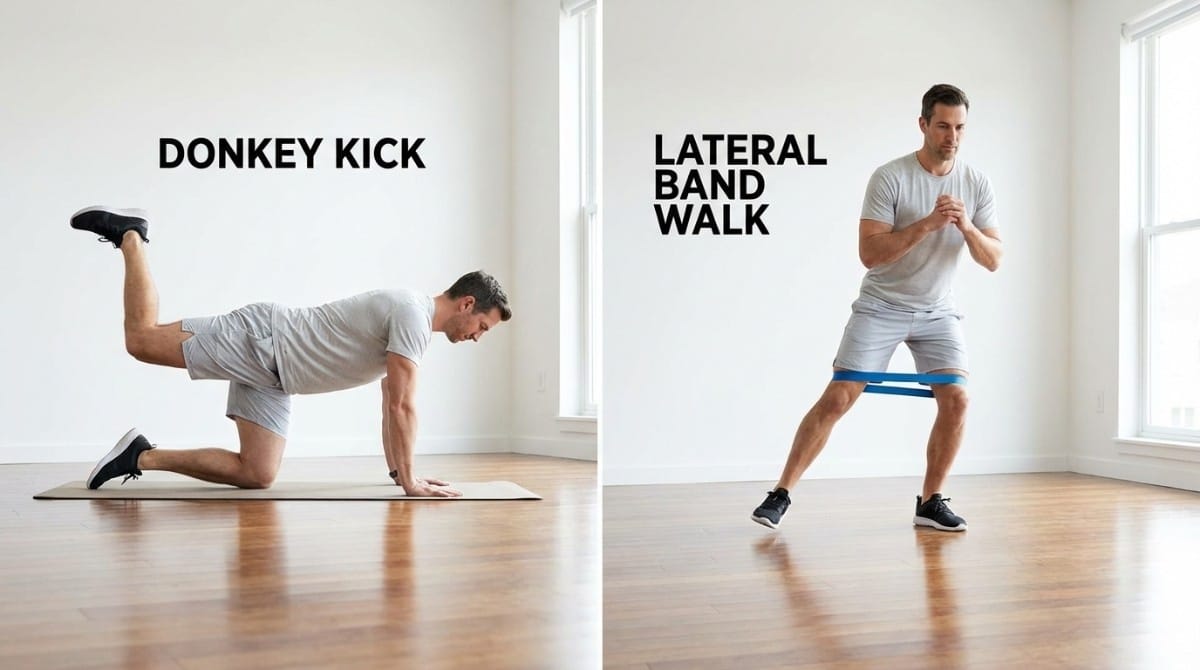
5. Donkey Kick Targets the gluteus maximus through hip extension in a loaded position while keeping the spine neutral.
- Start on hands and knees - wrists under shoulders, knees under hips
- Keep the knee bent at 90 degrees
- Drive one heel toward the ceiling, squeezing the glute at the top
- Return slowly without letting the lower back arch
- 3 sets of 12-15 reps per side
- Focus: The movement is hip extension - not lower back extension. If your back arches, you've gone too far.
6. Fire Hydrant Targets the gluteus medius and hip external rotators in a functional position.
- Start on hands and knees
- Keep the knee bent and lift one leg out to the side like a dog at a fire hydrant
- Hold 1-2 seconds at the top
- Lower slowly
- 3 sets of 12 reps per side
- Progression: Add a resistance band above the knees when this becomes easy
7. Lateral Band Walk One of the most effective exercises for the gluteus medius. Resisted abduction builds the lateral hip stability that prevents knee collapse and pelvic drop during walking and running.
- Place a resistance band just above the knees
- Stand with feet hip-width apart, slight bend in the knees
- Step sideways - one step out, one step in - maintaining tension on the band
- Keep the pelvis level throughout
- 3 sets of 15 steps per direction
- Key detail: Do not let the feet drag together - maintain the starting width on every step
🔵 Phase 3 - Functional Integration (Week 2 Onward)
These exercises build glute strength in positions that mirror real-world movement.
8. Bodyweight Squat with Glute Focus The squat only becomes a glute exercise when performed with deliberate glute engagement.
- Stand feet shoulder-width apart, toes slightly out
- Push the hips back first - not the knees forward
- Lower until thighs are parallel to the floor
- Drive through the heels to stand - squeeze the glutes hard at the top
- 3 sets of 12-15 reps
- Cue: Think "push the floor away" rather than "stand up"
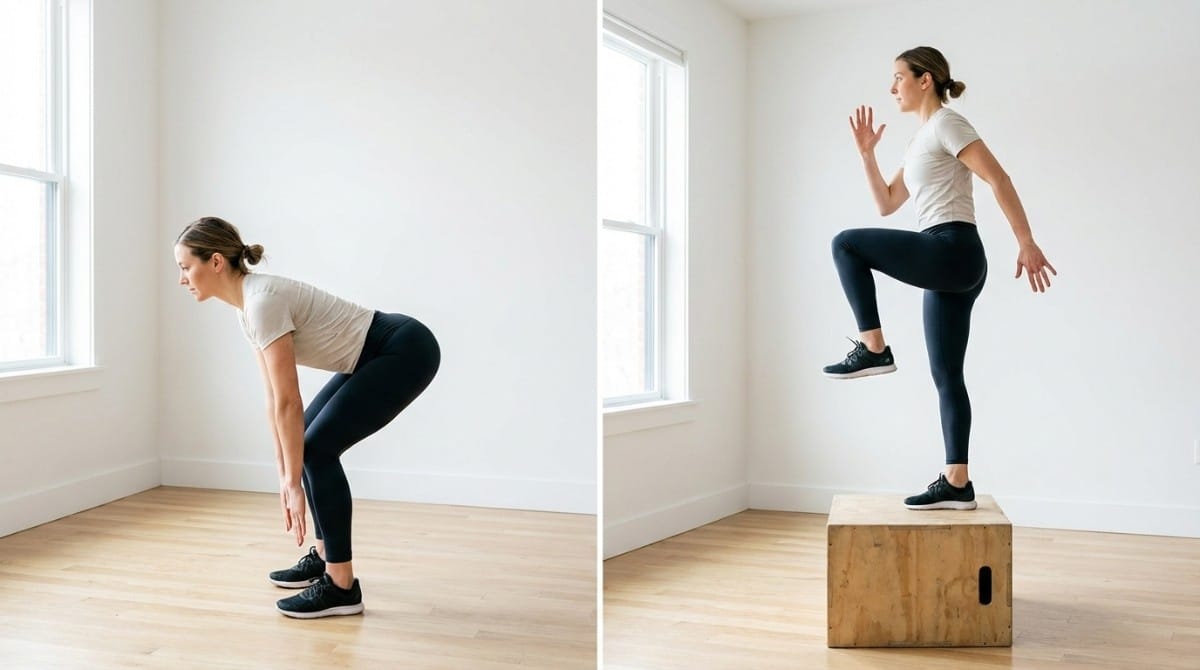
9. Romanian Deadlift (Bodyweight) The best exercise for teaching the hip hinge pattern and building posterior chain integration.
- Stand feet hip-width apart
- Hinge at the hips - push them backward while keeping the back flat
- Lower the hands toward the floor until you feel a hamstring stretch
- Drive the hips forward to stand - glutes contract hard at the top
- 3 sets of 10-12 reps
- Common mistake: Rounding the lower back. Keep a long spine throughout.
10. Step-Up with Hip Drive Functional unilateral glute strength. Directly translates to walking, stair climbing, and single-leg stability.
- Stand in front of a sturdy chair or step (approximately knee height)
- Step one foot onto the surface
- Drive through the heel of the elevated foot to stand up - bring the opposite knee up toward the chest at the top
- Lower slowly and controlled
- 3 sets of 10 reps per side
Step-by-Step Recovery Framework: 2-Week Glute Activation Plan
The non-negotiable daily minimum (10 minutes):
- Glute bridge - 3 x 15
- Clamshell - 3 x 15 per side
- Donkey kick - 3 x 12 per side
These three exercises take under 10 minutes and maintain baseline glute activation even on busy days. Consistency at this minimum level outperforms occasional longer sessions.
Pre-workout activation protocol (5 minutes): Before any lower body training session, complete:
- 15 glute bridges
- 15 clamshells per side
- 15 fire hydrants per side
This primes the glutes before they're needed for heavier compound movements - ensuring they fire during squats and deadlifts rather than defaulting to hip flexor and lower back compensation.
For desk workers who need a lunchtime or desk-break version of this, the 5-minute posture reset for desk workers integrates a compatible activation sequence.
Glute Activation vs Glute Strengthening - What's the Difference?
This distinction matters more than most people realize.
Most people skip directly to strengthening - then wonder why their glutes don't grow or their back pain doesn't improve. Activation is the prerequisite. Without it, the stronger muscles (hip flexors, lower back, hamstrings) continue to dominate every movement.
Research & Expert Insight
The connection between sitting, glute inhibition, and lower back pain is well-established in both sports science and clinical rehabilitation.
Key evidence points:
- Reciprocal inhibition is measurable: Electromyography (EMG) studies consistently show reduced gluteus maximus activation in individuals who sit for extended periods, with the iliopsoas demonstrating disproportionately elevated activity during the same movement tasks
- Glute medius and pelvic stability: Research in musculoskeletal biomechanics identifies gluteus medius weakness as a primary contributor to lateral pelvic drop during gait - a pattern directly linked to lower back and knee pain in sedentary populations
- Activation before loading: Sports rehabilitation research consistently shows that performing isolated glute activation exercises before compound lower body training significantly increases EMG activity in the gluteus maximus during subsequent squats and deadlifts compared to no activation
- Desk worker prevalence: Occupational health studies identify gluteal inhibition as highly prevalent in adults who sit more than 6 hours daily - with the majority unaware of the deficit until pain or movement assessment reveals it
Physiotherapists routinely prescribe glute activation protocols as the first intervention in lower back rehabilitation programs - before any strengthening work begins. This sequencing is supported by the research.
What Happens If You Never Activate Your Glutes?
Glute inhibition is not a static problem. Left unaddressed, it escalates:
- 🔙 Chronic lower back pain - the lumbar muscles overwork indefinitely to compensate for absent glute support
- 🦵 Knee pain - without gluteus medius stabilization, the knee collapses inward during walking and exercise
- 🚶 Altered gait mechanics - shortened stride, lateral hip drop, and increased lumbar rotation develop over time
- 🍑 Actual muscle atrophy - chronic non-use leads to measurable reduction in glute muscle mass and strength
- 📉 Performance plateau - gym-goers find their squat and deadlift progress stall because the primary mover isn't doing its share
- 😣 Postural collapse - anterior pelvic tilt deepens, forward head posture often follows as the chain reaction moves upward through the spine
Posture specialists note that anterior pelvic tilt - one of the most visible postural problems in desk workers - is in most cases primarily a glute inhibition problem. The tilted pelvis isn't just from tight hip flexors pulling it forward. It's from inhibited glutes failing to hold it back. Understanding the full postural chain is covered in the types of bad posture guide.
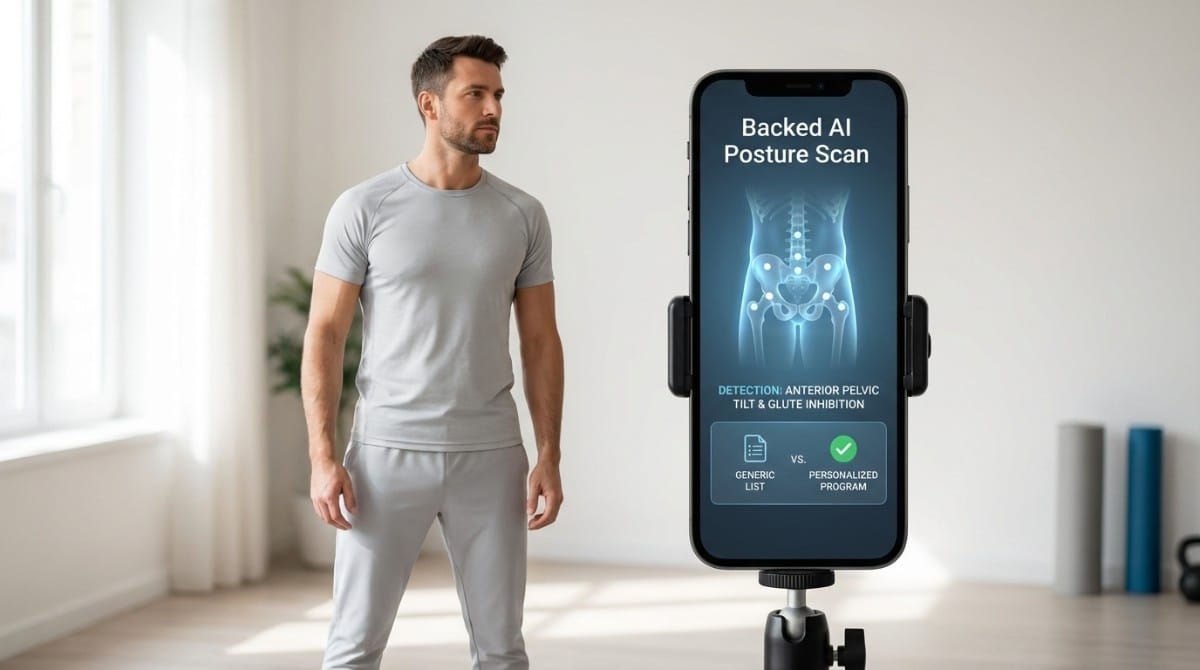
💙 Know Which Glutes Need Fixing - Then Fix Them Right
Glute inhibition is not the same in every body. For some people it's gluteus maximus weakness. For others it's medius instability. For many it's both - but in different proportions.
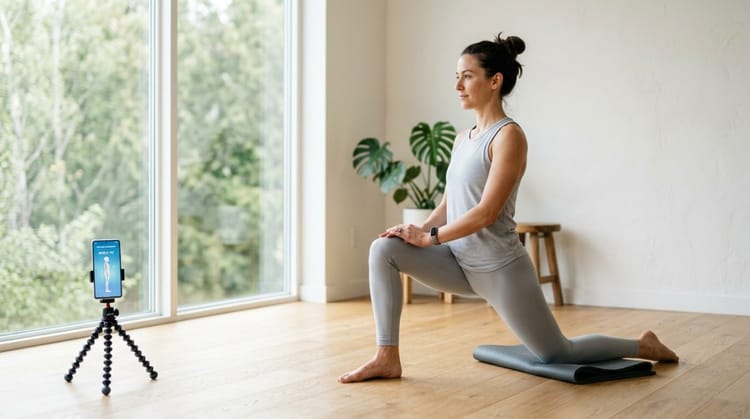
Backed AI scans your posture through your phone's camera, identifies whether anterior pelvic tilt, glute inhibition, and hip imbalance are present in your specific body, and builds a corrective program targeting your exact pattern.
Instead of working through a generic 10-exercise list and hoping something sticks, you get a sequenced plan that starts where your body actually is - and progresses as your activation improves.
What makes it different:
- 📸 AI posture scan - identifies whether your glute inhibition is driving anterior pelvic tilt, lower back pain, or both
- 🎯 Personalized exercise sequence - activation and strengthening exercises chosen for your specific deficit pattern
- 📈 Progress tracking - see your posture and alignment improving over weeks, which builds the consistency most people lack
The glutes are your body's largest muscle group. When they work, everything works better.
Download Backed AI and start correcting your posture today.
Final Takeaway
Glute inhibition from sitting is one of the most common - and most fixable - causes of lower back pain, poor posture, and hip tightness in desk workers. The solution follows a clear sequence: release the hip flexors first, activate the glutes in isolation, build strength progressively, then integrate into functional movement.
The exercises in this guide work. But they only work if you follow the sequence, maintain the consistency, and progress beyond bodyweight when activation is established.
Start today with glute bridges and clamshells. Add donkey kicks and fire hydrants by day 5. Move into functional strength by week 2. And if you want a program that tells you exactly which exercises your body needs - and in what order - Backed AI removes the guesswork entirely.
For readers who are also managing hip flexor tightness alongside glute inhibition, the hip flexor pain when sitting guide covers the release phase that should precede every activation session.
FAQ
Q1: What are glute activation exercises?
Glute activation exercises are targeted movements designed to restore the neural firing pattern of the gluteal muscles - particularly after prolonged sitting has caused reciprocal inhibition. They use isolated, controlled movements like glute bridges and clamshells to force the glutes to contract deliberately before compound strength exercises.
Q2: How do I know if my glutes are not activating properly?
Key signs include lower back pain or fatigue after standing and exercise, feeling squats and lunges primarily in your quads or lower back rather than your glutes, difficulty contracting the glutes on command, visible anterior pelvic tilt when standing, and chronic hip flexor tightness.
Q3: What is the best glute activation exercise?
The glute bridge is the most effective starting exercise for glute activation. It removes spinal load, allows isolated glute contraction, and is accessible for all fitness levels. The clamshell is the best companion exercise for targeting the gluteus medius specifically.
Q4: How long does it take to activate inhibited glutes?
Most people notice improved glute sensation and reduced lower back compensation within 1-2 weeks of daily glute activation exercises. Full restoration of firing patterns alongside meaningful strength gains typically takes 4-8 weeks of consistent, progressive training.
Q5: Should I activate my glutes before every workout?
Yes - especially before any lower body training. A 5-minute glute activation sequence (15 glute bridges, 15 clamshells per side, 15 fire hydrants per side) before squats, deadlifts, or lunges significantly increases gluteal EMG activity during those exercises and reduces lower back and quad compensation.