Posture Exercises for Seniors: Safe Routines to Reduce Back Pain and Stay Mobile
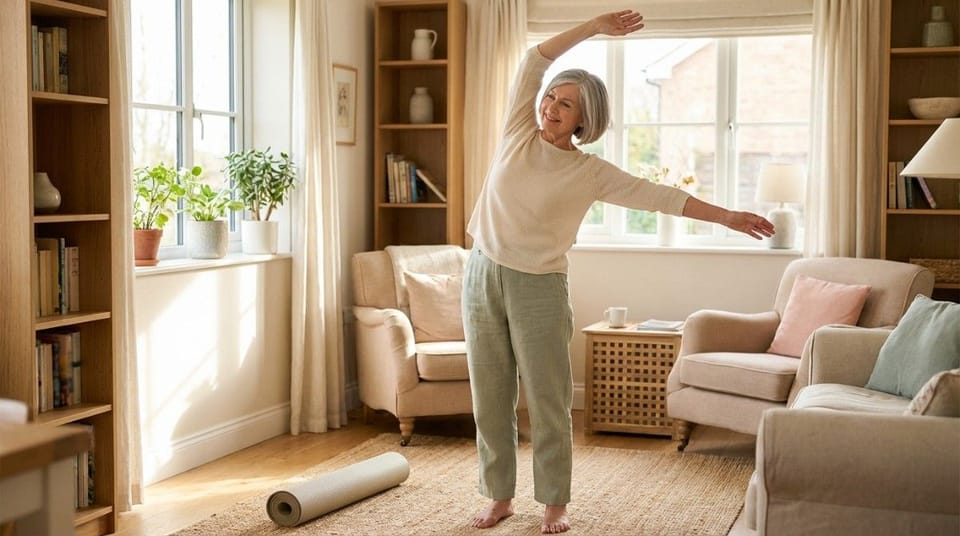
Good posture does not become less important as you age. It becomes more important.
The way you hold your body affects how you move, how much pain you feel, how easily you breathe, and how independently you live. For adults over 60, posture is directly connected to fall risk, mobility, joint health, and confidence.
The encouraging news: posture responds to exercise at any age. The muscles and movement patterns that support alignment can be improved, maintained, and rebuilt - even in your 70s and 80s.
This guide covers the safest and most effective posture exercises for older adults, structured into a gentle daily routine that takes 15 to 20 minutes and requires no special equipment.
TL;DR - Posture naturally changes with age but is not fixed - exercise consistently improves it - The key areas to address are the thoracic spine, hip flexors, core, and glutes - All exercises in this guide are low-impact, chair-accessible, and safe for most older adults - Daily practice of 15 to 20 minutes produces measurable results within 4 to 8 weeks - Improved posture directly reduces fall risk, back pain, and breathing restriction in seniors
Posture exercises for seniors are gentle, low-impact movements that strengthen the muscles supporting the spine, restore flexibility in the joints that stiffen with age, and retrain the body’s alignment patterns to reduce pain and maintain independent mobility.
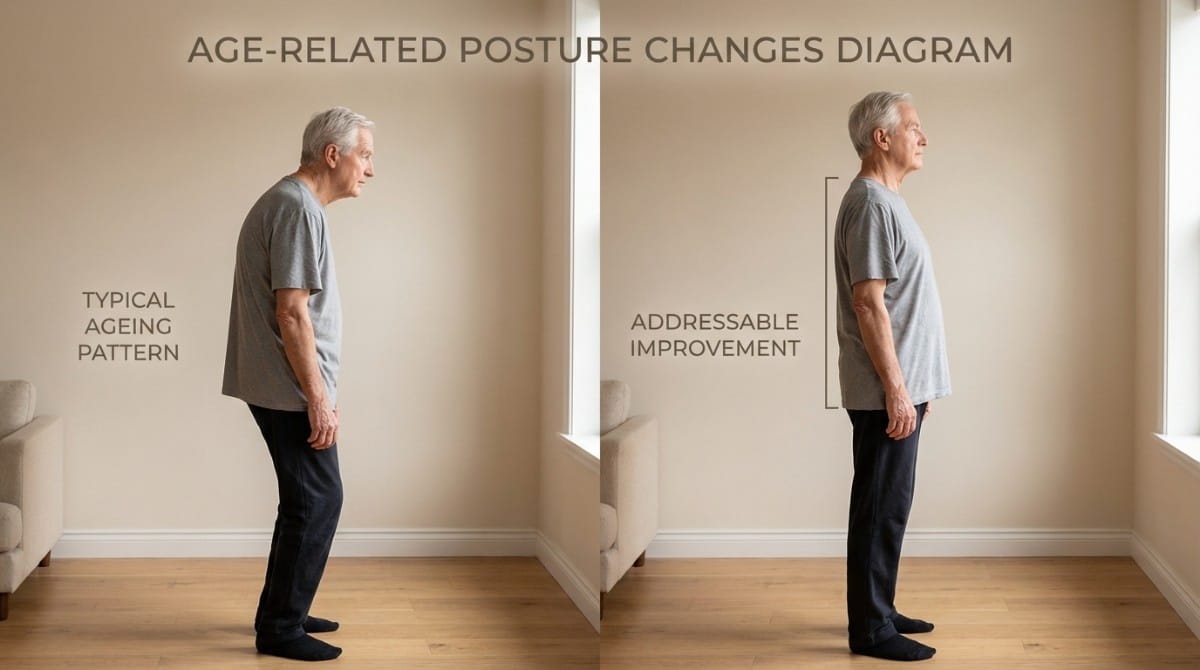
What Happens to Posture as We Age?
Posture changes gradually as part of the normal ageing process. Understanding what is happening - and why - makes it easier to target the right areas with exercise.
Several factors drive age-related postural change:
Muscle loss (sarcopenia): From around age 30, adults begin losing muscle mass gradually. By 60 and beyond, the muscles that hold the spine upright - the deep spinal extensors, glutes, and core - are often significantly weaker than they were in earlier decades.
Bone density changes: Reduced bone density in the thoracic vertebrae can lead to compression changes that increase the rounding of the upper back - a condition known as thoracic kyphosis or, in its more pronounced form, hyperkyphosis.
Joint stiffness: The thoracic spine and hips accumulate stiffness with age, reducing range of motion and making it harder to stand fully upright without active effort.
Reduced proprioception: The body’s sense of its own position in space decreases with age. Older adults often cannot feel when they are drifting into poor alignment - which makes consistent practice of corrective exercises even more important.
Shortened hip flexors: A lifetime of sitting, combined with reduced activity, shortens the hip flexors and creates the characteristic forward lean and reduced hip extension common in older adults.
Why Does This Matter Beyond Appearance?
Postural changes in older adults have functional consequences that go well beyond how someone looks:
• Fall risk increases when the centre of gravity shifts forward. Research in geriatric rehabilitation shows that hyperkyphosis - excessive upper back rounding - is an independent predictor of fall risk in older adults.
• Breathing capacity reduces as thoracic kyphosis compresses the chest cavity, reducing lung expansion.
• Pain increases as spinal compression, muscle fatigue, and joint stress accumulate in poorly aligned positions.
• Independence reduces as mobility and balance decline - affecting the ability to drive, climb stairs, and carry out daily tasks.
Key Insight 💡: For older adults, posture correction is not cosmetic. It is functional. Better alignment directly improves balance, reduces fall risk, eases pain, and preserves the independence that defines quality of life in later decades.
Why Does Exercise Help at Any Age?
Research in exercise physiology consistently shows that muscle responds to training stimulus regardless of age. Older adults may build strength and mobility more slowly than younger adults, but the capacity to improve is retained throughout life. The key differences for seniors are that exercises must be:
• Lower impact to protect joints
• Progressed more gradually
• Held for shorter initial durations
• Performed from supported positions where appropriate
This guide accounts for all of these factors.
What to Know Before Starting
These exercises are appropriate for most older adults in general good health. A few important notes:
• If you have osteoporosis: Avoid forward flexion exercises (bending the spine forward) and twisting under load. Focus on extension, gentle mobilisation, and supported strengthening.
• If you have had a recent fall, fracture, or joint replacement: Obtain clearance from your doctor or physiotherapist before beginning any new exercise program.
• If you experience sharp pain, dizziness, or chest discomfort during any exercise: stop immediately and seek medical advice.
• If balance is a concern: Perform standing exercises next to a sturdy chair or wall for support at all times.
For the majority of older adults with general back discomfort, stiffness, and postural decline, these exercises are safe, gentle, and highly beneficial.
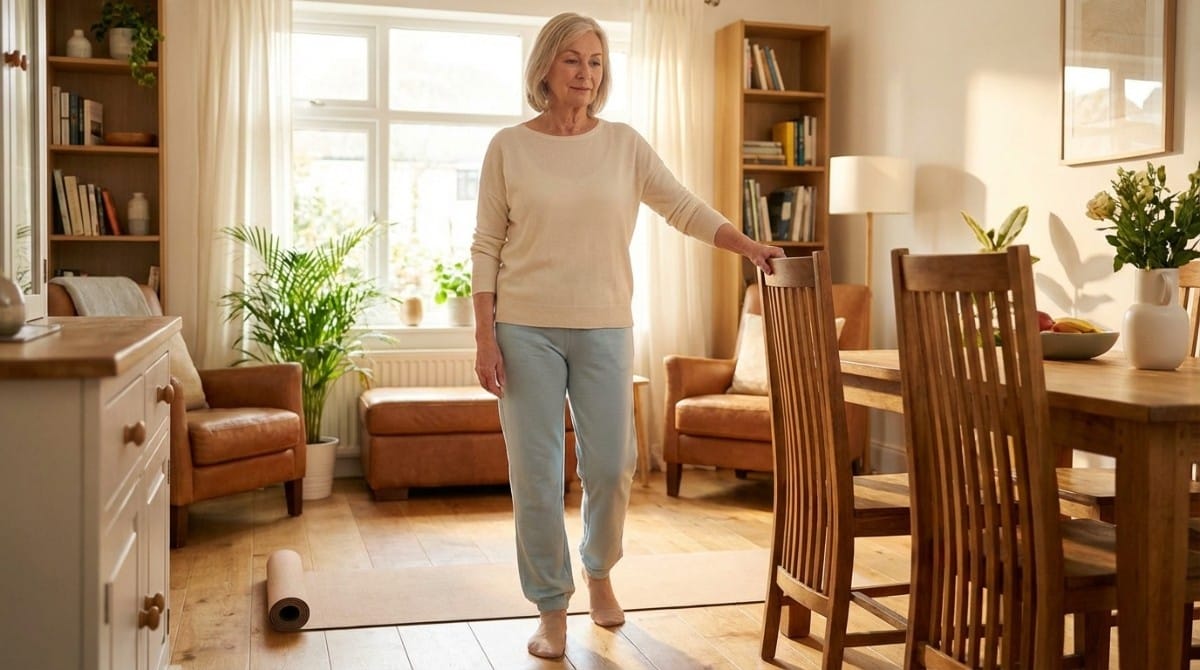
The Senior Posture Routine: 15 to 20 Minutes Daily
This routine is organised into three phases: mobilise, stretch, and strengthen. Each phase targets the areas most affected by age-related postural change. All exercises can be performed from a chair, on the floor with support, or standing with a support nearby.
When to do it: Morning is ideal - joints are ready to move after overnight stiffness releases. If mornings are difficult, any consistent daily time works equally well.
Equipment needed: A sturdy chair. Optional: a yoga mat for floor exercises.
Phase 1 – Mobilise (5 Minutes)
Gentle movement to warm up the joints and restore circulation before stretching or strengthening. Move slowly and within a comfortable range only.
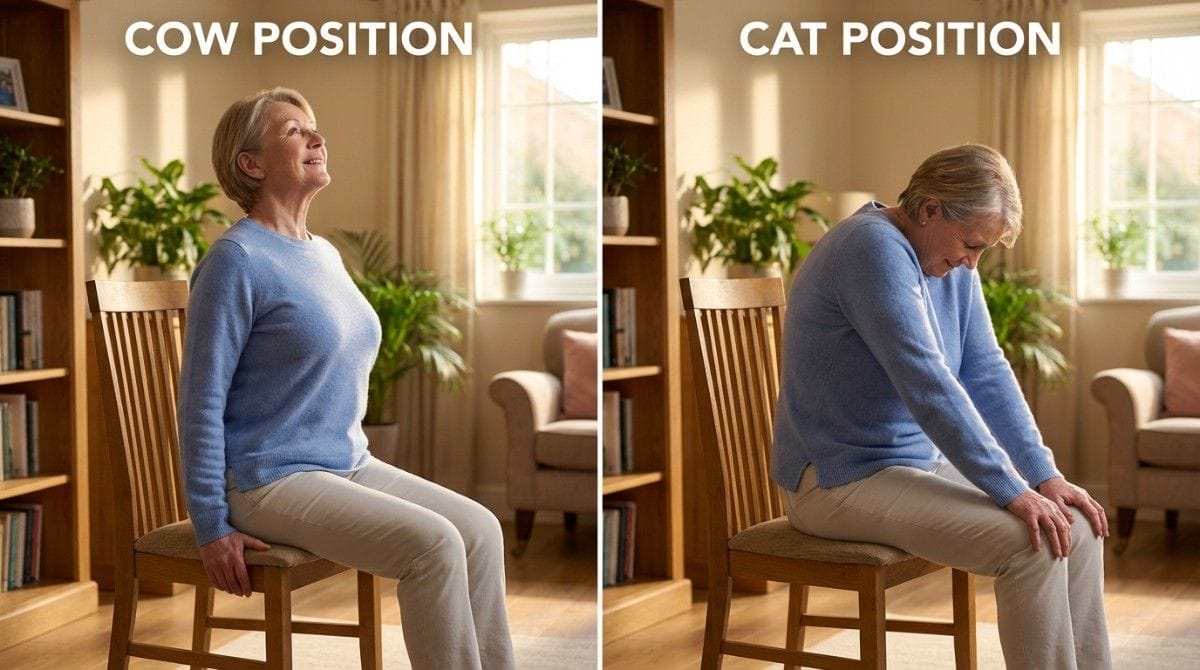
1. Seated Cat-Cow – 10 slow reps
Restores gentle movement to the thoracic and lumbar spine without any floor work required.
How to do it:
1. Sit upright near the front of a firm chair, feet flat on the floor hip-width apart
2. Place both hands lightly on your thighs
3. Inhale and gently arch your back - chest lifts, shoulders roll back, chin rises slightly (Cow)
4. Exhale and gently round your back - chin drops, shoulders roll forward, navel draws in (Cat)
5. Move slowly through each transition, one breath per movement
6. Repeat 10 times
Why it helps: Restores thoracic mobility and lumbar flexibility - the two areas most stiffened by age and prolonged sitting.
2. Seated Neck Rotation – 8 reps each direction
Restores cervical rotation that stiffens with age and forward head posture.
How to do it:
1. Sit tall in your chair with both feet flat on the floor
2. Keep your chin level - do not let it drop or lift
3. Slowly rotate your head to look over your right shoulder
4. Pause at the comfortable end of your range - do not push into pain
5. Slowly return to centre, then rotate left
6. Complete 8 reps each direction
Why it helps: Cervical rotation stiffness contributes to shoulder tension, headaches, and reduced awareness of surroundings - a fall risk factor.
3. Shoulder Roll and Chest Opener – 10 reps
Releases the upper trapezius and anterior shoulder tightness that drives rounded shoulders in older adults.
How to do it:
1. Sit tall in your chair
2. Roll both shoulders slowly backward in large circles - up, back, down, and forward
3. After 5 backward rolls, pause
4. Squeeze both shoulder blades gently together and hold for 3 seconds - feel the chest open
5. Release and repeat the sequence for 10 total reps
Why it helps: Directly counteracts the forward shoulder rounding pattern of thoracic kyphosis.
Phase 2 – Stretch (5 to 6 Minutes)
These stretches target the three structures most shortened in older adults with postural decline: the chest, hip flexors, and thoracic spine.
4. Seated Chest Opener Stretch – 3 x 30 seconds
Directly reverses the chest shortening that drives thoracic kyphosis and rounded shoulders.
How to do it:
1. Sit near the front of your chair, feet flat on the floor
2. Interlace your fingers behind your lower back, or simply clasp both hands together
3. Gently squeeze your shoulder blades together and lift your chest toward the ceiling
4. Keep your chin level and your lower back relaxed
5. Hold for 30 seconds, breathing slowly
6. Release, rest for a breath, repeat twice more
Modification: If clasping hands behind the back is difficult, simply hold the back of the chair with both hands and lean the chest forward and upward.
5. Seated Hip Flexor Stretch – 45 seconds each side
Lengthens the hip flexors that shorten from a lifetime of sitting - directly addressing the forward lean and reduced hip extension common in older adults.
How to do it:
1. Sit near the front of your chair
2. Slide your right leg back so the foot is behind the line of the knee - more extended than your left
3. Sit tall and gently press your right hip forward, maintaining upright posture
4. You should feel a gentle stretch in the front of the right hip
5. Hold 45 seconds, switch sides
Why it helps: Short hip flexors pull the pelvis forward and create the characteristic stoop. Releasing them directly improves upright stance.
6. Thoracic Extension over Chair Back – 60 seconds
Restores the upper back extension range of motion lost to kyphosis. This is one of the most impactful stretches for improving upright posture in older adults.
How to do it:
1. Sit in a firm chair and shuffle back so your upper back rests against the top edge of the chair back
2. The chair edge should sit at mid-to-upper back level - not the lower back
3. Support your head with both hands clasped behind it
4. Gently allow your upper back to extend over the edge, opening the chest toward the ceiling
5. Hold for 3 to 5 slow breaths
6. Adjust your position slightly higher or lower on the chair back and repeat
Important: Move slowly and within a comfortable range. If you feel any sharp discomfort in the spine, stop and try a smaller range.
Phase 3 - Strengthen (7 to 8 Minutes)
These exercises rebuild the muscles that support upright alignment. They are all low-impact, joint-friendly, and appropriate for most older adults. Chair-based and floor options are provided.
7. Seated Rows with Resistance or Towel – 3 x 10 reps
Strengthens the mid-back retractors - the muscles that hold the shoulder blades in correct position and prevent the upper back from rounding forward.
How to do it (towel version):
1. Sit upright in your chair
2. Hold a folded towel or resistance band in front of you at shoulder height, hands shoulder-width apart
3. Exhale and pull both ends of the towel apart while drawing your elbows back past your sides
4. Squeeze your shoulder blades firmly together at the end of the movement
5. Hold 2 seconds, release slowly
6. Repeat 10 reps for 3 sets
Without equipment: Perform the same movement without the towel - imagining you are pulling a resistance. The muscle activation is still meaningful as an isometric contraction.
8. Chin Tuck – 2 x 12 reps
Trains the deep cervical flexors and repositions the skull over the spine. Particularly valuable for older adults with forward head posture.
How to do it (seated):
1. Sit tall with both feet flat on the floor
2. Look straight ahead - do not tilt the chin down or up
3. Gently draw your chin straight back - as if making a slight double chin
4. Hold for 5 seconds, release fully
5. Repeat 12 times for 2 sets
Common mistake: Tilting the chin toward the chest. The movement is horizontal - the head slides back, not down.
9. Seated Glute Squeeze – 3 x 12 reps
Activates the glutes - which weaken significantly with age and prolonged sitting - reducing the forward pelvic tilt that causes lower back pain.
How to do it:
1. Sit upright near the front of your chair
2. Feet flat, hip-width apart
3. Squeeze both glutes firmly - as if you are trying to hold something between them
4. Hold the squeeze for 5 seconds
5. Release completely and repeat 6. 12 reps for 3 sets
Why it helps: Glute activation directly reduces the anterior pelvic tilt driving lower back pain in older adults - and it can be done anywhere, anytime.
10. Standing Wall Angels – 2 x 8 reps
Trains the mid and lower trapezius that hold the shoulder blades retracted - essential for maintaining upright posture against gravity.
How to do it:
1. Stand with your back against a smooth wall - feet 6 inches from the baseboard
2. Press your lower back, upper back, and the back of your head gently against the wall
3. Raise arms to a “W” position with elbows bent and backs of hands touching the wall
4. Slowly slide both arms up into a “Y” overhead position, maintaining wall contact throughout
5. Lower slowly back to “W”
6. Repeat 8 reps
Modification: If standing against the wall is difficult, reduce the range of movement - only slide the arms as far as you can while keeping contact with the wall.
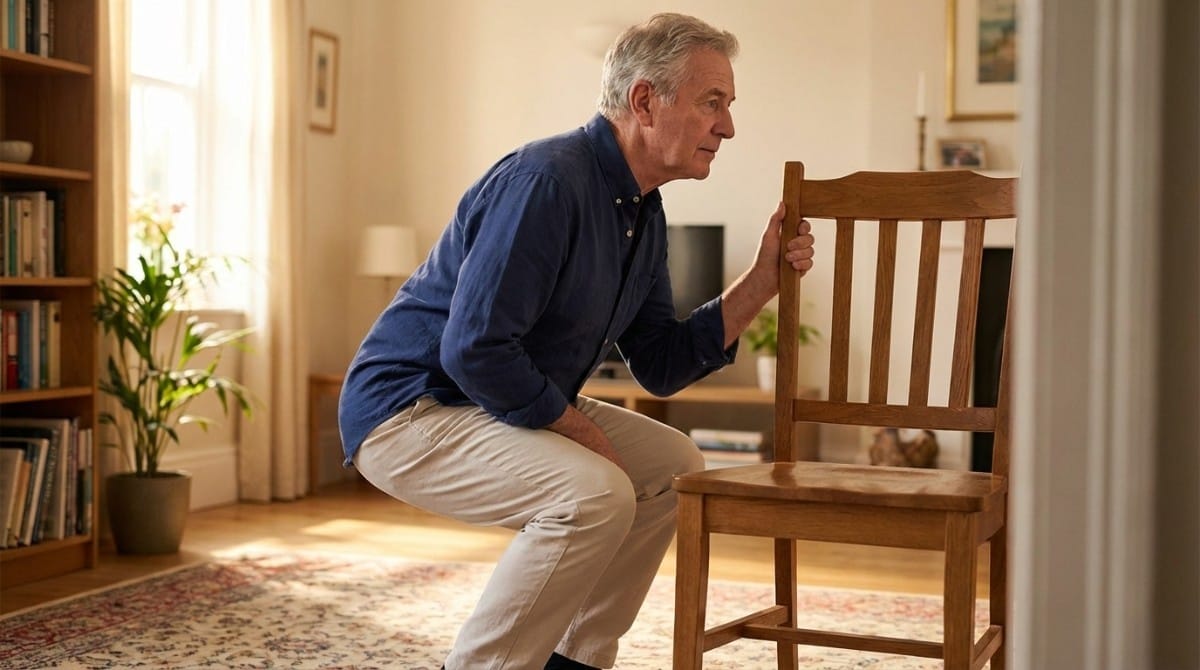
11. Mini Squat to Chair – 2 x 8 reps
Builds the leg and glute strength needed for safe standing posture, balance, and daily function - getting up from chairs, climbing stairs, and walking with a stable base.
How to do it:
1. Stand directly in front of a sturdy chair, feet hip-width apart
2. Hold the chair back lightly for balance if needed
3. Bend your knees and lower your hips slowly toward the chair - as if about to sit down
4. Stop just before you make full contact with the seat - hold 2 seconds
5. Press through your heels to stand back up tall
6. Repeat 8 times for 2 sets
Progress to a full sit-to-stand (without using hands to push up from the armrests) when you feel ready.
The Complete Senior Posture Routine at a Glance
|
# |
Exercise |
Duration
/ Reps |
Position |
Phase |
|
1 |
Seated
Cat-Cow |
10
reps |
Chair |
Mobilise |
|
2 |
Seated
Neck Rotation |
8
reps each side |
Chair |
Mobilise |
|
3 |
Shoulder
Roll and Chest Opener |
10
reps |
Chair |
Mobilise |
|
4 |
Seated
Chest Opener Stretch |
3
x 30 seconds |
Chair |
Stretch |
|
5 |
Seated
Hip Flexor Stretch |
45
seconds each side |
Chair |
Stretch |
|
6 |
Thoracic
Extension over Chair Back |
60
seconds |
Chair |
Stretch |
|
7 |
Seated
Rows with Towel |
3
x 10 reps |
Chair |
Strengthen |
|
8 |
Chin
Tuck |
2
x 12 reps |
Chair |
Strengthen |
|
9 |
Seated
Glute Squeeze |
3
x 12 reps |
Chair |
Strengthen |
|
10 |
Standing
Wall Angels |
2
x 8 reps |
Standing |
Strengthen |
|
11 |
Mini
Squat to Chair |
2
x 8 reps |
Standing |
Strengthen |
Total: 15 to 20 minutes. All exercises can be completed entirely from a chair except Wall Angels and Mini Squat - both of which use the chair for support.
How to Progress Safely Over Time
Progress should be gradual and based on comfort — not speed.
Weeks 1 to 2: Complete the routine at the recommended reps and durations. Focus on learning the movements and building the daily habit. Do not push range of motion.
Weeks 3 to 4: Begin extending hold times on the stretches by 10 to 15 seconds. Add one extra set to the glute squeeze and chin tuck.
Weeks 5 to 8: Add a light resistance band to the seated rows. Progress the mini squat toward a full sit-to-stand without hands. Begin performing the routine with less reliance on chair support for balance exercises.
After 8 weeks: If the routine feels manageable and you notice improvement in alignment, tension levels, and energy, consider adding two to three additional exercises - a standing march for hip mobility, a side-lying clamshell for glute medius, or a light forward step for balance training.
Daily Habits That Support Better Posture for Seniors
Exercise builds the capacity for good posture. Daily habits determine whether that capacity is used.
• Stand tall during regular activities. Washing dishes, making tea, waiting for the kettle - use these as posture check-in moments. Ears over shoulders. Chest open. Weight even between both feet.
• Adjust your sitting environment. A chair that is too low or too soft makes it almost impossible to sit with good alignment. A firm chair with a level seat and good back support is one of the most impactful environmental changes an older adult can make.
• Walk daily. Even 15 to 20 minutes of walking activates the posterior chain, maintains hip extension, and reinforces the upright alignment you are building with exercises.
• Check your footwear. Worn-down soles or unsupportive shoes alter gait mechanics and feed into postural compensation patterns. Well-fitted, supportive footwear directly supports upright posture.
• Get your vision checked. Many older adults unconsciously lean forward to see more clearly. An updated glasses prescription removes one of the most common unconscious drivers of forward head and forward lean in this population.
When This Approach Does Not Work
This routine is appropriate for most older adults with general postural decline, back stiffness, and age-related muscle weakness. There are situations where professional guidance should come first:
• Diagnosis of significant osteoporosis - forward flexion exercises should be avoided and the program should be physiotherapist-guided
• Recent vertebral fracture or compression fracture
• Significant balance impairment or a history of multiple falls - a physiotherapist or occupational therapist should assess first
• Neurological conditions affecting movement control
• Undiagnosed or unexplained back pain that is worsening rather than stable
For the majority of older adults experiencing the gradual postural changes of normal ageing, this routine is safe, gentle, and produces meaningful results.
Research and Expert Insight
The evidence base for posture exercise in older adults is strong and growing.
• Research in geriatric rehabilitation shows that targeted exercise programs improve thoracic kyphosis, reduce back pain intensity, and improve functional mobility in adults over 65 - even when the postural changes have been present for many years.
• Physiotherapists often recommend a combination of thoracic extension mobility and posterior chain strengthening as the most effective approach for age-related postural decline - the same two components that anchor this routine.
• Studies in fall prevention consistently identify hyperkyphosis and reduced hip extension strength as independent risk factors for falls in older adults - both of which are directly addressed by this exercise program.
• Research in exercise gerontology shows that older adults who maintain a consistent low-intensity exercise habit - even 15 minutes daily - show significantly slower rates of functional decline compared to sedentary peers.
• Posture specialists note that proprioceptive training - learning to feel and adjust one’s own alignment - is as important as physical strengthening in older adults, and that regular practice of simple alignment exercises rebuilds this capacity over time.

Every older adult’s posture pattern is different. The degree of thoracic rounding, the severity of hip flexor shortening, the level of deep core weakness - these vary significantly from person to person. Backed AI uses your phone camera to scan your specific posture and build a personalised correction program around your alignment pattern. No guessing. A routine designed for your body. Try Backed AI free →
Final Takeaway
Posture does not have to decline with age. It can be maintained, improved, and protected through consistent targeted exercise - at 60, 70, or beyond.
The routine in this guide addresses every major driver of age-related postural change: thoracic stiffness, hip flexor shortening, glute weakness, deep neck flexor inhibition, and reduced mid-back strength. It takes 15 to 20 minutes, requires no equipment beyond a sturdy chair, and can be done at home every morning.
The physical benefits are real: less pain, better balance, improved breathing, reduced fall risk. But the deeper benefit is what good posture restores - the ease of movement, the upright presence, and the daily independence that define a high quality of life in later years.
Start with the first exercise. Do it today. Build from there.
Why Generic Senior Exercise Programs Often Disappoint
Many older adults have tried exercise programs recommended by well-meaning sources and stopped when results did not materialise. Here is why that happens:
1. Not targeted to the individual. One older adult’s primary problem is thoracic kyphosis. Another’s is hip flexor tightness and a forward lean. A third has primarily glute weakness and lower back pain. A generic program addresses none of them with adequate specificity.
2. Progressed too quickly or not at all. Generic programs either push too hard too fast - causing discomfort that leads to stopping - or stay at the same level indefinitely, preventing the progressive adaptation that produces real change.
3. No feedback on form. An exercise done incorrectly by an older adult can reinforce the same compensations it is meant to correct. Without feedback, many people practise the wrong thing for weeks.
4. No way to track improvement. Without visible progress, motivation collapses. Most generic programs give no objective measure of improvement - making it easy to feel that nothing is working.
The Smarter Alternative for Older Adults 📱
Backed AI addresses the personalisation gap that separates effective posture correction from generic exercise content.
• 🔍 AI posture scan - A quick camera scan from your phone analyses your specific alignment pattern - identifying where your posture needs the most work and what is driving it.
• 📋 Personalised program - Receive a corrective exercise routine built specifically around your posture profile, your mobility level, and your goals - not a template designed for the average adult.
• 📈 Progress tracking - See your posture improving over time with objective tracking. Visible progress is one of the strongest motivators for maintaining a daily habit - at any age.
Better posture is achievable at any age. Backed AI makes sure the path to it is built for your body.
Download Backed AI and start correcting your posture today. → backedapp.com
FAQ
Q1: Is it safe for seniors to do posture exercises every day? Yes - for the types of gentle, low-impact exercises in this guide, daily practice is both safe and recommended. Unlike intense strength training, which requires rest days for muscle recovery, mobility and postural strengthening exercises at this intensity level benefit from daily repetition. Consistency is the primary driver of results in posture correction.
Q2: Can posture really improve after 70? Yes. Research consistently shows that muscle responds to training stimulus throughout life. Older adults may progress more slowly than younger adults, but the capacity to build strength, restore mobility, and improve postural alignment is retained well into the 70s and 80s. The most important factor is consistency, not age.
Q3: What is the best single exercise for seniors with rounded shoulders? Thoracic extension over the chair back and seated rows together form the most effective combination for rounded shoulders in older adults. Thoracic extension restores the mobility needed to stand upright. Seated rows rebuild the mid-back strength that holds the shoulder blades back. Used together, they address both the flexibility and strength components of the problem.
Q4: Do posture exercises reduce fall risk in older adults? Yes - directly. Research in geriatric rehabilitation shows that hyperkyphosis and reduced hip extension strength are independent risk factors for falls in older adults. This routine addresses both. Improved posture shifts the centre of gravity back toward neutral, improving balance and reducing the forward lean that makes falls more likely.
Q5: How long before a senior notices improvement from posture exercises? Most older adults notice reduced stiffness and improved energy within 2 to 3 weeks of daily practice. Visible improvement in posture alignment typically becomes noticeable to others within 4 to 8 weeks. Significant changes in back pain intensity and ease of movement are usually reported within 6 to 8 weeks of consistent daily exercise.