Hip Flexor Pain When Sitting: Why It Happens and 6 Ways to Stop It
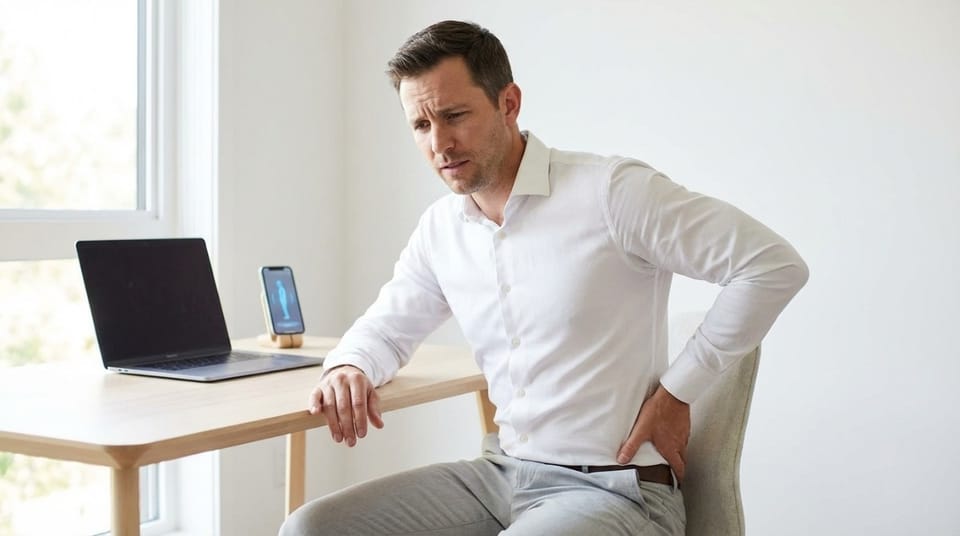
That deep ache or sharp tightness at the front of your hip when you sit down - or stand up after sitting - is not random. It's your hip flexors telling you something is wrong. Hip flexor pain when sitting is one of the most common complaints among desk workers, and most people ignore it until it starts affecting their lower back, their movement, and their daily comfort. Here's exactly what's happening and how to fix it.
Hip flexor pain when sitting is discomfort or tightness in the muscles at the front of the hip that occurs when these muscles become shortened, overloaded, or inflamed from sustained seated positions.
TL;DR
- 🪑 Sitting keeps your hip flexors in a shortened position for hours - causing pain and tightness
- 💥 The pain is felt at the front of the hip, groin area, or deep in the hip crease
- 🔗 Untreated hip flexor pain leads to lower back pain, posture problems, and reduced mobility
- 🧘 Targeted stretching provides relief - but strengthening prevents it from returning
- ⏱️ Movement breaks every 60 minutes are one of the most effective interventions
- ⚠️ Sharp or radiating pain may indicate something more serious - know the warning signs
- 📱 Personalized programs address your specific hip pattern - not a generic stretch list
What Is Hip Flexor Pain When Sitting?
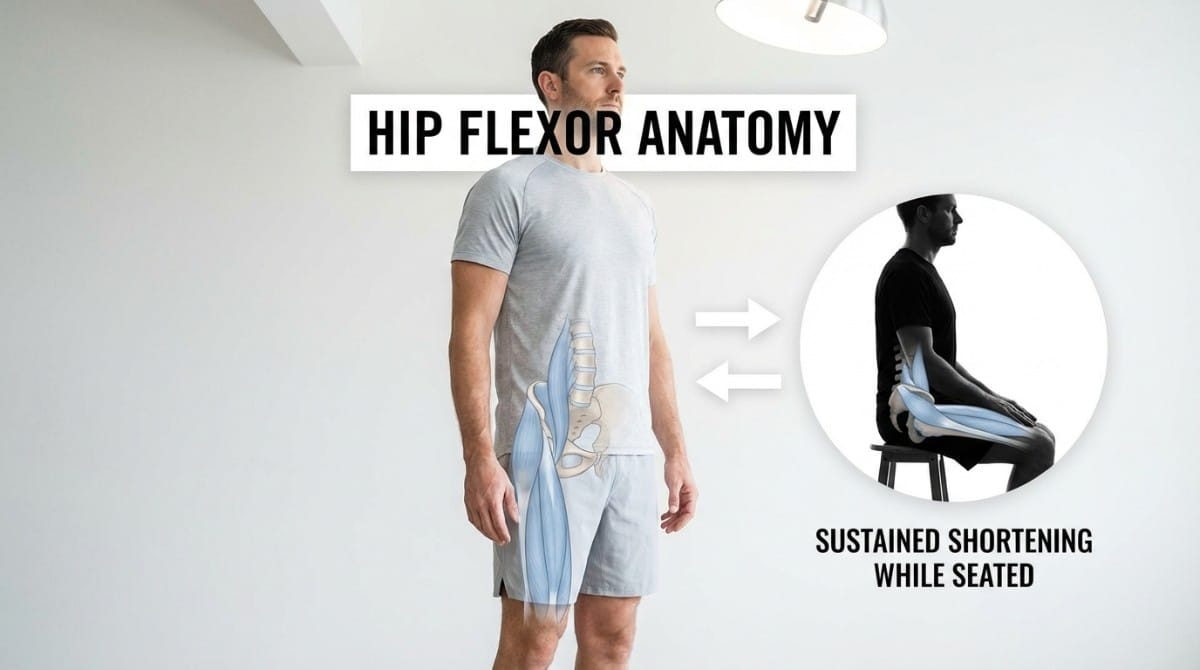
The hip flexors are a group of muscles at the front of your hip. Their primary job is to bring your knee toward your chest - which happens every time you walk, climb stairs, or sit down.
The main hip flexor muscles are:
- Iliopsoas - the deepest and most powerful, running from the lumbar spine through the pelvis to the inner thigh
- Rectus femoris - part of the quadriceps that also crosses the hip joint
- Tensor fasciae latae (TFL) - runs along the outer hip and connects to the IT band
- Sartorius - the long diagonal muscle crossing the thigh
When you sit, all of these muscles move into a shortened, contracted position. For a brief sit - that's fine. For 6-10 hours of daily sitting - the muscles adapt to that shortened length. They stop returning fully to their resting length when you stand. They become tight, irritated, and eventually painful.
Hip flexor pain when sitting is the body's signal that this adaptation has gone too far.
For desk workers, this connects directly to the broader posture cycle explained in the guide on posture exercises for desk workers - hip flexor tightness is typically the first domino.
Why Does Sitting Cause Hip Flexor Pain?
This is the mechanism most people don't understand - which is why they keep treating the symptom without fixing the cause.
The seated position:
When you sit, your hip angle closes to roughly 90 degrees. This places the hip flexors - especially the iliopsoas - in a shortened, compressed state. For the first hour, this is manageable. After several hours, the tissue begins to adapt.
Here's what happens progressively:
- Muscle shortening - the hip flexors adapt to the 90-degree seated angle and lose their resting length
- Reduced blood flow - sustained compression reduces circulation to the muscle tissue
- Trigger point formation - tight bands develop within the muscle, creating localized tenderness
- Tendon irritation - the iliopsoas tendon, where it attaches at the inner thigh, becomes inflamed with repeated load
- Pain on transition - standing up from sitting compresses and then suddenly loads the shortened muscle - which is why the pain often peaks during that transition
Key Insight: The pain you feel when sitting or standing up isn't the problem - it's the symptom of a muscle that has been held in a shortened position for too long. Treating the pain without changing the pattern is like muting a fire alarm without putting out the fire.
What Does Hip Flexor Pain When Sitting Feel Like?
Knowing what you're feeling helps you confirm the source and choose the right intervention.
Common hip flexor pain descriptions:
- Deep ache or pressure at the front of the hip or groin
- Sharp pinching sensation at the hip crease when sitting down or standing up
- Tightness or pulling feeling in the upper thigh or lower abdomen
- Discomfort that worsens the longer you sit
- Stiffness when first standing up that eases after a few steps
Where exactly is it felt?
This localization matters. The exercise that relieves TFL pain is not identical to the one that relieves iliopsoas pain. A one-size-fits-all stretch list often misses the specific structure that's causing the problem.
6 Ways to Stop Hip Flexor Pain When Sitting
These six interventions work together. The first three provide immediate relief. The last three fix the underlying pattern. 🧘
Fix 1 - Break Up Your Sitting Every 60 Minutes
This is the highest-leverage intervention - and the most underused.
Every hour of unbroken sitting increases hip flexor shortening and tissue compression. A 5-minute standing or walking break every 60 minutes interrupts that cycle before it compounds.
What to do:
- Set a timer for 55 minutes when you sit down to work
- Stand, walk to a different room, or do 5-10 standing hip circles
- Even 2-3 minutes of movement resets circulation and partial muscle length
This won't undo existing tightness - but it dramatically slows the rate at which it builds. If you only do one thing on this list, do this one.
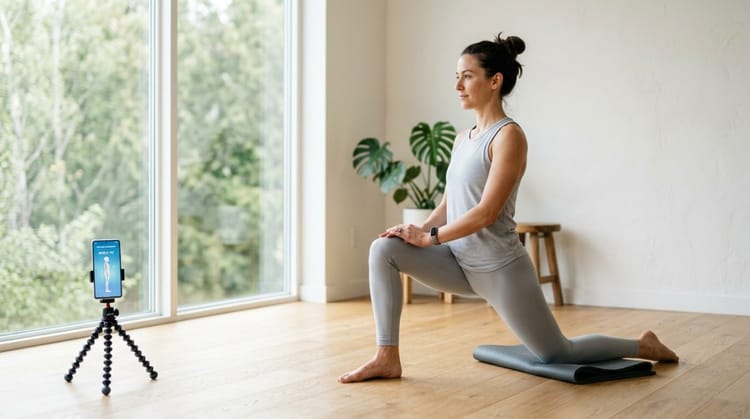
Fix 2 - Kneeling Hip Flexor Stretch
The most effective direct intervention for hip flexor pain when sitting.
How to do it:
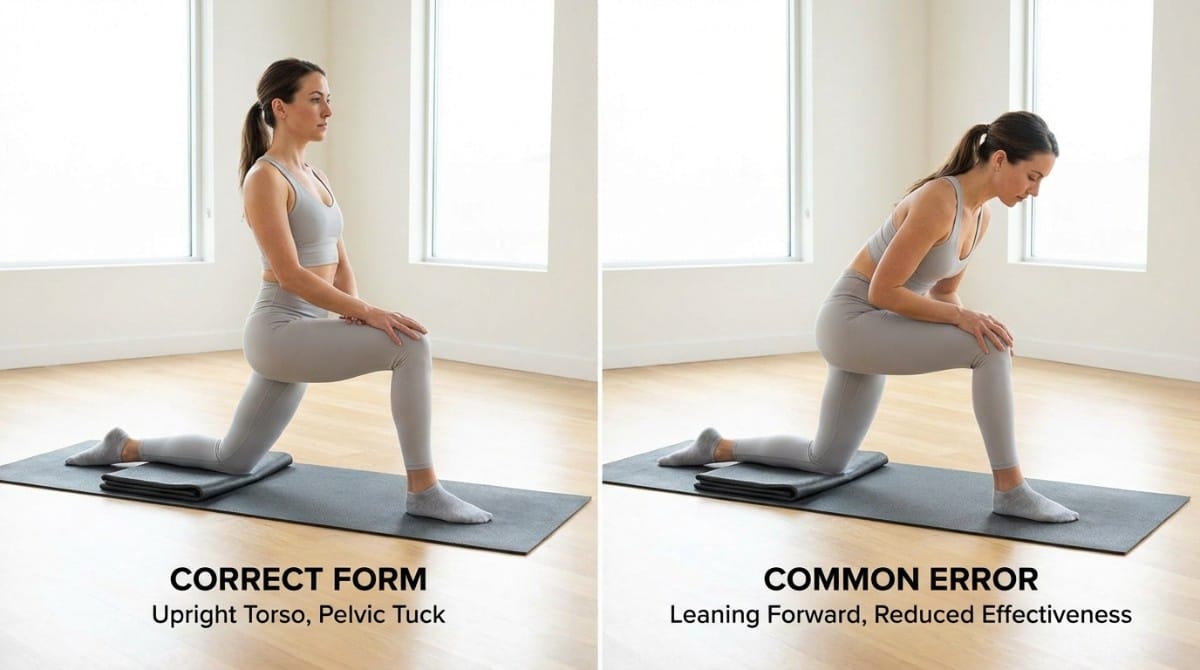
- Kneel on your right knee on a mat or folded towel
- Place your left foot forward with the knee at 90 degrees
- Keep your torso upright - do not lean forward
- Tuck your pelvis slightly backward (posterior pelvic tilt) - this is the key step most people miss
- Gently drive your right hip forward until you feel a stretch at the front of the right hip
- Hold 30-45 seconds
- Repeat on the left side
- Do 2-3 sets per side
Common mistake: Leaning the torso forward reduces the stretch on the iliopsoas. Keep the spine tall. The stretch should be felt at the front of the back-leg hip - not in the front thigh.
Fix 3 - Standing Hip Flexor Release (Desk-Friendly)
For when you can't get on the floor at work.
How to do it:
- Stand upright next to your desk or a wall for balance
- Step your right foot back into a long standing lunge position
- Keep both feet pointing forward
- Squeeze the right glute gently - this tilts the pelvis and deepens the stretch without needing to kneel
- Hold 20-30 seconds per side
- Repeat 2-3 times per side during the workday
This can be done discreetly at a standing desk or in a private office. It's not as deep as the kneeling stretch - but done consistently throughout the day, it prevents accumulation. For a full desk-compatible routine, the daily posture reset for desk workers integrates this approach.
Fix 4 - Glute Activation to Relieve Hip Flexor Dominance
Tight hip flexors and weak glutes are almost always found together. The glutes are the antagonist to the hip flexors - when one is overactive, the other is underactive.
Reactivating the glutes reduces the load on the hip flexors and restores balanced hip function.
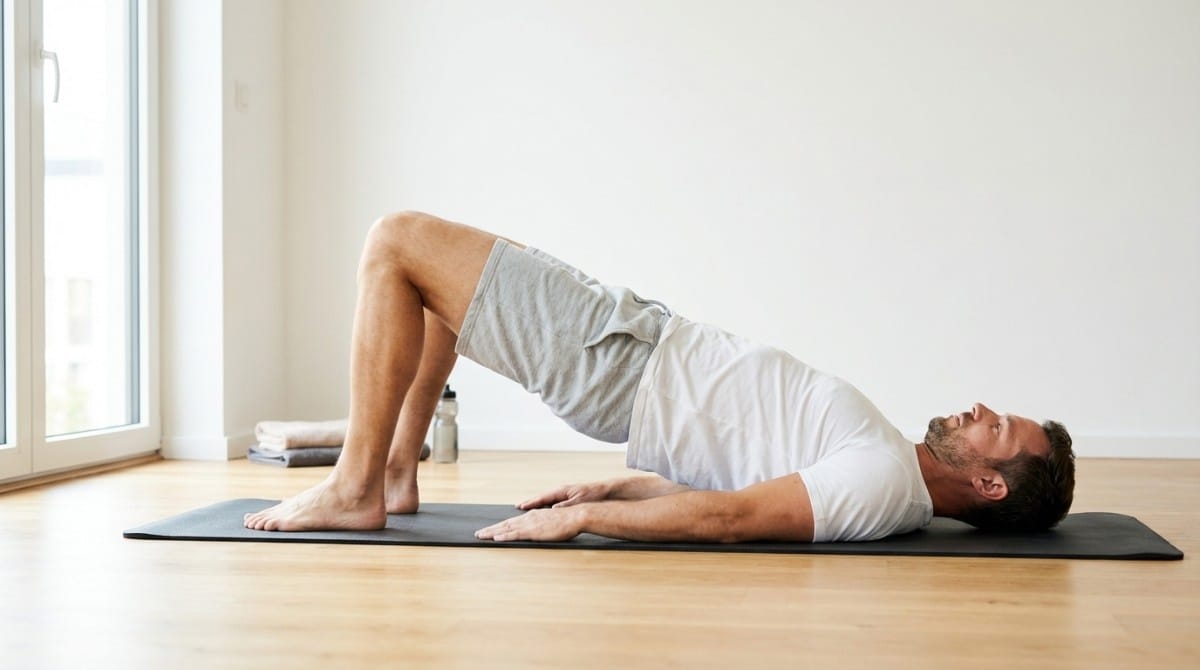
Glute Bridge:
- Lie on your back, feet flat, knees bent
- Drive your hips toward the ceiling, squeezing the glutes at the top
- Hold 2 seconds at the top
- Lower slowly
- 3 sets of 12-15 reps
Standing Glute Squeeze:
- Stand upright and squeeze both glutes firmly for 5 seconds
- Release and repeat 10 times
- Can be done at your desk without anyone noticing
This is the fix most people skip - and it's the reason the pain keeps coming back. As covered in the tight hips and lower back pain guide, glute inhibition is the downstream consequence of chronic hip flexor tightness.
Fix 5 - Adjust Your Seated Posture and Chair Setup
Sometimes the position itself is the problem - not just the duration.
Seated posture adjustments that reduce hip flexor compression:
- Raise your seat height - a lower seat increases hip flexion angle past 90 degrees, increasing compression on the iliopsoas. Your thighs should be roughly parallel to the floor or angled slightly downward.
- Sit at the front third of your chair - sitting deep into a chair with a soft seat compresses the hip crease and rotates the pelvis backward, loading the hip flexors differently
- Use a lumbar support - maintaining the lumbar curve prevents the pelvis from rolling backward, which indirectly reduces hip flexor strain
- Avoid crossing your legs - this creates asymmetrical pelvic load and concentrates tension in one hip flexor
The 90-90-90 rule: Hips at approximately 90 degrees, knees at 90 degrees, ankles at 90 degrees. This is the seated position that minimizes hip flexor compression and maintains neutral pelvic alignment.
For a complete ergonomic setup guide that addresses the full chain from desk height to screen position, the posture and ergonomics framework for desk workers provides a practical room-by-room approach.
Fix 6 - Foam Roll the Hip Flexors and TFL
Foam rolling before stretching increases tissue pliability and breaks up trigger points that stretching alone can't reach.
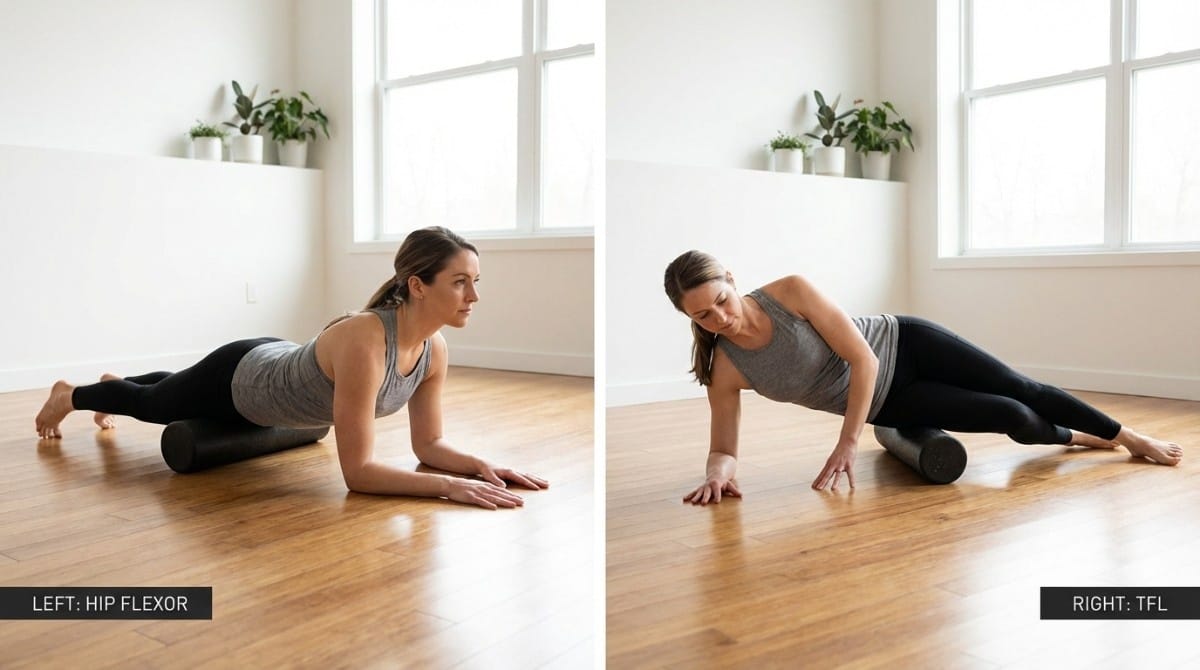
Hip flexor foam roll:
- Lie face down with the foam roller placed just below your right hip crease
- Prop yourself up on your forearms - take some weight off the roller
- Slowly move forward and back over the front of the hip
- When you find a tender spot, pause for 10-15 seconds
- Continue for 30-45 seconds per side
TFL foam roll:
- Lie on your right side with the roller positioned at the outer hip, just below the hip bone
- Stack your left foot in front for balance
- Slowly roll from the hip to just above the knee
- Pause on tender spots for 10-15 seconds
- 30-45 seconds per side
Always foam roll before stretching - not after. It prepares the tissue for a deeper, more effective stretch.
Step-by-Step Recovery Framework: Ending Hip Flexor Pain at Your Desk
Follow this plan over 2 weeks. It works from immediate symptom relief to lasting pattern correction.
The non-negotiable daily minimum:
- Morning: 2 min foam roll + kneeling stretch (both sides)
- Midday: 5-min standing break + standing hip flexor release
- Evening: Glute bridge 3 x 12 + supine hip flexor stretch
This daily minimum takes under 15 minutes total. The people who beat hip flexor pain permanently are rarely doing more - they're just doing it consistently.
Research & Expert Insight
Hip flexor pain from sitting is well-documented in occupational health and musculoskeletal rehabilitation research.
Key evidence points:
- Adaptive shortening: Research in sedentary populations consistently identifies iliopsoas shortening as a predictable outcome of sustained sitting - particularly in individuals who sit more than 6 hours daily without movement breaks
- Tendon irritation: Studies in sports medicine identify the iliopsoas tendon as a common site of overuse irritation in both athletes and sedentary individuals - driven by repetitive hip flexion loading patterns
- Reciprocal inhibition: Posture specialists and physiotherapists consistently document that tight hip flexors neurologically suppress glute activation - a phenomenon called reciprocal inhibition - which creates a self-sustaining pain cycle
- Ergonomic intervention: Occupational health research shows that combining posture education with structured movement breaks significantly reduces hip and lower back pain in desk workers compared to either intervention alone
The clinical consensus is clear: hip flexor pain when sitting is a postural and movement problem - not a structural one in most cases. It responds well to consistent, targeted intervention.
What Happens If You Ignore Hip Flexor Pain When Sitting?
Hip flexor pain when sitting is rarely an isolated problem. Left unaddressed, it expands into a wider dysfunction:
- 🔙 Lower back pain - tight hip flexors tilt the pelvis forward, compressing the lumbar spine and disabling the glutes
- 🦵 Knee pain - altered hip mechanics change load distribution through the knee joint
- 🚶 Altered gait - shortened hip flexors restrict stride length and create compensatory movement patterns
- 📉 Reduced athletic performance - limited hip extension reduces power output in walking, running, and training
- 😣 Chronic pain cycle - what starts as occasional tightness becomes a persistent baseline that affects work, sleep, and movement confidence
Physiotherapists often note that patients who present with chronic lower back pain have frequently had unaddressed hip flexor pain for months or years before the back pain developed. The hip is the upstream problem; the back is the downstream consequence.
When This Approach Doesn't Work
The stretching and strengthening approach works for the vast majority of people with hip flexor pain from sitting. But there are exceptions.
Seek professional assessment if:
- The pain is sharp, catching, or accompanied by a clicking or snapping sensation at the hip (may indicate iliopsoas tendinopathy or snapping hip syndrome)
- Pain radiates down the front of the thigh toward the knee (may indicate femoral nerve involvement)
- You have a history of hip labral tears, FAI, or hip replacement
- The pain developed suddenly after a specific movement or fall
- Consistent daily stretching for 3-4 weeks produces no meaningful improvement
- Pain is present at rest - not just when sitting or transitioning
These presentations require clinical assessment. Generic hip flexor protocols are not designed for structural pathology.
Why Most People Can't Fix Hip Flexor Pain Long-Term
The internet is full of "5 stretches for hip flexor pain" articles. Most people try them, feel better for a day or two, and then the pain returns.
Here's why:
- Stretching-only approach - stretches release tension temporarily but don't address glute weakness or postural pattern. The hip flexors retighten within hours of returning to the desk.
- No sitting habit change - doing 10 minutes of stretching while still sitting for 8 unbroken hours is losing battle math
- Wrong muscle targeted - TFL pain and iliopsoas pain require different approaches. A generic "hip flexor stretch" may miss the actual tight structure entirely.
- No progression - the same stretch at the same intensity produces diminishing returns after week one
- No personalization - the right intervention depends on which muscles are tight, how severe the shortening is, and what your daily pattern looks like
💙 Stop Guessing. Start Fixing.
If you've been stretching your hip flexors without lasting results, the problem isn't effort - it's personalization.
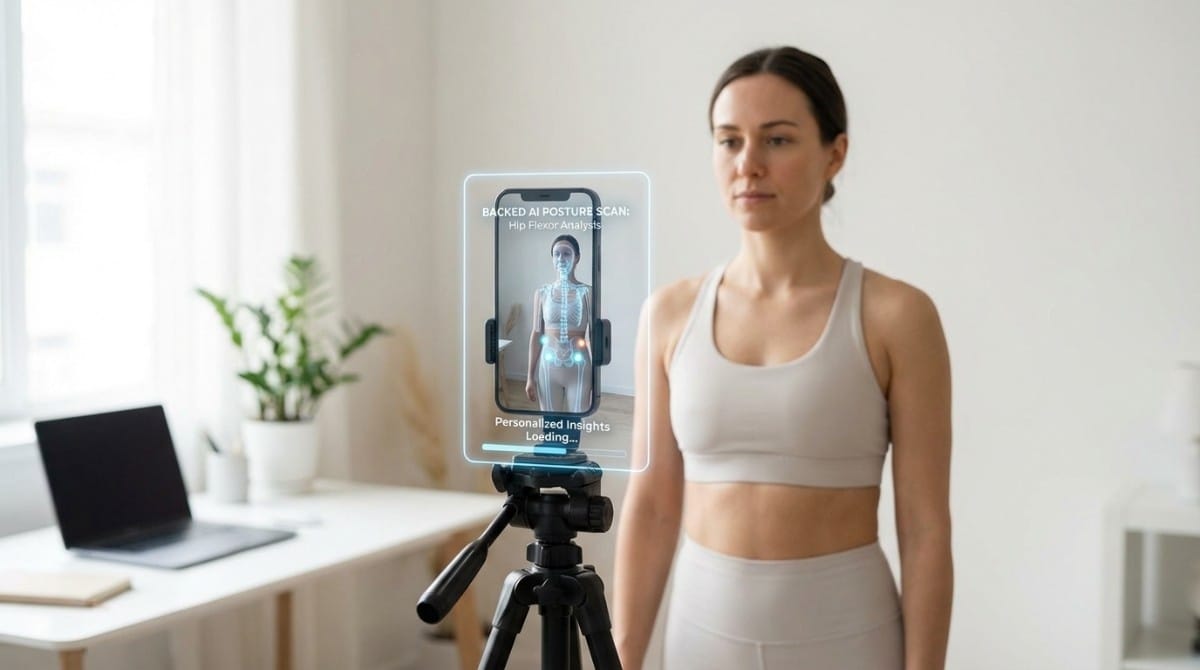
Backed AI scans your posture through your phone's camera, identifies which specific hip and postural imbalances are driving your pain, and builds a corrective program targeting your exact pattern. Not a generic list. A plan built around your body.
What you get that a stretch list can't give you:
- 📸 AI posture scan - identifies whether your hip flexor pain is iliopsoas-driven, TFL-driven, or posture-pattern-driven
- 🎯 Personalized corrective sequence - exercises chosen and sequenced for your specific imbalances
- 📈 Progress tracking - visual proof that your posture and mobility are improving, which is what keeps you consistent
Hip flexor pain when sitting is fixable. But it requires addressing your body specifically - not the average body a generic article was written for.
Download Backed AI and start correcting your posture today.
Final Takeaway
Hip flexor pain when sitting is caused by muscles that have adapted to a shortened position from too much sustained sitting. The pain at the front of your hip, the tightness when you stand up, the stiffness that's there every morning - that's your body telling you the pattern needs to change.
The fix is layered: break up your sitting, stretch the specific muscle that's tight, reactivate your glutes, adjust your chair setup, and foam roll before you stretch. Do those five things consistently and most people see meaningful improvement within 1-2 weeks.
Ignore it, and hip flexor pain becomes lower back pain. Lower back pain becomes a chronic posture problem. That trajectory is common - and entirely preventable.
For readers who have already developed lower back pain alongside hip tightness, the tight hips and lower back pain connection guide covers the full downstream pattern and correction framework.
FAQ
Q1: What causes hip flexor pain when sitting? Hip flexor pain when sitting is caused by the hip flexor muscles - especially the iliopsoas - being held in a shortened, compressed position during prolonged sitting. Over time, the muscles adapt to this shortened length, develop trigger points, and become irritated when loaded during transitions like standing up.
Q2: Where exactly is hip flexor pain felt? Hip flexor pain is most commonly felt as a deep ache or sharp pinch at the front of the hip joint, in the groin area, or at the hip crease. It may also radiate into the upper thigh or lower abdomen. Pain is often worst when sitting down, standing up, or after prolonged sitting.
Q3: How do I relieve hip flexor pain from sitting? The most effective immediate relief comes from the kneeling hip flexor stretch (30-45 seconds per side), followed by glute bridges to reactivate the posterior chain. Combined with standing movement breaks every 60 minutes, most people feel significant relief within 1-2 days of consistency.
Q4: Can sitting all day cause hip flexor pain? Yes. Sitting keeps the hip flexors in a shortened position for hours, causing adaptive shortening, reduced blood flow, trigger point formation, and tendon irritation. This is one of the most common musculoskeletal complaints among desk workers and people with sedentary lifestyles.
Q5: When should I see a doctor for hip flexor pain? Seek professional assessment if your pain is sharp or catching, accompanied by a clicking sensation, radiates down the front of the thigh, developed after an injury, or shows no improvement after 3-4 weeks of consistent stretching and strengthening. These may indicate tendinopathy, snapping hip syndrome, or nerve involvement.