
What Is a Dowager's Hump? Causes, Signs, and When to Worry
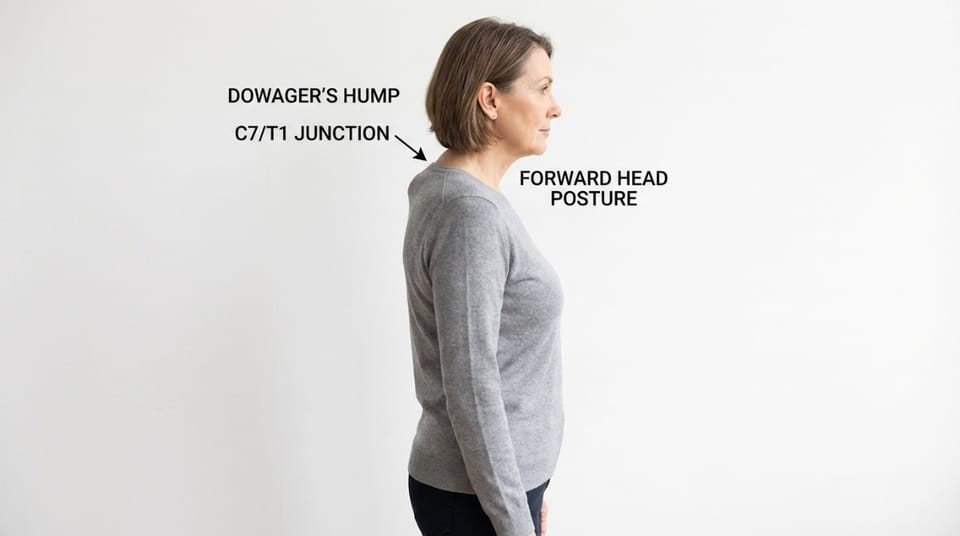
You might have noticed it in the mirror, felt it when someone pointed it out, or seen it gradually develop in a parent or older relative. The rounded hump at the base of the neck and upper back has a name - and more importantly, it has causes you can address.
A dowager's hump is a visible rounded protrusion at the junction of the neck and upper back, caused by a combination of postural misalignment, spinal compression, and soft tissue changes at the cervicothoracic junction.
It's more common than most people realise - and far more treatable than it looks.
TL;DR
- A dowager's hump forms at the C7/T1 junction due to forward head posture, spinal compression, or hormonal changes
- The postural type is the most common and most treatable with targeted exercises
- It affects women more frequently - but men develop it too, especially with prolonged desk work
- Early signs include neck stiffness, upper back tightness, and a visible or palpable bump
- Medical evaluation is needed if the hump appeared suddenly, is growing fast, or comes with other symptoms
- Most postural dowager's humps respond well to a structured correction plan within 8-12 weeks

What Is a Dowager's Hump?
The term "dowager's hump" originally referred to the rounded upper back posture commonly seen in older women - often associated with age-related bone density loss. Today, it's used more broadly to describe any visible hump-like protrusion at the cervicothoracic junction, regardless of age or gender.
It goes by several names:
- Dowager's hump - the most common colloquial term
- Buffalo hump - often used in clinical contexts related to hormonal causes
- Cervicothoracic kyphosis - the medical term for the spinal curvature pattern involved
- Neck hump - the everyday term increasingly used by younger adults noticing it from screen use
The location is consistent across all types: the base of the skull and upper back, typically between the C6 and T2 vertebrae. What varies is the cause - and the cause determines the treatment.
What Causes a Dowager's Hump?
There are three distinct cause categories. Understanding which applies to you is the first step toward the right solution.
1. Postural (Most Common)
This is the type most people are dealing with - and the most responsive to treatment.
Chronic forward head posture - from hours at a desk, looking down at a phone, or sleeping with poor neck support - places enormous sustained load on the cervical spine. For every inch the head drifts forward, it adds roughly 10 lbs of effective load on the neck and upper back.
Over months and years, this causes:
- The upper spine to round and compress into kyphosis
- The deep neck flexors to weaken and lengthen
- The suboccipital muscles at the base of the skull to shorten and tighten
- Fat and connective tissue to accumulate at the C7 junction as the body adapts to the load
As explored in the complete breakdown of forward head posture and rounded shoulders, these patterns almost always develop together - which is why fixing a dowager's hump requires addressing both simultaneously.
2. Age-Related (Osteoporosis and Bone Density Loss)
In older adults - particularly postmenopausal women - declining bone density can cause vertebral compression fractures. These fractures create a wedge shape in the vertebrae, producing a progressive forward curve in the upper spine.
This type is distinct from postural kyphosis and typically requires medical management alongside any exercise programme.
3. Hormonal or Medical
Less common but clinically significant. Causes include:
- Cushing's syndrome - excess cortisol causes fat redistribution to the upper back and neck
- Long-term corticosteroid use - produces a similar fat accumulation pattern
- Lipomatosis - benign fatty tissue growth at the cervicothoracic junction
These types do not respond to postural exercises. Medical evaluation and treatment is required.

Who Gets a Dowager's Hump?
The short answer: more people than you'd expect - and increasingly younger ones.
Physiotherapists note that dowager's hump is no longer primarily an "older woman's condition." The average age of first presentation has dropped significantly over the past decade, driven almost entirely by increased screen time and sedentary desk work.
What Are the Early Signs of a Dowager's Hump?
Catching it early dramatically improves outcomes. Watch for:
- A visible or palpable bump at the base of the neck
- Persistent stiffness or tension in the upper neck and shoulders
- Difficulty fully straightening the upper back
- Neck pain that worsens after long periods at a screen
- A feeling of heaviness or fatigue in the upper back by end of day
- Gradual rounding of the shoulders alongside the neck protrusion
Many people notice the hump in photos before they feel it physically. If you're seeing it in side-profile images - particularly at the C7 junction where the neck meets the upper back - it's worth starting a correction plan early.
For context on the broader postural patterns that accompany it, the guide to types of bad posture provides a useful reference for identifying what's happening across the full spine.
Why Does a Dowager's Hump Get Worse Over Time?
Left unaddressed, the postural type follows a predictable deterioration cycle:
- Forward head posture increases load on the cervical spine
- The deep neck flexors weaken from sustained stretch
- The upper back rounds further to compensate
- Soft tissue accumulates at C7 as structural adaptation
- The rounded position becomes the body's new "default"
- Correcting it becomes progressively harder as the spine adapts
This is why early intervention matters. A hump that's been developing for 6 months is significantly easier to correct than one that's been present for 5 years.
Key Insight: The body adapts to the positions it holds most frequently. A dowager's hump is the spine's structural response to years of forward head loading - which means reversing it requires consistently and deliberately holding better positions.
Research & Expert Insight
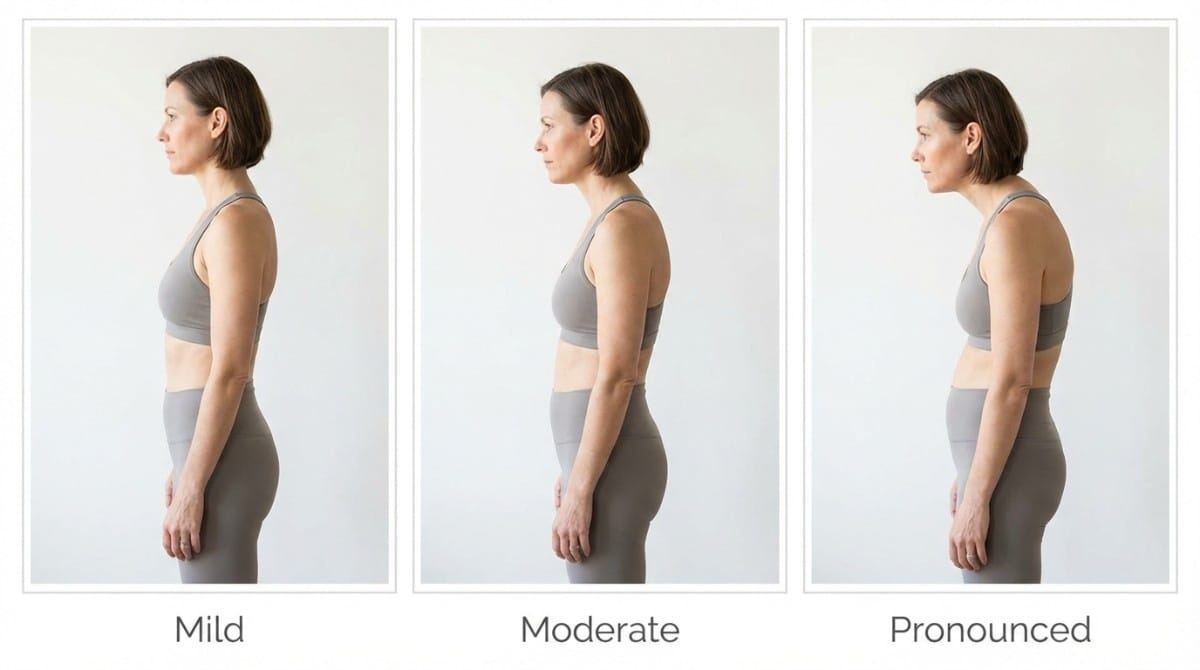
Physiotherapists and musculoskeletal specialists consistently identify three structural factors in postural dowager's hump cases:
- Inhibited deep cervical flexors - the muscles that hold the head in neutral alignment
- Restricted thoracic extension - reduced ability to extend the upper spine upright
- Shortened anterior chain - tight chest, neck flexors, and suboccipital muscles pulling the head forward
Research in musculoskeletal rehab shows that structured exercise programmes targeting all three factors produce measurable improvements in cervical alignment and hump appearance. The most successful protocols combine mobility restoration (foam roller thoracic extension, chest stretching) with progressive strengthening (chin tucks, scapular stabilisation, prone back extensions).
Outcomes are significantly better when programmes are personalised to the individual's specific postural profile - rather than following a generic exercise list that doesn't account for the degree of misalignment or existing mobility restrictions.
When Should You See a Doctor?
Most postural dowager's humps are safe to address with a structured exercise programme. But medical evaluation is the right first step if:
- The hump appeared quickly - over weeks rather than months
- It is painful to touch or growing noticeably in size
- You are experiencing unexplained weight gain, fatigue, or skin changes alongside it
- You are on long-term corticosteroid medication
- You are over 60 and have not been evaluated for bone density
- The hump is present with no clear postural history (extensive desk or screen work)
These signs may indicate a hormonal or structural cause that exercises cannot and should not be the primary treatment for.
Can a Dowager's Hump Be Fixed?
For the postural type - yes, in most cases.
The degree of improvement depends on:
- How long it has been present - earlier intervention produces faster and more complete results
- Severity of the underlying postural pattern - mild to moderate cases respond well to exercise alone
- Consistency of the correction programme - this is the single biggest predictor of outcome
- Age - younger adults typically see faster structural improvement
Most people with a postural dowager's hump see visible improvement within 8-12 weeks of consistent, correctly sequenced corrective exercise. Complete correction of a longstanding hump may take 6-12 months.
For a full exercise and recovery protocol, the step-by-step guide to fixing a neck hump covers the exact exercises, phasing, and progression framework.
Best Exercises for Dowager's Hump (Quick List)
- Chin Tucks - reactivates the deep neck flexors that pull the head back into neutral. 3 sets of 10 reps, 5-second hold.
- Thoracic Extension on Foam Roller - restores upper spine mobility at the C7-T4 region. 60-90 seconds daily.
- Wall Angels - resets scapular position and opens the anterior chain. 3 sets of 10 slow reps.
- Doorway Chest Stretch - lengthens the shortened pectoral muscles pulling the head forward. 3 x 30-second holds.
- Prone Y-T-W Raises - activates the mid and lower trapezius to stabilise the shoulder blades. 2 sets of 10 per position.
- Cat-Cow with Cervical Extension - improves segmental spinal mobility and reduces morning stiffness. 10 slow cycles, twice daily.
For seniors or those with limited mobility, posture exercises for seniors offers a modified framework that's safe and equally effective.

When This Approach Doesn't Work
Exercise-based correction has real limits. It won't produce results if:
- The hump is driven by a hormonal or medical condition (Cushing's, lipomatosis, steroid use)
- Osteoporotic vertebral fractures are the structural cause - these need medical management first
- The postural programme is inconsistent - missing more than 3 sessions per week stalls adaptation
- Exercises are performed with poor form - particularly chin tucks done with neck extension rather than retraction
- The underlying daily postural habits (screen height, seating, sleep position) aren't addressed alongside the exercise plan
If you've been doing corrective exercises consistently for 8 weeks with no visible change, a physiotherapist or musculoskeletal specialist assessment is the right next step.
🔵 The Smarter Way to Start Correcting a Dowager's Hump
Understanding what a dowager's hump is - and why it forms - is the essential first step. The second step is having a plan that actually matches your specific postural pattern.
Generic exercise lists don't know how far forward your head sits, how restricted your thoracic extension is, or whether you need to start with mobility or activation work first. That's the difference between a plan that produces results and one that stalls after two weeks.
Backed AI scans your posture using your phone camera, identifies the specific misalignment driving your hump, and builds a personalised corrective programme around your actual profile - not a template.
- 📍 Posture scan technology - identifies your exact forward head position and upper back rounding pattern
- 🔄 Phased, progressive programming - mobility first, then activation, then strength - in the right sequence for your body
- 🔔 Consistency system - daily reminders and progress tracking keep you on track when motivation dips
Most people know they need to fix their posture. What they're missing is a clear, personalised path to do it - and the daily structure to follow through.
Download Backed AI and start correcting your posture today.
Final Takeaway
A dowager's hump is not an inevitable part of ageing - and for most people, it's not permanent. The postural type, which is by far the most common, develops gradually from forward head posture and responds well to a structured, consistent correction programme.
The key variables are: catching it early, understanding the cause, using the right exercises in the right order, and building daily habits that stop reinforcing the pattern.
Start with a clear picture of what's happening in your spine. Then build a plan around it.
FAQ
Q1: What exactly is a dowager's hump?
A dowager's hump is a rounded protrusion at the junction of the neck and upper back - typically at the C7/T1 vertebrae - caused by forward head posture, spinal compression, or hormonal fat redistribution. The postural type is the most common and most treatable.
Q2: Is a dowager's hump the same as a neck hump?
Yes - the terms are often used interchangeably. "Dowager's hump" is the traditional term, historically associated with older women. "Neck hump" is the more commonly used everyday term, particularly among younger adults developing the condition from screen and desk use.
Q3: Can a dowager's hump go away on its own?
No - a dowager's hump will not resolve without active intervention. Left unaddressed, postural humps typically worsen progressively as the spine adapts to the forward-loaded position. Structured corrective exercises are required to reverse it.
Q4: At what age does a dowager's hump develop?
It can develop at any age. While it was historically associated with postmenopausal women over 60, physiotherapists now frequently see it in adults in their 20s and 30s due to increased screen time and desk-based work patterns.
Q5: How do I know if my dowager's hump is postural or medical?
A postural hump typically develops gradually over months or years alongside a history of desk work, screen use, or poor sleep posture. A medical hump (hormonal or bone-density related) may appear more quickly, is often accompanied by other symptoms (weight changes, fatigue, skin changes), and requires a doctor's evaluation rather than an exercise programme.