
How to Fix a Neck Hump: The Complete Recovery Guide

A neck hump can shrink and often disappear with the right combination of targeted stretches, strengthening exercises, and consistent daily habits. Most cases are postural - meaning they are caused by muscle imbalance and poor alignment, not bone structure - and are fully addressable at home.
TL;DR
- A neck hump at the base of the skull is usually a sign of forward head posture and tight upper traps
- The root cause is muscle imbalance, not just "bad posture"
- Fixing it requires stretching tight muscles AND strengthening weak ones
- Consistency matters more than intensity - daily 10-minute routines outperform weekly gym sessions
- Most people see visible improvement within 4 to 8 weeks
- AI-guided programs help by personalizing exercises and tracking real progress
What Is a Neck Hump?
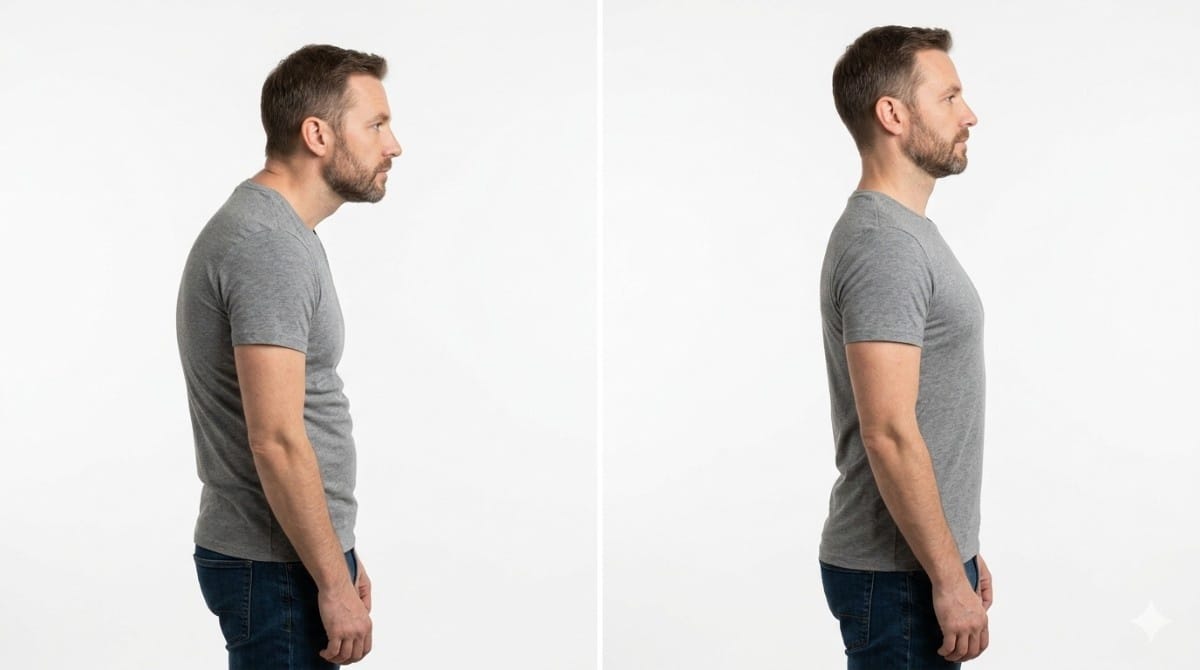
A neck hump is a postural deformity where the tissue at the base of the skull or top of the spine becomes visibly raised due to chronic forward head alignment and muscle imbalance.
It goes by several names: dowager's hump, buffalo hump, C7 hump, or simply a neck hump. Despite the different labels, the underlying mechanism is usually the same.
When your head drifts forward consistently - from hours at a desk, looking down at a phone, or sleeping in poor positions - your upper neck muscles tighten and shorten. The tissue at the back of the neck bunches and thickens over time. Bones and soft tissue both adapt to load.
The result is a visible bump at the junction of the neck and upper back.
It is not just cosmetic. A neck hump can cause headaches, neck stiffness, shoulder tension, and reduced range of motion. It affects how you carry yourself - and how you feel in your own body.
👉 If you want to understand how this connects to other posture problems, this breakdown of the most common types of bad posture explains the full picture.
Why Does a Neck Hump Form?
The neck hump is not random. It is the result of a predictable pattern of muscle behavior.
The tight muscles pulling your head forward:
- Suboccipitals (base of skull)
- Upper trapezius
- Levator scapulae
- Pectorals (chest)
- Sternocleidomastoid (side of neck)
The weak muscles no longer holding you upright:
- Deep cervical flexors (front of neck)
- Mid and lower trapezius
- Rhomboids (between shoulder blades)
- Serratus anterior
When the tight muscles dominate and the weak muscles switch off, your head slowly migrates forward. For every inch your head moves forward of your shoulders, the effective load on your cervical spine increases by roughly 10 pounds. Your posterior neck tissue compensates by thickening and tensing. Over months and years, this becomes structurally visible.
🔑 Key Insight: Fixing a neck hump is not just about stretching. Stretching relieves tension. But if you don't strengthen the muscles that hold correct alignment, the hump comes back. You need both sides of the equation.
How to Fix a Neck Hump: Step-by-Step Recovery Framework
Recovery works in three phases. Rushing to phase three without completing phase one is one of the most common reasons people stop seeing results.
Phase 1 - Release (Weeks 1 to 2)
Goal: Reduce tension in overactive muscles before asking them to work differently.
- Suboccipital release (massage base of skull with fingertips, 60 seconds daily)
- Upper trap stretch (tilt ear to shoulder, hold 30 seconds each side)
- Levator scapulae stretch (look down toward armpit, hold 30 seconds each side)
- Chest doorway stretch (arms at 90 degrees, lean into doorframe, 30 seconds)
Do these daily. They are not optional warm-ups. They are Phase 1.
Phase 2 - Activate (Weeks 2 to 4)
Goal: Wake up the muscles that have been switched off by forward head posture.
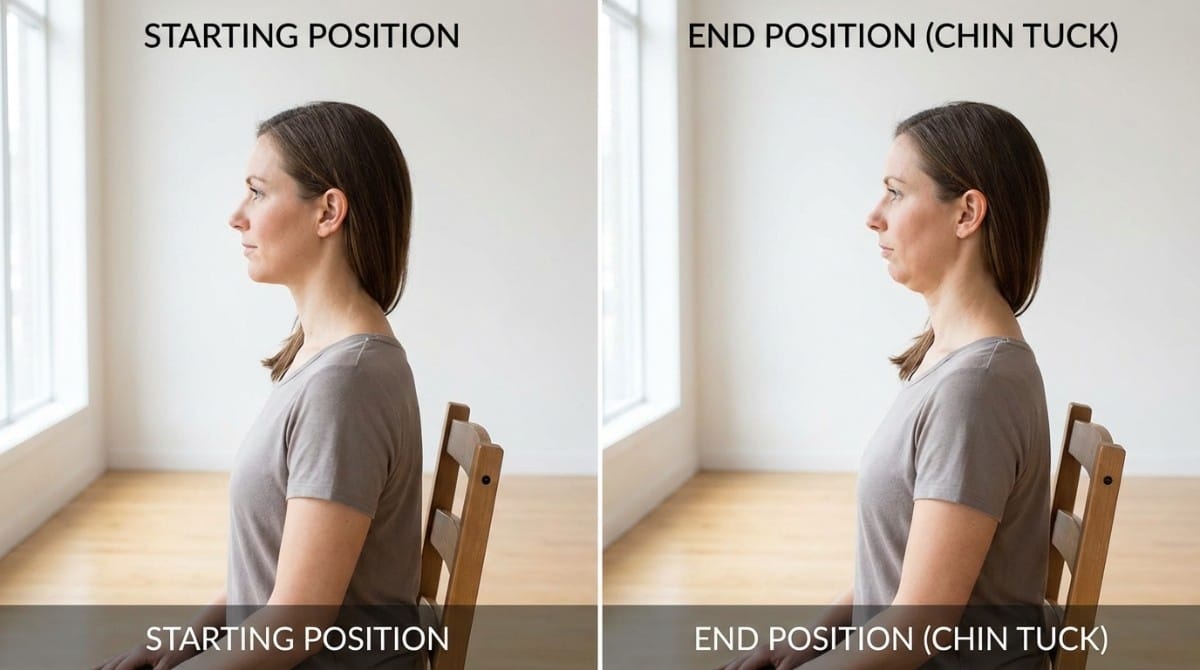
- Chin tucks (retract chin straight back, not down - 3 sets of 10 reps)
- Wall angels (stand with back to wall, raise arms overhead while maintaining contact - 3 sets of 10)
- Band pull-aparts (or substitute with prone Y-raises - 3 sets of 12)
- Scapular retractions (squeeze shoulder blades together, hold 5 seconds - 3 sets of 15)
👉 If you sit at a desk all day, this posture routine designed specifically for desk workers is a strong complement to Phase 2.
Phase 3 - Strengthen and Maintain (Week 4 Onward)
Goal: Build the endurance capacity to hold correct posture naturally throughout the day.
- Progressed chin tucks with resistance band
- Prone YTW raises (lie face down, form Y, T, and W shapes with arms - 3 sets of 8 each)
- Face pulls (with resistance band - 3 sets of 15)
- Deep neck flexor endurance work (hold chin tuck isometrically for increasing durations)
Progress only when Phase 2 movements feel easy and controlled.
Best Exercises to Fix a Neck Hump (Quick List)
- Chin Tucks - The single most effective exercise for neck hump. Retrains deep cervical flexor activation and directly counteracts forward head posture.
- Wall Angels - Trains scapular mobility and thoracic extension simultaneously. Consistently highlighted by posture specialists as a reset for the entire upper back.
- Suboccipital Release - Manual release of the muscles at the base of the skull. Reduces the compressive tension driving tissue thickening at the hump site.
- Prone Y-T-W Raises - Activates mid and lower trapezius, which are chronically weak in most forward head posture cases.
- Doorway Chest Stretch - Opens the pectoral muscles that pull the shoulders and head forward. Essential for lasting postural change.
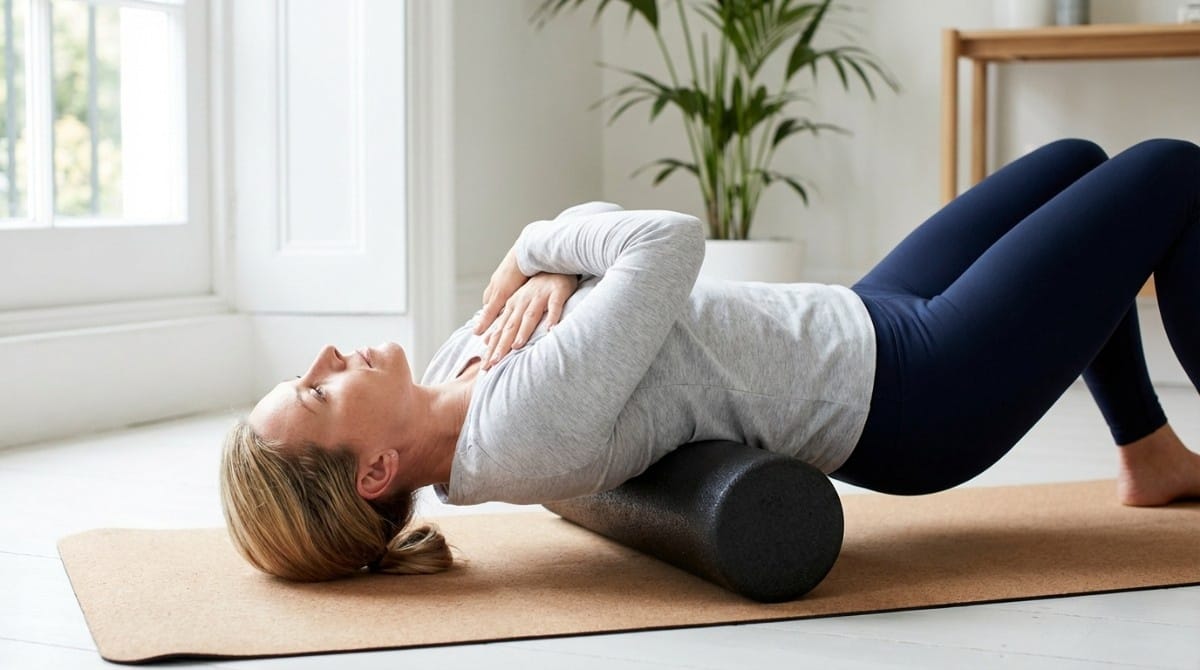
- Thoracic Extension Over a Foam Roller - Mobilizes the mid-back so the neck isn't compensating for thoracic stiffness.
- Scapular Retractions - Trains the rhomboids to hold the shoulders back without active effort over time.

Research & Expert Insight
Posture specialists consistently highlight the role of the deep cervical flexors as the critical missing piece in most neck hump correction programs. These small muscles at the front of the neck are responsible for holding the head in neutral alignment. In people with chronic forward head posture, they become inhibited - not weak from disuse, but neurologically suppressed because the dominant tight muscles take over.
Research in musculoskeletal rehab shows that combined stretching and strengthening protocols produce significantly better long-term outcomes than stretching alone. Physiotherapists often recommend a minimum of 6 to 8 weeks of consistent daily work before expecting structural change in soft tissue.
The thoracic spine also plays an underappreciated role. A stiff mid-back forces the neck to compensate, which accelerates hump formation. Mobilizing the thoracic spine reduces the compensation load on the cervical region.
What Happens If You Ignore a Neck Hump?
Left unaddressed, a neck hump does not stay static. The tissue adapts to the compressed, forward position and becomes progressively more fixed.
Common consequences of leaving it untreated:
- Chronic tension headaches radiating from the base of the skull
- Reduced cervical range of motion (difficulty turning the head fully)
- Upper back and shoulder pain from compensating posture
- Nerve compression symptoms (tingling in arms or hands in advanced cases)
- Accelerated disc wear in the cervical spine
- Increasing visibility of the hump, which affects confidence and self-image
Early intervention produces faster results with less effort. A mild neck hump addressed at 6 months of formation responds in weeks. A hump that has been present for years takes longer and requires more consistent effort.
When This Approach Doesn't Work
This recovery framework works for the majority of postural neck humps. But there are cases where standard exercises will not be sufficient.
Seek professional guidance if:
- The hump is firm and does not change with posture shifts (may indicate fat deposit or lipoma rather than a postural hump)
- You experience significant pain, numbness, or tingling in the arms
- You have been diagnosed with osteoporosis or a spinal compression fracture
- The hump developed very rapidly without obvious postural cause
- You have tried consistent rehabilitation for 3 months with no improvement
For the majority of adults - desk workers, screen users, people with years of poor posture - this framework will deliver measurable results within 4 to 8 weeks.
👉 If tightness in your lower back accompanies your neck issues, this guide to tight lower back stretches and root causes addresses the full postural chain.
Why Most Exercise Plans Fail
Most people start a neck hump correction routine and quit within two weeks. Here is why:
- Wrong exercises first. Starting with strengthening before releasing tight muscles means the dominant muscles take over and nothing changes.
- Inconsistency. Doing exercises 3 times a week instead of daily means the nervous system never builds new alignment habits.
- No progression. The same exercises become easy and stop producing change. Without progression, adaptation stops.
- No feedback. Without knowing whether your form is correct or whether you're improving, it is easy to lose motivation and direction.
This is where structure and personalization make the difference. Generic YouTube routines cannot account for your specific muscle imbalances, your severity, or your lifestyle.
If you want a smarter starting point, Backed AI's approach to personalized posture correction is worth exploring - especially for tracking progress over time.
Final Takeaway
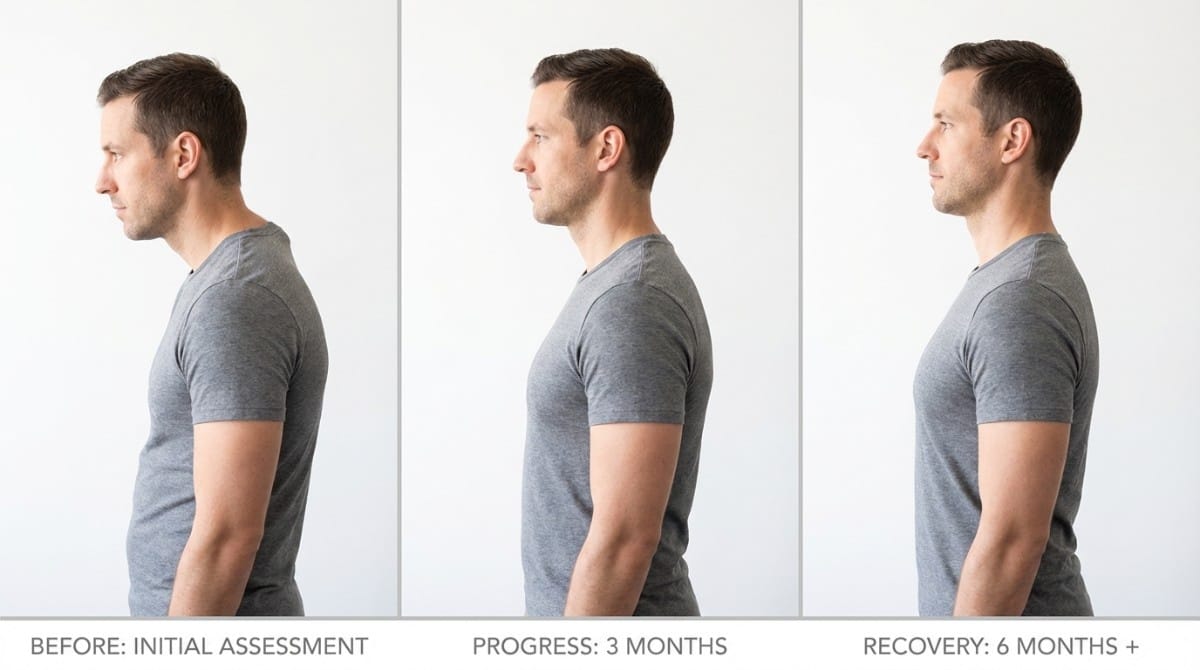
A neck hump is a postural problem, not a permanent condition. The tissue and muscle patterns driving it are adaptable - which means they can be reversed with the right approach.
The key principles:
- Release tight muscles first
- Activate and strengthen weak muscles second
- Progress the difficulty over time
- Be consistent daily, not just occasionally
- Address screen habits and sleep position alongside exercises
Most people who stick to a structured 6 to 8 week protocol see real, visible change. The ones who don't are usually missing one of the three pillars: the right exercises, the right sequence, or the right consistency.
Take the Guesswork Out of Fixing Your Neck Hump
The framework above works. But doing it right - with correct form, the right progression, and enough consistency - is where most people struggle.
Generic exercise lists cannot tell you:
- Whether your form is correct
- Which muscles are your personal weak points
- When to progress and when to back off
- Whether you are actually improving
Backed AI was built to solve exactly this. It uses AI posture analysis through your phone camera to assess your specific alignment, then builds a personalized corrective program around your actual imbalances - not a generic routine designed for no one in particular.
Why Backed AI works where generic plans don't:
- 📍 Personalized from day one - your program is built around your posture scan, not a template
- 📈 Progress tracking that keeps you accountable - you can see real improvement over time
- 🔁 Habit-building reminders - consistency is built into the experience, not left to willpower
You don't need expensive physiotherapy appointments or a stack of YouTube tabs. You need a plan that fits your body and follows you through.
Download Backed AI and start correcting your posture today.
FAQ
Q1: Can a neck hump be fixed permanently? Yes - for most people. A postural neck hump is caused by muscle imbalance and soft tissue adaptation. With consistent stretching, strengthening, and corrected habits, the hump can reduce significantly or disappear entirely. Severe or long-standing cases take longer but respond to the same approach.
Q2: How long does it take to fix a neck hump? Most people see visible improvement within 4 to 8 weeks of daily targeted exercise. Full correction for moderate cases typically takes 3 to 6 months. The key variable is consistency - daily practice beats occasional intense sessions every time.
Q3: What exercises are most effective for a neck hump? Chin tucks are the single most effective exercise because they directly activate the deep cervical flexors that hold the head in correct alignment. Wall angels, prone Y-T-W raises, and thoracic extension work are essential supporting exercises. Stretching tight muscles (pecs, upper traps, suboccipitals) must come first.
Q4: Is a neck hump a serious medical condition? Most neck humps are postural and not medically dangerous, but they can cause headaches, reduced neck mobility, and shoulder tension if left unaddressed. Seek medical advice if the hump is hard, appeared suddenly, or is accompanied by pain radiating into the arms.
Q5: Can you fix a neck hump without a physiotherapist? Yes, for most postural cases. A structured at-home program combining targeted stretches and strengthening exercises is effective for the majority of people. AI-powered tools like Backed AI can provide personalized guidance and progress tracking that approximates a professional plan without clinic visits.