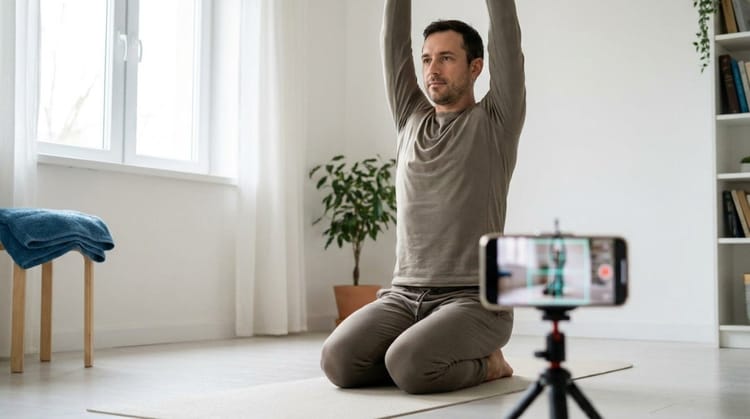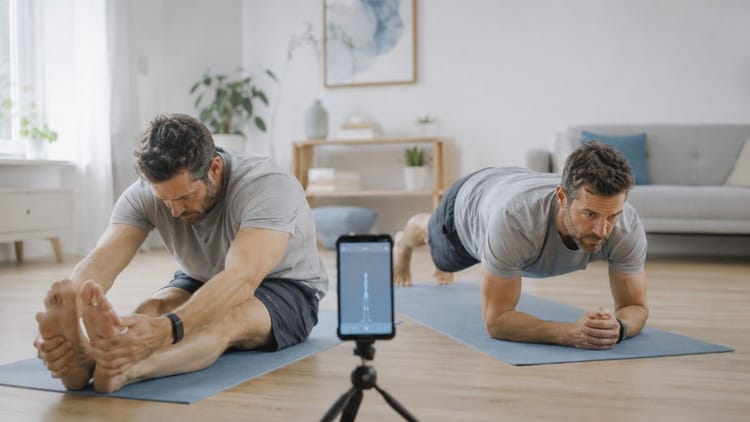
How to Test Your Thoracic Mobility at Home (3 Quick Checks)
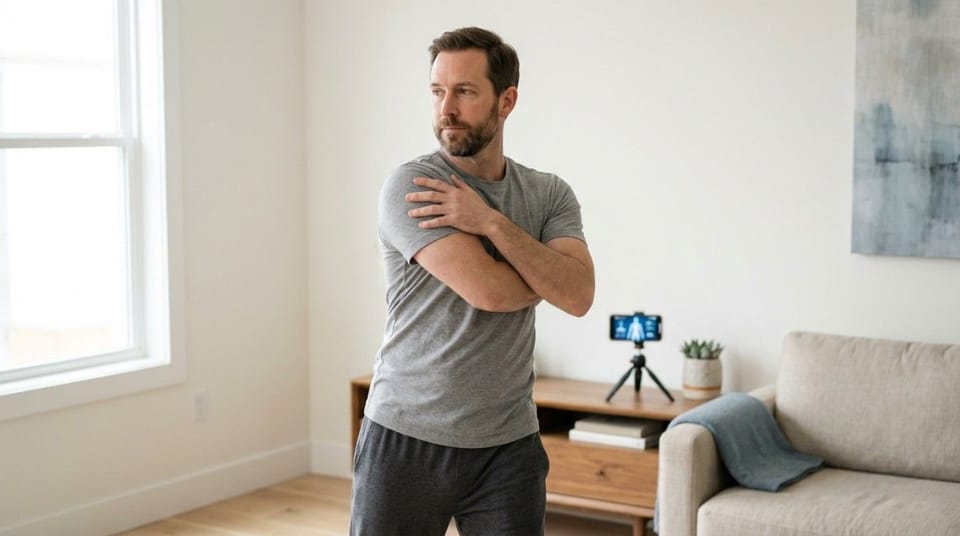
You can test your thoracic mobility at home with three simple checks: a seated rotation test, an overhead reach test, and a wall extension test. Together they reveal whether your mid-back moves freely or has stiffened from sitting. This guide walks you through each self-test, what your results mean, and what to do next.
TL;DR
- 🧍 A thoracic mobility self-test checks how well your mid-back (T1 to T12) rotates, extends, and flexes.
- 🔄 The seated rotation test is the fastest way to spot side-to-side asymmetry.
- 🙌 The overhead reach test shows whether your lower back is compensating for a stiff upper back.
- 🧱 The wall extension test isolates true thoracic extension without help from your shoulders.
- ⏱️ All three tests take under 5 minutes combined, no equipment needed.
- 📋 A failed test is a starting point, not a diagnosis. It tells you where to focus your exercise routine.
What Is a Thoracic Mobility Self-Test?
A thoracic mobility self-test is a set of simple, unweighted movements used to check how freely your mid-back extends, rotates, and flexes without your lower back or shoulders taking over the movement.
These are not clinical measurements. A physiotherapist uses angle-specific tools for that. What a home self-test gives you is something more useful day to day: a clear signal of whether your thoracic mobility exercises are actually needed, and roughly where the restriction sits. 🔍
Most people never test this. They just notice the downstream symptoms, a tight upper back, rounded shoulders, or shoulder pain when reaching overhead, without connecting it back to the joint that's actually stuck.
Why Does Thoracic Mobility Need Testing?
Your thoracic spine doesn't announce its own stiffness. It compensates quietly, and the compensation shows up somewhere else first.
Testing matters because:
- It tells you whether your upper back, not your shoulder or lower back, is the actual restriction.
- It reveals side-to-side asymmetry that a general stretching routine might miss.
- It gives you a baseline to compare against after a few weeks of exercise.
Without a baseline, "my back feels looser" is a guess. With one, it's a measurement.
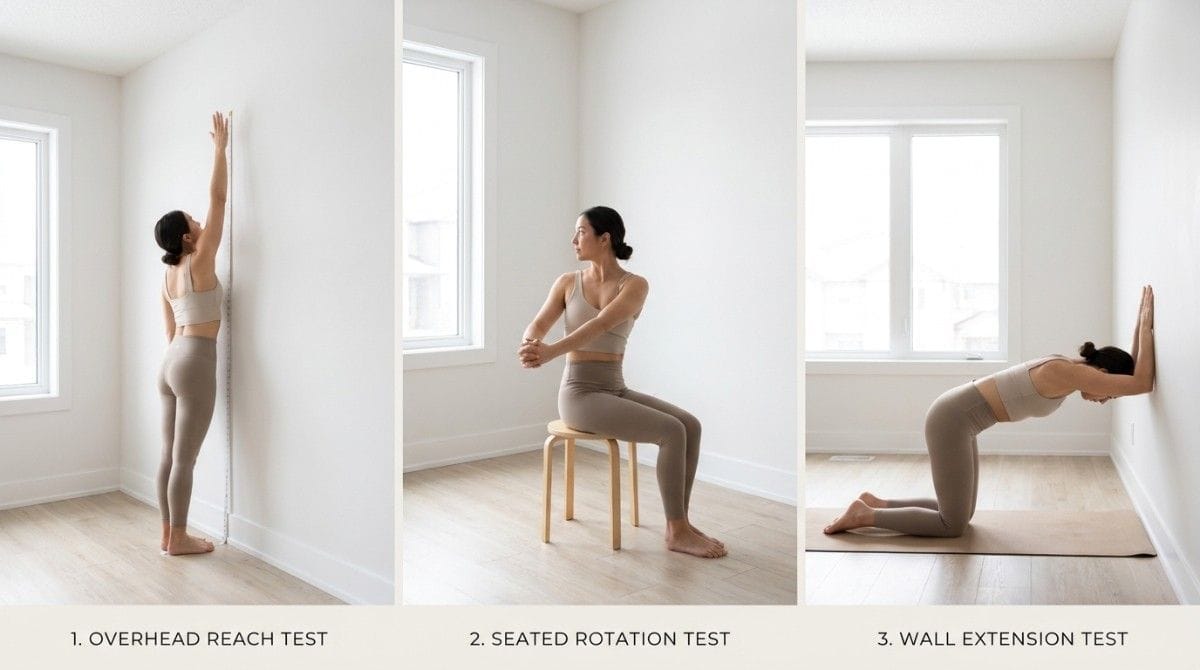
How To Perform the Overhead Reach Test
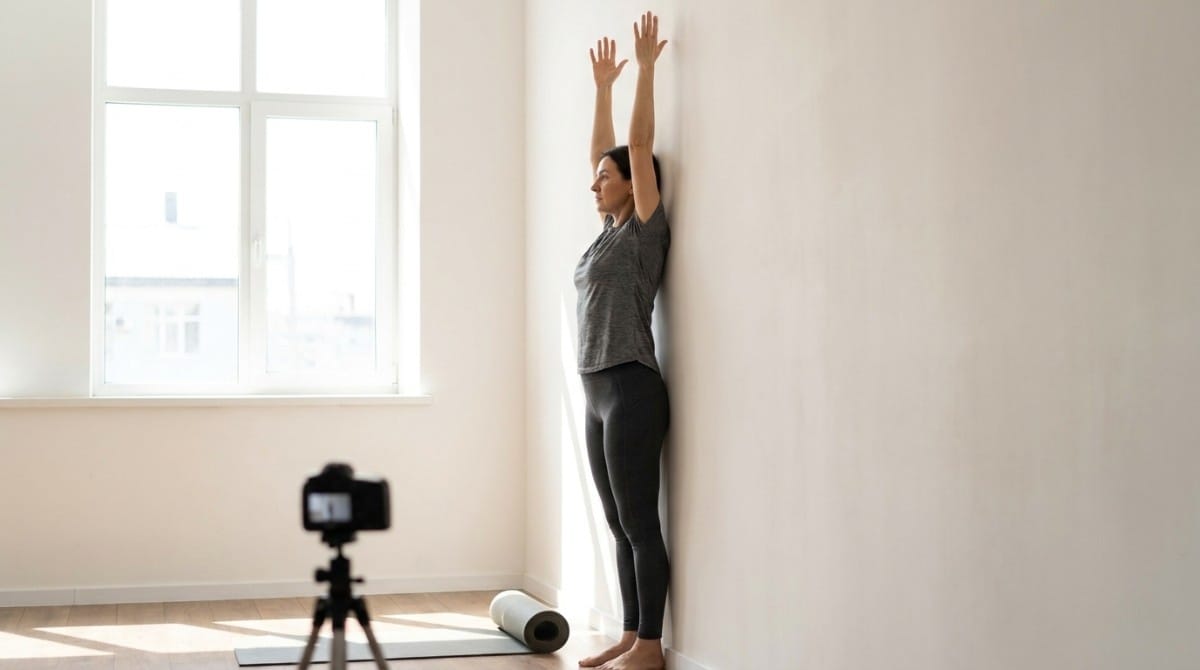
- Stand with your back flat against a wall, heels a few inches away from it.
- Raise both arms straight overhead, trying to keep your lower back pressed to the wall.
- Watch where your lower back arches away from the wall as your arms rise.
Pass: Arms reach close to fully overhead with minimal lower back arch. Restricted: Your lower back lifts off the wall well before your arms are vertical. This usually means your thoracic spine is borrowing range from your lumbar spine.
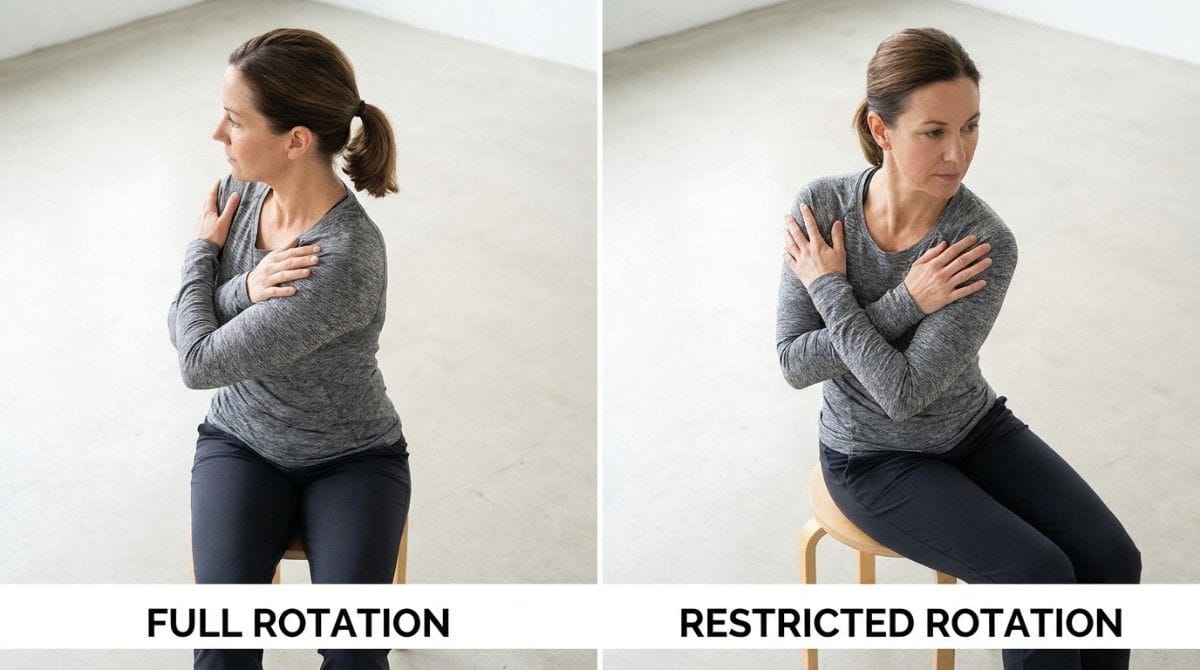
How To Perform the Seated Rotation Test
- Sit tall on a chair or stool, feet flat, arms crossed over your chest.
- Keeping your hips completely still, rotate your upper body as far as you can to the right.
- Return to center, then rotate to the left.
- Compare how far you rotated on each side.
Pass: Roughly equal rotation on both sides, with a smooth, even feel. Restricted: A noticeable gap between sides, or a hard stopping point well before you'd expect.
What Happens If Your Results Show Restriction?
A restricted result on any of these tests is common, not alarming. It simply confirms what most desk-based lifestyles produce over time. 📉
What tends to follow if it's left unaddressed:
- The lower back keeps absorbing movement that should come from the mid-back, which can build into recurring stiffness or ache.
- Overhead reach continues to shrink, making everyday tasks like reaching into a cupboard feel harder.
- Rounded shoulders and a forward-leaning posture become more pronounced over months, not days.
The fix is the same regardless of which test flagged the issue: a consistent, targeted mobility routine, which we cover in detail in our guide to the 8 best thoracic mobility exercises.
Best Thoracic Mobility Self-Tests (Quick List)
- Overhead reach test – Reveals whether your lower back compensates for limited thoracic extension.
- Seated rotation test – Flags asymmetry between your left and right rotation.
- Wall extension test – Isolates true thoracic extension without shoulder assistance.
- Standing side-bend test – Checks lateral flexion, the most overlooked plane of thoracic movement.
- Child's pose reach test – A floor-based option that shows extension and flexion together in one position.
How To Perform the Wall Extension Test
- Kneel or sit facing a wall, close enough to place your forearms flat against it at shoulder height.
- Slowly try to arch your upper back while keeping your forearms in contact with the wall.
- Notice how far your chest opens before you feel a hard stop.
Pass: A clear, comfortable arch through your mid-back with a soft end range. Restricted: Little to no movement, or the arch seems to come entirely from your lower back instead.
If you already do wall angels as part of your posture routine, this test uses a similar wall-contact principle to isolate the same joint.
Step-by-Step Self-Assessment Framework
Step 1 – Baseline. Run all three main tests (overhead reach, seated rotation, wall extension) and jot down a simple pass/restricted note for each.
Step 2 – Identify the pattern. Restriction almost always clusters. A common pattern seen in desk workers is limited extension plus even rotation, which points toward a sitting-driven stiffness rather than a structural issue.
Step 3 – Match the fix to the finding. Extension-restricted results respond best to foam roller extension and wall slides. Rotation asymmetry responds best to thread the needle and dowel rotation, done evenly on both sides.
Step 4 – Re-test every 2 to 3 weeks. Use the same three tests to track real change instead of relying on how your back "feels."
💡 Key Insight: The number that matters most isn't how far you can move. It's whether this month's result is better than last month's. Self-tests are only useful as a comparison tool, not a one-time verdict.
Self-Test Comparison Table
📲 If interpreting these results yourself feels uncertain, Backed AI's camera-based posture scan can measure your actual thoracic range and flag the exact pattern, extension, rotation, or both, without the guesswork of a mirror test.
When This Approach Doesn't Work
Home self-tests are a useful screening tool, not a diagnosis. They fall short in a few specific situations.
- Sharp or radiating pain during testing – stop immediately and see a professional rather than pushing through a movement.
- Known structural conditions – scoliosis, osteoporosis, or a prior vertebral fracture change what "restricted" even means for your spine.
- No change after 6 to 8 weeks of consistent exercise – a plateau this long is a signal to get an in-person assessment rather than repeating the same self-test.
- Numbness or tingling in the arms – this points toward a nerve issue, which is outside the scope of a mobility self-test entirely.
Research & Expert Insight
Physiotherapists often use simple, tool-free screens like these as a first-pass check before deciding whether deeper assessment is needed. The logic is straightforward: if a basic test already reveals a clear side-to-side or extension deficit, that's usually enough to justify starting a mobility routine before booking a clinical evaluation.
Research in musculoskeletal rehab shows that self-reported mobility restrictions, when re-tested consistently over several weeks, track reasonably well with more formal range-of-motion measurements, especially for extension and rotation.
Final Takeaway
Testing your thoracic mobility takes less than five minutes and needs no equipment. The overhead reach, seated rotation, and wall extension tests together give you a clear read on whether your mid-back, not your shoulders or lower back, is the actual source of your stiffness. A restricted result isn't a diagnosis. It's a starting point that points directly to the right exercises and a baseline to measure your progress against.
Why Most Self-Assessments Stall Out
Most people who test their own mobility hit the same wall a few weeks later:
- No consistent baseline – testing once and never again means there's nothing to compare progress to.
- Guessing at the pattern – a mirror test can flag "something feels tight" without pinpointing extension vs rotation vs asymmetry.
- No follow-through plan – identifying a restriction and doing nothing about it changes nothing.
- No progression tracking – even a good routine plateaus if there's no way to see whether it's actually working.
A Smarter Way to Track Your Thoracic Mobility
A mirror and a wall get you a rough read. They can't tell you precisely how many degrees you're missing, whether one side is meaningfully worse than the other, or whether last month's routine actually moved the needle.
Backed AI uses your phone camera to scan your posture, measure your actual range against your own baseline, and build a corrective program that targets your specific restriction instead of a generic list of stretches.
- 📍 Objective posture scan – replaces the guesswork of a mirror test with a measured baseline.
- 📈 Progress tracking over time – shows whether your extension or rotation is actually improving, not just whether it "feels" better.
- 🔔 Consistency system – daily reminders keep the follow-through going after the first self-test, which is where most people drop off.
You've already done the hard part by testing yourself. The next step is turning that result into a plan that adjusts as you improve.
Download Backed AI and start correcting your posture today.
FAQ
1. How often should I test my thoracic mobility? Every 2 to 3 weeks is enough to see real trends without over-testing. Daily testing adds noise, not clarity.
2. Is it normal to have less rotation on one side? A small difference is common. A large, consistent gap between sides is worth addressing with targeted rotation work on the tighter side.
3. Can I test thoracic mobility if I have back pain? Mild stiffness is fine to test around. Sharp, radiating, or nerve-related pain means you should stop and see a professional instead of self-testing.
4. What's a normal result for the overhead reach test? Most people without significant restriction can raise their arms close to vertical while keeping their lower back nearly flat against the wall. A big early arch usually signals limited thoracic extension.
5. Do these self-tests replace a physiotherapy assessment? No. They're a useful screening tool to decide where to start, not a clinical diagnosis. Persistent restriction or pain still warrants a professional evaluation..