
8 Best Exercises for Thoracic Mobility (Fix a Stiff Upper Back)

The best exercises for thoracic mobility target extension, rotation, and flexion in your mid-back through moves like foam roller extensions, cat-cow, thread the needle, and open books. Doing 8 to 12 minutes of these drills most days loosens a stiff thoracic spine, restores overhead reach, and takes pressure off your neck and lower back. Below is the exact routine, how to progress it, and when it stops being enough on its own.
TL;DR
- 🧩 Thoracic mobility exercises restore movement to the mid-back (T1 to T12), the spine segment stiffened most by sitting.
- 🚫 A stiff thoracic spine limits overhead reach and forces your neck and lower back to compensate.
- 🔑 Core moves: foam roller extension, cat-cow, thread the needle, open book rotation, quadruped extension, and dowel rotation.
- ⏱️ Aim for 8 to 12 minutes, 5 to 6 days a week, for change in 3 to 6 weeks.
- 💪 Mobility work fades fast without strength work layered on top.
- ⚠️ Skip aggressive extension drills with osteoporosis, a recent fracture, or acute disc symptoms.
What Is Thoracic Mobility?
Thoracic mobility is the range of motion available in the mid-back (T1 to T12), specifically its ability to extend, rotate, and flex without the neck or lower back taking over the movement.
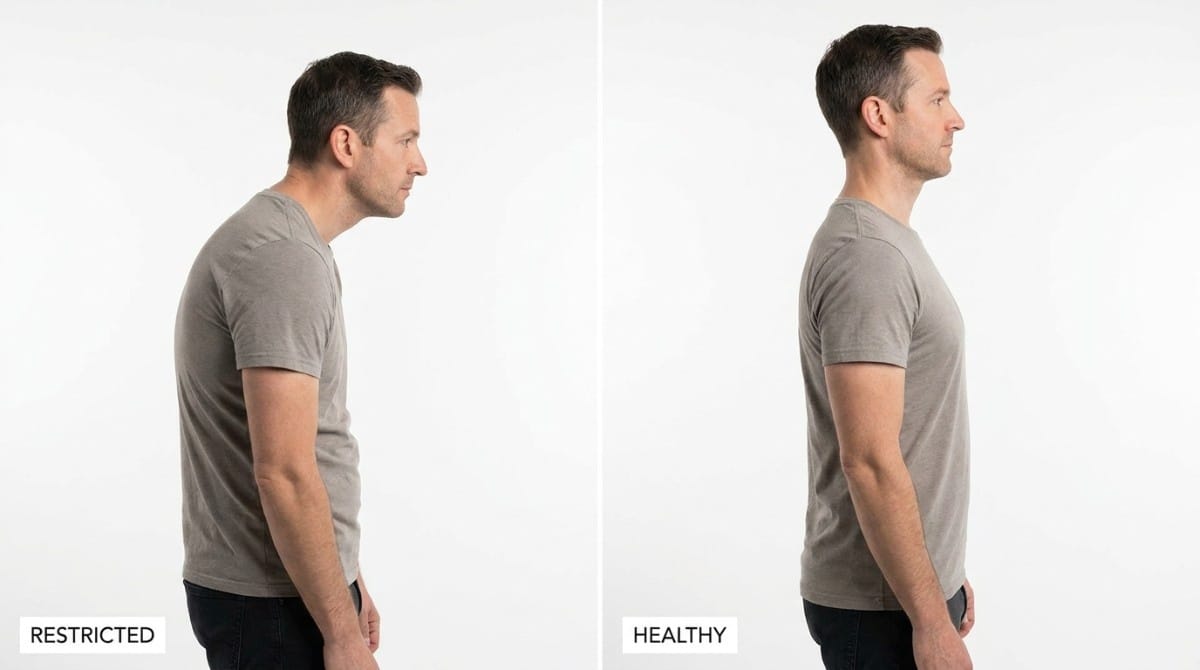
Your thoracic spine sits between your shoulder blades. It is built for stability, not just movement, which is exactly why it stiffens so easily. Desk work, phone scrolling, and driving all push it into the same rounded position for hours at a time. 🖥️
Research in musculoskeletal rehab shows that roughly 15 degrees of thoracic extension is needed just to lift your arms fully overhead. Lose that range, and your body borrows movement from somewhere else, usually your lower back or your shoulder joint, which are not built to cover for it.
If you already follow a desk posture reset routine, thoracic mobility work is the missing piece that unlocks the rest of it.
Why Does the Thoracic Spine Get Stiff?
Sitting keeps your ribcage and spine locked in a flexed position for long stretches. Over time, the joints and surrounding tissue adapt to that shortened range.
Three habits drive most of the stiffness:
- Prolonged sitting with a rounded upper back.
- Looking down at screens for hours without a break.
- Skipping any rotation or extension movement in daily life.
None of this happens overnight. It builds slowly, which is also why it reverses slowly with consistent input. 🔄
How To Test Your Thoracic Mobility at Home
You do not need equipment to get a rough read on your mobility.
- Sit tall in a chair with your arms crossed over your chest.
- Keeping your hips still, rotate your upper body as far as you can to one side.
- Compare left and right. A big difference between sides is a sign of asymmetry worth addressing.
- Stand and reach both arms straight overhead against a wall. Struggling to keep your lower back flat signals limited thoracic extension.
Best Exercises for Thoracic Mobility (Quick List)
- Foam roller thoracic extension – Lie back over a foam roller at bra-strap height and gently arch backward to open the mid-back.
- Cat-cow – On hands and knees, alternate rounding and arching your spine to move through flexion and extension.
- Thread the needle – From hands and knees, sweep one arm under your body and rotate through the opposite side.
- Open book rotation – Lying on your side with knees bent, rotate your top arm and chest open like a book.
- Quadruped thoracic extension – Hands behind your head on all fours, lift your elbows toward the ceiling using your mid-back.
- Dowel-assisted rotation – Holding a stick across your shoulders, rotate side to side while keeping your hips still.
- Wall slide with extension – Standing against a wall, slide your arms overhead while keeping contact, similar in spirit to the wall angel posture reset.
- Standing thoracic rotation – From a semi-squat, rotate your torso toward the sky, following your hand with your eyes.

Step-by-Step Recovery Framework
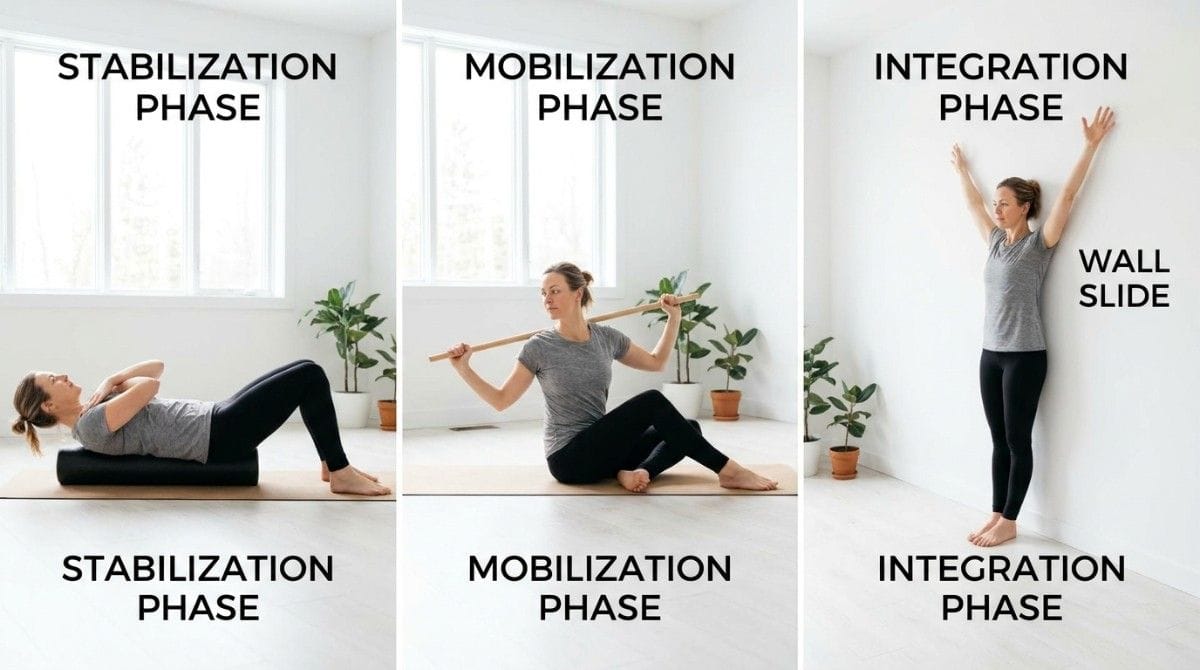
Weeks 1 to 2 – Mobilize. Focus purely on range of motion. Foam roller extension, cat-cow, and thread the needle daily, 8 to 10 minutes total.
Weeks 3 to 4 – Add rotation. Layer in dowel-assisted rotation and standing thoracic rotation. Keep the original moves in the routine.
Weeks 5 and beyond – Add strength. Bring in wall slides and light band rows so the new range of motion has muscle support behind it, similar to the progression covered in our bodyweight back exercise guide.
💡 Key Insight: Mobility without strength is a rented improvement. Your thoracic spine will only keep new range of motion if the muscles around it are strong enough to hold it there.
What Happens If You Ignore a Stiff Thoracic Spine?
A stiff thoracic spine rarely stays contained to your mid-back. 📉
Your body compensates by borrowing movement from joints nearby. Physiotherapists often see this show up as:
- Increased lower back arching during overhead lifting or reaching.
- Rounded shoulders and forward head posture worsening over time.
- Reduced shoulder range of motion, sometimes progressing toward impingement.
- Shallower breathing, since a locked ribcage limits chest expansion.
None of these are dramatic on their own. Together, over months, they add up to the tight, achy upper back most desk workers eventually notice.
Thoracic Mobility Exercise Comparison
Want a fuller strengthening routine once mobility improves? Foam rolling technique carries over directly.
📲 If manually tracking form and progress feels like guesswork, Backed AI's camera-based posture scan can flag exactly where your thoracic restriction sits before you start.
When This Approach Doesn't Work
Thoracic mobility exercises help most people with stiffness from sitting and inactivity. They are not a fix for every case.
- Osteoporosis or recent vertebral fracture – aggressive extension drills need medical clearance first.
- Acute disc herniation or nerve symptoms – numbness, tingling, or radiating pain need professional assessment, not self-directed mobility work.
- Structural scoliosis or fixed kyphosis – mobility work helps around the edges but won't reverse a structural curve.
- Poor ergonomics left unaddressed – no amount of daily mobility work outruns eight hours of slumped sitting at a badly set up desk.
If any of these apply, talk to a physiotherapist before building a routine around this guide.
Research & Expert Insight
Posture specialists suggest that thoracic stiffness rarely stays isolated. Because the thoracic spine, ribs, and shoulder blades move as a linked system, a restriction in one area shows up as compensation somewhere else, often the neck or lower back.
Research in musculoskeletal rehab shows that consistent daily mobility input, even in short sessions, produces measurable range-of-motion gains within 3 to 6 weeks in sedentary adults. The dose matters more than the intensity.
Final Takeaway
A stiff thoracic spine is one of the most common, and most fixable, drivers of upper back tension, rounded shoulders, and reduced overhead mobility. A short daily routine of extension, rotation, and flexion drills, layered with strength work after the first few weeks, is enough for most people to see real change. For structural or nerve-related issues, mobility work supports recovery but is not a replacement for professional care.
Why Most Exercise Plans Fail
Most people don't fail at thoracic mobility because the exercises are wrong. They fail for four repeatable reasons:
- Inconsistency – a routine done twice a week never builds enough range of motion to stick.
- Wrong form – rotating from the lower back instead of the mid-back reinforces the compensation pattern instead of fixing it.
- No progression – staying on the same three stretches for months plateaus fast.
- No personalization – a generic YouTube list doesn't know whether your restriction is extension, rotation, or both.
A Smarter Way to Fix a Stiff Thoracic Spine
Generic exercise lists, including this one, treat every stiff upper back the same way. In reality, one person needs more rotation work, another needs more extension, and a third needs strength before mobility will even hold.
Backed AI uses your phone camera to scan your posture, identify where your thoracic restriction actually sits, and build a corrective program around your specific pattern instead of a one-size-fits-all routine.
- 📍 Personalized posture scan – pinpoints whether your limitation is extension, rotation, or asymmetry between sides.
- 🔄 Progressive programming – phases mobility, then strength, in the right order for your body instead of guessing.
- 🔔 Built-in consistency system – daily reminders and progress tracking solve the "I forgot" problem that ends most routines.
A stiff thoracic spine gets worse quietly, one hunched hour at a time. The sooner your routine is built around your actual body, the sooner that reverses.
Download Backed AI and start correcting your posture today.
FAQ
1. How long does it take to improve thoracic mobility?
Most people notice looser movement within 2 to 3 weeks of daily practice. Visible change in posture and overhead reach usually takes 4 to 6 weeks of consistent effort.
2. Can I do thoracic mobility exercises every day?
Yes. These are low-intensity movements, and daily practice is what produces the fastest results. Just add strength work on top after the first couple of weeks.
3. What's the difference between thoracic mobility and flexibility?
Flexibility refers to muscle length. Mobility refers to how well a joint moves through its full range, which involves both muscle and joint function together.
4. Do I need a foam roller to improve thoracic mobility?
No. Cat-cow, thread the needle, and open book rotation all work without equipment. A foam roller simply adds a deeper extension stretch.
5. Why does my lower back hurt when I try thoracic mobility exercises?
This usually means your lower back is compensating for a stiff mid-back. Focus on keeping your hips still and isolating movement to the upper back, or scale back range until form improves.