
Neck Hump Stretches vs Strengthening: What Order Should You Do Them In? 💙

The order matters more than the exercises. Most people fixing a neck hump do the right moves in the wrong sequence, and that single mistake is why their progress stalls. The fix is not harder work; it is smarter ordering.
This guide breaks down exactly when to stretch, when to strengthen, what order to do them in within a single session, and how to sequence them across weeks for the fastest, most lasting results.
🧠 TL;DR
- Stretching opens range of motion. Strengthening holds the new range.
- The correct single-session order: warm-up → mobility / stretching → activation → strengthening → reset.
- The correct multi-week order: stretch-dominant first, then activate, then load progressively.
- Strengthening tight tissue without first mobilizing it builds dysfunction, not posture.
- Skipping strengthening leaves you in a permanent "loose but unstable" loop.
- Most people quit at week 4 because they sequence wrong and stop seeing results.
- Sequencing right, even with fewer exercises, beats sequencing wrong with more.
What Is "Sequencing" for a Neck Hump?
Sequencing for a neck hump is the strategic ordering of mobility, stretching, activation, and strengthening exercises, both within a single session and across weeks of recovery, so that each step prepares the body for the next and lasting postural change becomes possible.
It is the difference between a routine that works in 8 weeks and one that stalls at week 4. The Backed AI complete neck hump recovery guide covers the full framework; this article goes deep on the ordering logic specifically.
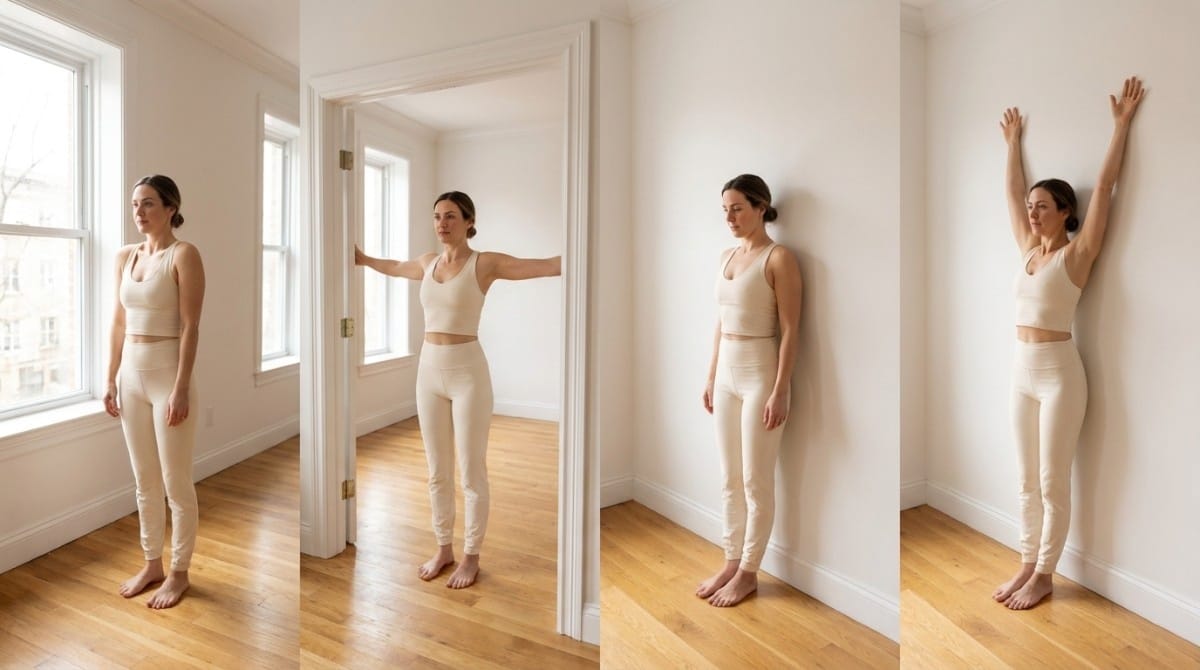
Why Does Order Matter for Fixing a Neck Hump?
Tissue does not respond to the same exercise the same way at every state. A stiff thoracic spine cannot produce a clean wall angel. A tight chest cannot allow proper chin tuck depth. A cold body cannot tolerate strengthening load.
Three reasons sequencing is non-negotiable:
- Tight tissue resists strengthening. Loading a shortened muscle reinforces the shortening.
- Mobile-but-weak posture collapses. Stretching without strengthening means the new range has no support.
- Cold tissue tears easier. Skipping warm-up turns mobility work into injury risk.
Posture specialists suggest that the single biggest predictor of postural correction success is exercise order, not exercise selection.
💡 Key Insight: Stretching and strengthening are not competitors. They are sequential partners. Stretching opens the door; strengthening holds it open. Doing them in the wrong order is like trying to push a door open while standing on the wrong side.
The Single-Session Order (5 Stages)
Inside one workout or routine, follow this sequence:
| Stage | Time | What You Do | Why |
|---|---|---|---|
| 1. Warm-up | 1–2 min | Slow shoulder rolls, gentle neck rotations | Wake up tissue, raise temperature |
| 2. Mobility / Stretching | 3–5 min | Doorway chest stretch, thoracic extension, chin tuck holds | Open shortened tissue and stiff joints |
| 3. Activation | 2–3 min | Light chin tucks, scapular squeezes, prone Y-T-W | Wake up sleeping postural muscles |
| 4. Strengthening | 3–5 min | Wall angels, prone presses, banded rows | Build sustainable support in the new range |
| 5. Cool Reset | 1 min | Standing tall, neutral breathing | Lock in the new alignment |
Total time: about 12–15 minutes. The ratio shifts as you progress (more stretching early on, more strengthening later), but the order stays the same.
The Multi-Week Order (4 Phases)
Across weeks, the routine should evolve. Start stretch-heavy, end strengthen-heavy:
| Phase | Weeks | Focus Ratio | Goal |
|---|---|---|---|
| Phase 1 – Mobilize | Week 1–2 | 80% stretch / 20% activation | Restore range of motion |
| Phase 2 – Activate | Week 3–4 | 50% stretch / 50% activation | Wake up dormant postural muscles |
| Phase 3 – Strengthen | Week 5–8 | 30% stretch / 70% strengthen | Build holding capacity |
| Phase 4 – Integrate | Week 9+ | Maintenance mix | Make new posture automatic |
The mistake almost everyone makes: jumping from Phase 1 straight to Phase 3 because "stretching feels too easy." That skip is exactly why their hump stalls.
How To Decide What Order Is Right For You
A simple flow:
- Hump feels stiff and locked? Spend more time in Phase 1.
- You can stretch fine but slump back into the hump within minutes? You need Phase 2 and 3.
- You feel "loose but weak"? You jumped phases. Go back and add activation work.
- You feel sore in a sharp way during stretching? Reduce intensity, add warm-up.
The full progression aligns naturally with the week-by-week neck hump recovery timeline, so you can match your phase to your week.
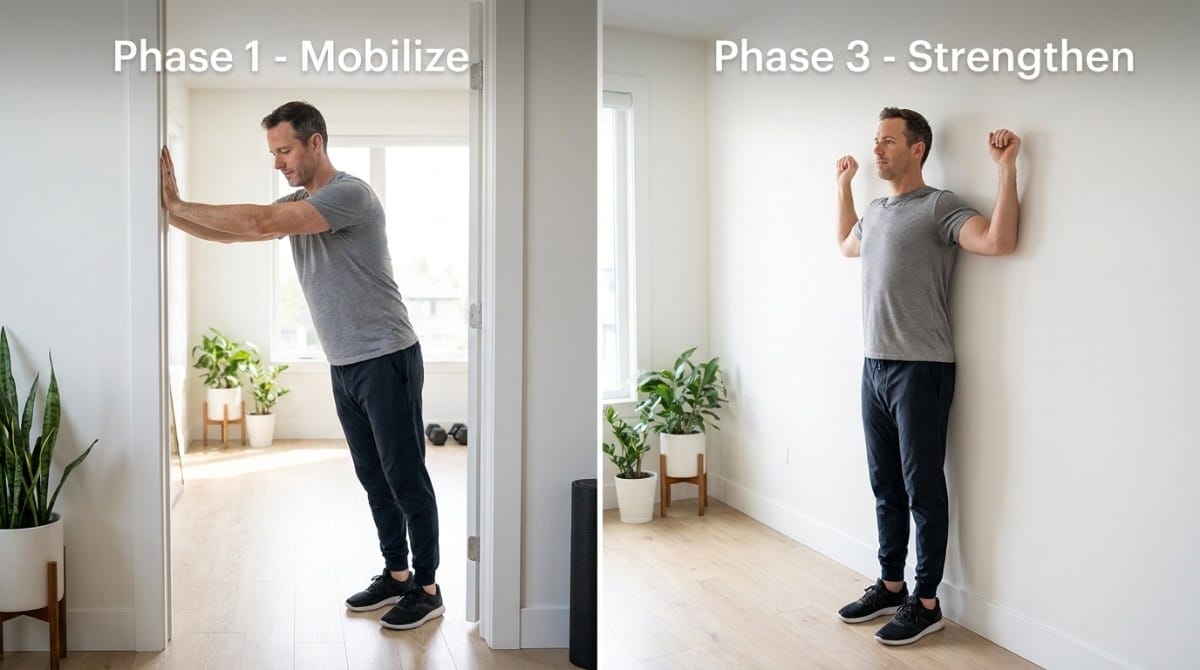
Best Stretching and Strengthening Pairings (Quick List) 🔁
The highest-leverage pairs that work in sequence:
- Doorway chest stretch → Wall angels – Open the chest, then strengthen the upper back in the new range.
- Thoracic extension → Prone Y-T-W raises – Mobilize the mid-back, then activate the muscles that hold it tall.
- Chin tuck holds → Resisted chin tucks – Stretch the deep neck, then strengthen the same line.
- Upper trap stretch → Scapular squeezes – Release the side neck, then build mid-back support.
- Foam roller chest opener → Banded face pulls – Open shortened pecs, then strengthen the rear shoulder.
Each pair takes 3–4 minutes. A full session uses 2–3 pairs, not all five.
Common Sequencing Mistakes That Stall Progress 🚫
- Skipping warm-up. Cold tissue does not stretch well, and it does not load well either.
- Strengthening before stretching. You build force into a tight, restricted pattern.
- Doing only stretching for months. You get loose but stay weak. The hump returns under daily load.
- Doing only strengthening. You build force in a hump pattern. The hump gets harder, not better.
- Stretching aggressively after a long day. Tired tissue tears easier; reduce intensity.
- Mixing all four stages randomly in a single session. No clear order means no clear adaptation.
What Happens If You Don't Sequence Properly?
The pattern most people fall into:
- They stretch for two weeks and feel looser.
- They skip the activation and strengthening phases.
- The looseness fades within days of stopping daily stretching.
- They conclude "stretching doesn't work" and quit.
The truth is more useful: stretching alone has a ceiling. Without activation and strengthening, the body simply re-tightens to the only support pattern it knows. That is why sustainable change requires all four stages, in order. The same long-term cycle issue is described in why pain and posture issues keep coming back, applied here to the cervical spine.
When This Approach Doesn't Work
The ordering framework above applies to postural neck humps in healthy adults. It needs modification when:
- You have known osteoporosis or recent vertebral fracture
- You have post-surgical restrictions on cervical or thoracic loading
- The hump is from a hormonal or fat-deposit cause
- You experience numbness, tingling, or sharp pain during any stage
In those cases, work with a clinician to adapt the sequence safely. For everyone else, this order is reliable.
Research & Expert Insight 🔬
Research in musculoskeletal rehab shows that combined mobility and progressive strengthening protocols produce significantly better long-term outcomes than either approach alone. Physiotherapists often recommend 6–8 weeks of consistent sequenced work before expecting structural change in soft tissue. The pattern across studies is consistent: stretching-only protocols plateau within 4–6 weeks; sequenced protocols continue producing gains for months.
The thoracic spine plays an underappreciated role. A stiff mid-back forces the neck to compensate, which accelerates hump formation. Mobilizing the thoracic spine reduces compensation load, but only if it is followed by strengthening that holds the new mobility in place.
How to Build a Weekly Schedule (Step-by-Step Recovery Framework)
A practical week split that works for most people:
| Day | Focus | Time |
|---|---|---|
| Monday | Full sequence (warm-up → stretch → activate → strengthen) | 12 min |
| Tuesday | Stretch + activation only | 8 min |
| Wednesday | Full sequence | 12 min |
| Thursday | Stretch + activation only | 8 min |
| Friday | Full sequence | 12 min |
| Saturday | Light stretch + walk | 10 min |
| Sunday | Rest or gentle bed-based stretches | 5 min |
This gives three "build" days, two "maintain" days, and two recovery days each week. It pairs naturally with the complete daily stretching routine for neck hump for the stretch portion.
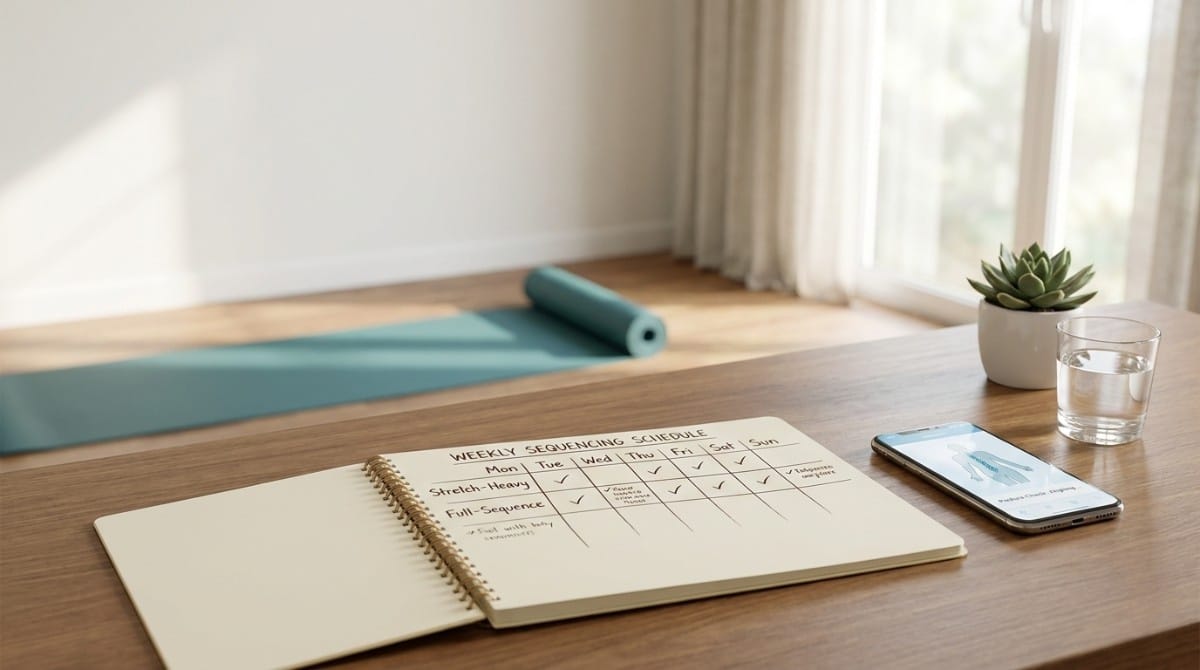
Why Do Some People Get Faster Results With Less Volume?
The answer is almost always sequencing. Two people doing the same exercises for the same number of minutes will see different results based on ordering.
Better-sequenced person:
- Warms up, stretches, activates, strengthens, cools down.
- Progresses through phases as the body adapts.
- Sees visible change at week 4–6.
Worse-sequenced person:
- Strengthens cold, then stretches when sore.
- Stays in one phase for months.
- Plateaus at week 4 and quits.
Same effort. Different order. Different outcome.
Lifestyle Habits That Support Good Sequencing
A few habits that make ordering easier:
- Schedule the routine at the same time daily, ideally morning or post-workday.
- Pair each session with a posture cue you actually see (note on monitor, phone wallpaper).
- Keep a simple log: "stretch days" vs "full sequence days."
- Avoid stacking the routine after intense workouts; tired tissue compromises form.
- Walk daily; movement primes the body for sequenced sessions.
If you want personalized sequencing without guesswork, Backed AI scans your posture using your phone camera, identifies which phase your body needs most, and adapts the order automatically as you progress through the weeks.
Final Takeaway
Stretching and strengthening are not rivals. They are stages in a sequence, and the order is what makes a routine work or fail. Inside a single session: warm up, stretch, activate, strengthen, reset. Across weeks: start mobility-heavy, progressively shift to strengthening-heavy. Match your phase to where your body actually is, not where you wish it was.
A routine done in the right order with fewer exercises will outperform a longer routine done in the wrong order, every time. Get the sequence right, and the hump finally gives up the ground it has been holding for years.
Why Most Recovery Plans Get the Order Wrong
Most generic neck hump plans give you a list of exercises with no sequencing logic. The reasons it fails repeat:
- No phase awareness. A plan that works in week 1 is wrong by week 5.
- No personalization. Your dominant driver decides the order, not a generic template.
- No form feedback. Doing a strengthening move with bad form reinforces the wrong pattern.
- No progression cues. Without signals to advance, you stay stuck in one phase forever.
A Smarter Way to Sequence Your Recovery
Backed AI was built to solve the sequencing problem. It scans your posture using your phone camera, identifies whether your hump is mostly chest tightness, thoracic stiffness, or weak postural muscles, and orders your routine accordingly. As your body adapts, the app shifts the ratio of stretching to strengthening for you.
What you get:
- 📱 Personalized sequencing based on your actual posture scan, not a generic template
- 🎯 AI form guidance so each move targets the right tissue in the right order
- 📈 Progress tracking that signals when to advance to the next phase
It removes the single biggest reason people stall: doing the right work in the wrong order.
👉 Download Backed AI and start fixing your neck hump in the right order today.
FAQ
Q1. Should I stretch or strengthen first for a neck hump?
Stretch first, then strengthen. Stretching opens range of motion in tight tissue; strengthening holds the new range in place. Doing them in reverse loads a shortened pattern and reinforces the hump.
Q2. Can I just stretch and skip strengthening?
No. Stretching alone produces short-term looseness but no lasting structural change. Without strengthening, the body re-tightens to its only available support pattern, which is the hump itself.
Q3. How long should I stay in the stretch-only phase?
About 1–2 weeks for most adults. Then add light activation for 2 weeks, then progressively layer in strengthening from week 5 onward.
Q4. What's the right ratio of stretching to strengthening?
It changes by phase. Weeks 1–2: 80% stretch / 20% activation. Weeks 3–4: 50/50. Weeks 5+: 30% stretch / 70% strengthen.
Q5. Can I do stretches in the morning and strengthening at night?
Yes, this is a great split. Morning is ideal for mobility because the body is stiffest. Evening works well for strengthening because tissue is warm from daily movement.