
Pillow Choice and Dowager's Hump: How Your Sleep Setup Either Heals or Hurts Your Posture 💙

You spend roughly a third of your life in bed. If your pillow, mattress, and sleep position are working against your cervical spine, you are quietly undoing the daily stretching and strengthening you do for your dowager's hump. The right setup, on the other hand, becomes a silent eight-hour partner in your recovery.
This guide breaks down which pillow, mattress, and sleep position actually help reduce a dowager's hump, and which ones make it worse without you realizing.
🧠 TL;DR
- A bad sleep setup can erase 8 hours of cervical recovery every single night.
- One supportive pillow at the right height beats two stacked pillows by a wide margin.
- Side and back sleeping support neutral cervical alignment; face-down sleeping does not.
- Memory foam or contour pillows usually work better than soft, flat traditional pillows.
- Mattress firmness should support, not sink. Very soft mattresses worsen alignment.
- Even the best routine plateaus if your sleep setup keeps re-creating the hump nightly.
- Small setup changes produce visible results in 2–4 weeks for most adults.
What Is a "Sleep Setup" for Dowager's Hump?
A sleep setup for dowager's hump is the combination of pillow type, pillow height, sleep position, and mattress firmness that keeps the cervical spine in neutral alignment for 6–8 hours each night, allowing the hump to soften rather than reinforcing the forward-curved pattern.
Think of it as the passive half of recovery. Your daily stretches are the active inputs; your sleep setup is what your body does with that work overnight. The Backed AI complete neck hump recovery guide covers the full framework; this article goes deep on the sleep environment piece.
Why Does Your Sleep Setup Matter So Much for Dowager's Hump?
Three things compound across 6–8 hours of sleep:
- Static positioning. Whatever shape you sleep in, your tissues adapt to.
- Long duration. Eight hours is longer than any other single position you hold each day.
- No feedback. You cannot consciously correct posture while asleep.
Posture specialists suggest that sleep setup is the most underestimated lever in dowager's hump recovery. People obsess over their stretches and ignore the eight-hour position that often built the hump in the first place.
💡 Key Insight: Your sleep setup is doing more for or against your hump than any single exercise you do. Get the setup right, and your daily routine compounds. Get it wrong, and you spend half your effort just maintaining ground.
How to Choose the Right Pillow for a Dowager's Hump
A practical breakdown by sleep style:
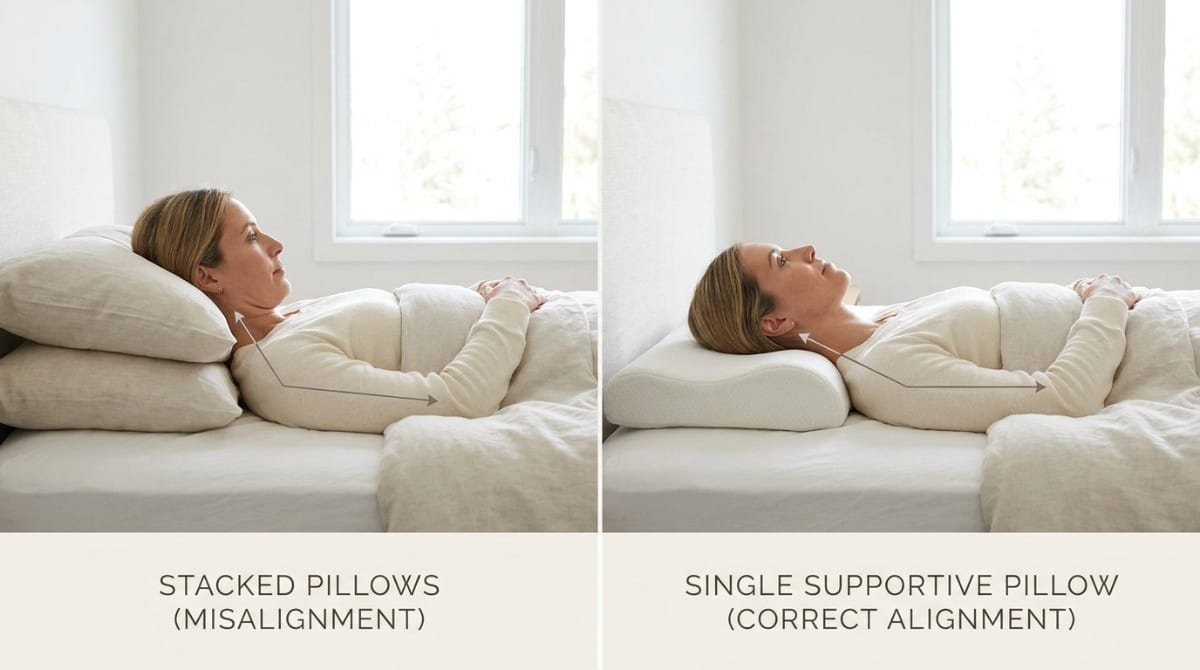
The principle is simple: the pillow should fill the gap between your head and the mattress so your neck stays in line with the rest of the spine. Too tall pushes the head forward (worsens hump). Too flat lets the head drop back (strains the cervical spine).
What Is the Best Sleep Position for Dowager's Hump?
A clear ranking based on cervical alignment:
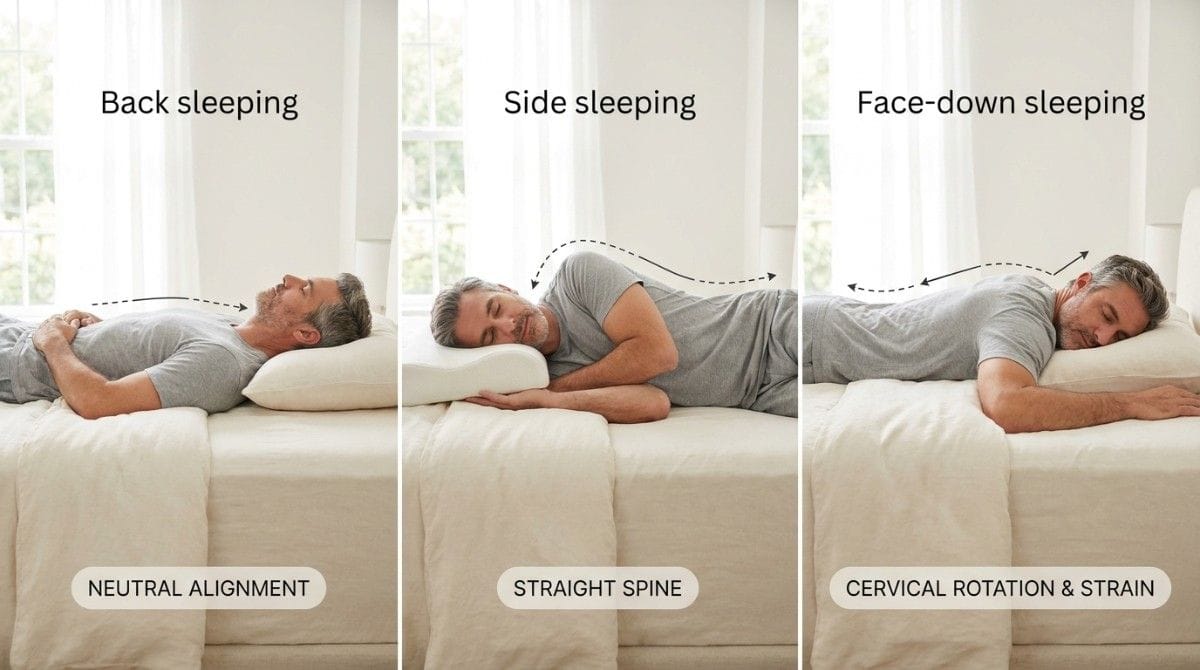
- Back sleeping with one supportive pillow – Best for cervical neutrality and even spine loading.
- Side sleeping with a contour pillow – A close second; supports the head and fills the shoulder gap.
- Side sleeping with a pillow between the knees – Adds full-body alignment benefit.
- Combination sleeping – Acceptable if your pillow adapts to both positions.
- Face-down sleeping – Worst for cervical alignment. Forces 6+ hours of neck rotation.
If you currently sleep face-down, switching is worth the temporary discomfort. Pair the new position with the gentle in-bed stretch routine to ease the transition.
Best Pillow Materials for Dowager's Hump (Quick List) 🛏️
A short list of materials that consistently support cervical alignment:
- Memory foam (medium-firm) – Conforms to the head and neck without flattening over time.
- Latex – Natural, supportive, and breathable. Holds shape well across years.
- Contour cervical pillow – Specifically designed with a curve that supports the neck.
- Buckwheat hull pillow – Adjustable fill, naturally cooling, firm support.
- Hybrid foam pillows – Combine memory foam and cooling gel for support without heat retention.
Materials to avoid for postural recovery: very soft down pillows that flatten under the head, old polyester pillows that have lost loft, and ultra-thick pillows marketed for "luxury" rather than cervical support.
How To Build the Right Sleep Setup (Step-by-Step Recovery Framework)
A practical phasing structure that does not require buying everything at once:
The whole upgrade can be done with one new pillow and a body pillow, often under the cost of two months of physiotherapy.
Common Sleep Setup Mistakes That Slow Progress 🚫
- Stacking two pillows. Six hours of forward neck flexion every night.
- Sleeping with your phone on the pillow. Often pulls the head into a side rotation pattern.
- Using the same pillow for over 3 years. Lost loft means lost support.
- A mattress that is too soft. Causes the spine to sag and the head to drop.
- Sleeping with arms overhead. Stresses the rotator cuff and reinforces shoulder tightness.
- Watching TV in bed propped on pillows for hours. Same forward-head pattern as desk work, just in bed.
What Happens If You Ignore Your Sleep Setup?
Your daily stretching becomes a treadmill. You make small gains during the day; your sleep setup erases them at night. People in this loop often plateau at week 4–6 and conclude their routine is not working. The actual issue is environmental.
Fixing sleep setup typically restores progress within 2–4 weeks. The same long-term cycle issue is described in why issues like this keep coming back, applied here to the cervical spine.
Why Does a Bad Pillow Build a Hump Faster?
It is the duration. Every hour your head sits forward of your shoulders, the deep neck flexors weaken and the soft tissue at the base of the neck thickens. A bad pillow stacks 6–8 hours of that exact pattern, every single night, for years. Combined with daytime forward-head posture, it explains why dowager's humps form gradually but steadily across decades. The closely-linked pattern of rounded shoulders and forward head posture is reinforced overnight in the same way.
When This Approach Doesn't Work
A perfect sleep setup is highly effective for postural dowager's hump. It is not enough on its own when:
- The hump is from a hormonal fat deposit (Cushing's, certain medications)
- Severe osteoporosis has caused vertebral compression
- The hump appeared rapidly with no postural change
- You experience numbness, tingling, or sharp pain that interferes with sleep
In those cases, see a clinician first. For everyone else, sleep setup is one of the highest-leverage, lowest-effort changes you can make.
Research & Expert Insight 🔬
Research in musculoskeletal rehab shows that cervical alignment during sleep significantly affects daytime neck pain, stiffness, and postural alignment scores. Physiotherapists often recommend a single supportive pillow with cervical contour as a baseline upgrade for adults with forward head posture and dowager's hump. The pattern across studies is consistent: combining sleep environment changes with daytime mobility produces faster recovery than mobility work alone.
Lifestyle Habits That Multiply Sleep Setup Results
A few habits that compound a good sleep setup:
- Stop screen use 30 minutes before bed. Phones at chin level reinforce the hump even at night.
- Do 5 minutes of gentle bed stretches before sleep.
- Stretch chest in the morning to reset what sleep cannot fully fix.
- Keep the bedroom cool. Better sleep means better tissue recovery.
- Replace your pillow every 2–3 years. Loft fades quietly.
If you want personalized cueing on whether your current setup is working, Backed AI scans your posture using your phone camera and identifies whether your overnight position is helping or hurting your hump. It also adapts your daytime routine to account for what your sleep setup is doing.
Final Takeaway
Sleep setup is not a small detail. It is one third of your day, and for adults with a dowager's hump, it is the single largest passive lever you have. Switch to one supportive pillow at the right height, train yourself toward back or side sleeping, check your mattress for sag, and the hump finally has 24 hours of opposition rather than 16.
The fix is not exotic, expensive, or complicated. It is one good pillow, the right position, and consistency. In a few weeks, you will notice less morning stiffness, easier neck movement, and a posture that feels better not just after stretching, but immediately on waking.
Why Most Recovery Plans Ignore Sleep
Most generic neck hump plans focus entirely on the daytime: exercises, stretches, posture cues. Sleep gets one bullet point about pillows and is then forgotten. The reasons it costs people progress repeat:
- No personalization. A generic pillow recommendation ignores your sleep style and body shape.
- No feedback. You cannot see what your spine is doing for 8 hours overnight.
- No environmental tracking. Most plans treat the sleep setup as fixed instead of adjustable.
- No integration. Daytime routines and overnight setups are usually treated as separate problems.
A Smarter Way to Use Sleep for Dowager's Hump Recovery
Backed AI was built to integrate the full 24 hours of posture, not just the waking ones. It scans your alignment using your phone camera, asks about your sleep position and pillow, and builds a recovery routine that accounts for what your overnight setup is doing.
What you get:
- 📱 Personalized recovery routines that integrate daytime and sleep environment factors
- 🎯 AI form guidance so daytime work targets the right tissue
- 📈 Progress tracking that shows visible alignment changes over weeks of consistent practice
It is the simplest way to make sure your hump is being worked on for 24 hours a day, not just the waking 16.
👉 Download Backed AI and start fixing your dowager's hump around the clock today.
FAQ
Q1. What kind of pillow is best for a dowager's hump?
A medium-firm contour or memory foam pillow that supports the natural curve of the cervical spine. Side sleepers need 4–6 inches of height to fill the shoulder gap; back sleepers need 3–4 inches.
Q2. Is it bad to sleep with two pillows if I have a dowager's hump?
Yes. Stacked pillows push the head forward for 6–8 hours nightly, reinforcing the same forward-head pattern that creates a dowager's hump. One supportive pillow at the right height is consistently better.
Q3. What is the best sleep position for reducing a neck hump?
Back sleeping with one supportive pillow is the best for cervical neutrality. Side sleeping with a contour pillow is a close second. Face-down sleeping is the worst because it forces hours of cervical rotation.
Q4. How often should I replace my pillow?
Every 2–3 years for most pillow types. Memory foam and latex can last slightly longer. A pillow that has lost its loft no longer supports cervical alignment.
Q5. Can fixing my sleep setup alone reverse a dowager's hump?
Not on its own, but it removes the biggest passive driver. Combined with daytime stretching and strengthening, fixing sleep setup typically accelerates visible change by several weeks.