
How Long Does It Take to Reverse a Neck Hump with Stretching? An Honest, Week-by-Week Timeline 💙

Most people want a number. Two weeks? Six? Six months? The honest answer depends on how long the hump has been there, how consistent your routine is, and which drivers are most active in your body. But there is a reliable timeline most adults can expect, and it is more encouraging than you think.
This guide walks you through what changes in week 1, week 4, week 8, and beyond, the milestones to look for, and why some people see results faster than others.
🧠 TL;DR
- Most adults notice less stiffness within 1–2 weeks of daily stretching.
- Visible posture improvement usually appears at 4–6 weeks.
- Significant softening of the hump itself takes 8–12 weeks of consistent work.
- Long-standing humps (5+ years) may need 4–6 months for major change.
- Stretching alone helps; stretching plus strengthening works faster.
- Daily 8–12 minute sessions outperform long weekly workouts.
- Skipping 2–3 days a week roughly doubles the timeline.
What Does "Reversing a Neck Hump" Actually Mean?
Reversing a neck hump means progressively reducing the forward curvature at the base of the neck by mobilizing the thoracic spine, lengthening the chest, strengthening postural muscles, and retraining the head to sit over the shoulders rather than in front of them.
It is not a binary on-off result. It is a gradual softening. The hump does not disappear in one moment; it shrinks across visible milestones. The Backed AI complete neck hump recovery guide breaks down each driver in detail.
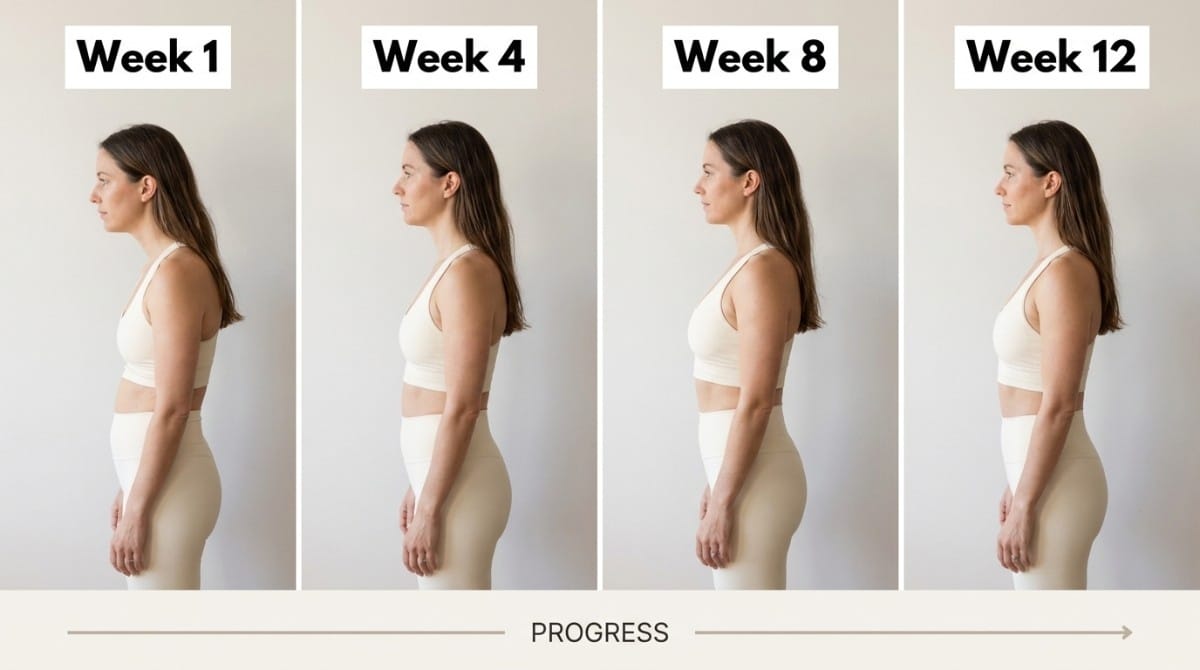
The Honest Week-by-Week Timeline
What most adults can expect with a consistent daily stretching routine:
| Phase | Timeline | What You'll Feel | What You'll See |
|---|---|---|---|
| Phase 1 – Early Relief | Week 1–2 | Less morning stiffness, easier head movement | Minimal visible change |
| Phase 2 – Soft-Tissue Release | Week 3–4 | Looser chest, deeper breathing, less neck tension | Subtle posture lift, especially in photos |
| Phase 3 – Visible Change | Week 5–8 | Easier upright posture, less fatigue at end of day | Clearly improved alignment, hump begins softening |
| Phase 4 – Structural Shift | Week 9–16 | Posture starts to feel automatic | Visible reduction in hump curvature |
| Phase 5 – Long-Term Maintenance | Month 4+ | Posture holds without conscious effort | Continued refinement, fewer regressions |
💡 Key Insight: The hump took years to build, but the soft-tissue and joint changes that drive it can begin to reverse in days. Visible change lags behind tissue change by about 3–4 weeks. This is why people often quit just before results appear.
Why Does Stretching Take Time to Work?
Three slow processes are happening underneath the surface:
- Soft-tissue remodeling. Tight fascia and shortened muscles need repeated input over weeks to lengthen.
- Joint mobility return. Stiff thoracic vertebrae take time to regain segmental movement.
- Neuromuscular retraining. Your nervous system has to relearn what "neutral" feels like.
Posture specialists suggest that the slowest of the three, neuromuscular retraining, is what makes posture changes durable. Quick fixes feel good for a day; structural change holds for years.
What Changes in Each Phase (Quick List) 📅
A clearer view of what you can expect at each milestone:
- Week 1 – Less stiffness when waking up, easier neck rotation, mild soreness in upper back from new mobility work.
- Week 2 – Chest feels more open, breathing slightly deeper, end-of-day neck fatigue reduced.
- Week 4 – Friends or family may notice you "look a bit taller." Side-profile photos show subtle change.
- Week 6 – Posture feels easier to maintain without conscious effort. The hump is visibly softer.
- Week 8 – Side-profile comparison photos show clear improvement. Less mid-back tightness.
- Week 12 – Major visible softening of the hump. Posture begins to feel automatic.
- Month 4–6 – Long-standing humps significantly reduced. Maintenance routine takes over.
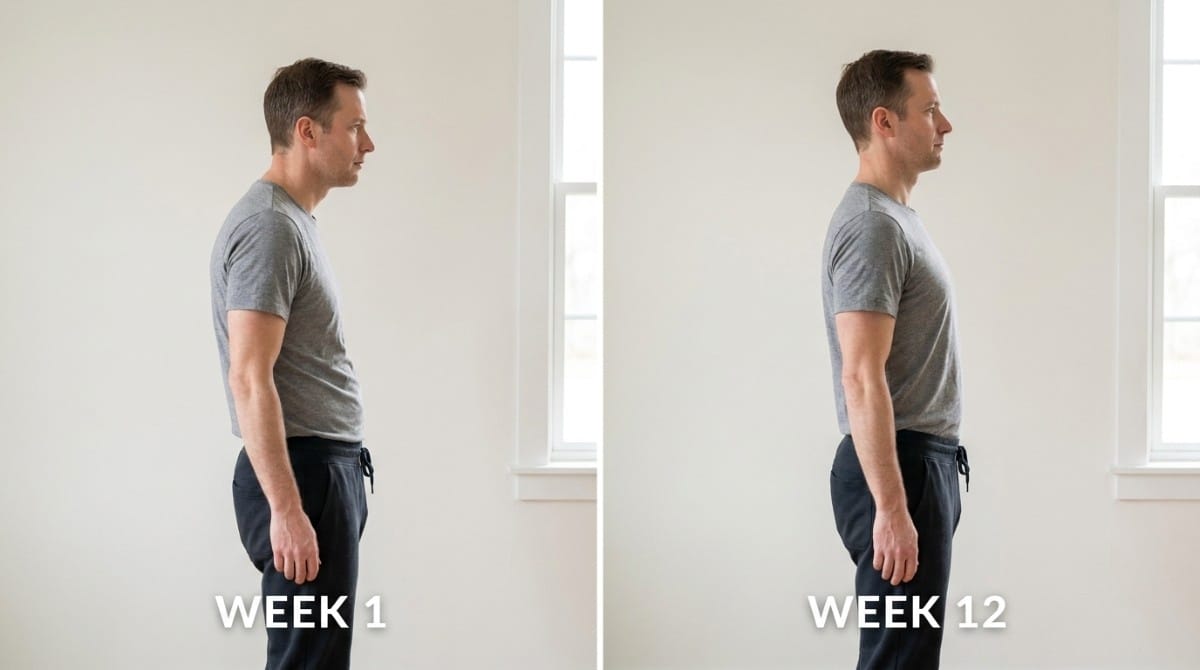
What Affects Your Personal Timeline?
Three big variables explain why two people doing the same stretches see different results at different speeds:
| Factor | Faster Timeline | Slower Timeline |
|---|---|---|
| Age | 20s–30s | 60s+ |
| How long the hump has existed | Under 2 years | Over 5 years |
| Daily consistency | 5–6 days/week | 2–3 days/week |
| Routine completeness | Stretch + strengthen | Stretch only |
| Lifestyle factors | Active job, screen breaks | Sedentary, all-day screens |
| Sleep position | One supportive pillow | Two stacked pillows or face-down |
| Stress & posture awareness | High awareness | Low awareness |
This is also why combined patterns like rounded shoulders alongside forward head posture often take longer to fully reverse, since two patterns are reinforcing each other.
Why Do Some People See Results in 4 Weeks and Others Take 4 Months?
It comes down to four things stacking together:
- The age of the hump. A two-year postural hump softens fast. A 15-year hump takes longer.
- Daily input. Skipping days roughly doubles your timeline.
- Whether you only stretch or also strengthen. Stretching alone has a ceiling.
- Whether you reset lifestyle drivers. A perfect routine plus 10 hours of forward sitting daily creates a tug-of-war.
For desk workers especially, the lifestyle factor is huge. The same pattern that drives the hump also drives common desk-work issues, which is why combining mobility work with the kind of strategy laid out in the 15-minute daily desk worker posture routine tends to produce faster results than stretching alone.
Common Reasons People Don't See Results in the Expected Timeline 🚫
- Quitting at week 3. Most visible change appears in week 4–6. People stop right before payoff.
- Stretching only the neck. Without addressing chest and thoracic spine, change stalls.
- Doing the routine but never adjusting their workstation. You undo the work in 20 minutes of bad posture.
- Inconsistent practice. Two days on, three days off, then a week off. Tissue does not adapt.
- Skipping strengthening. Stretching opens range; strengthening holds it.
- Sleeping with two stacked pillows. Eight hours of forward neck flexion every night.
What Happens If You Stop Stretching?
Most progress holds for 2–4 weeks after stopping, then slowly reverses unless replaced with an active lifestyle. The hump is essentially a tug-of-war between your daily posture habits and your daily mobility work. Stop the mobility work, and the daily habits win again. This is the same long-term cycle issue described in why back pain keeps coming back, applied to the cervical spine.
When This Approach Doesn't Work
The timelines above apply to postural neck humps. They do not apply when:
- The hump is from a hormonal fat deposit (Cushing's, certain medications)
- Severe osteoporosis has caused vertebral compression
- A bony spinal abnormality is the cause
- The hump appeared rapidly with no postural change
In those cases, see a clinician. For everyone else, the timeline is reliable enough that you can plan around it.
Research & Expert Insight 🔬
Research in musculoskeletal rehab shows that consistent daily mobility work targeting the thoracic spine and chest produces measurable cervical alignment improvements in as little as 8 weeks. Physiotherapists often recommend a 12-week timeline for visible change because that aligns with the typical soft-tissue and neuromuscular adaptation window. The pattern across the literature is consistent: short, frequent, multi-modal sessions (stretch + strengthen + posture cues) outperform single-modality routines.
How to Speed Up Your Timeline
Five compounding levers, ranked from highest impact to lowest:
- Add light upper-back strengthening twice a week. The single biggest accelerator.
- Raise your monitor to eye level. Removes the daily driver of regression.
- Insert posture breaks every 60–90 minutes. Stops static collapse.
- Sleep with one supportive pillow. Eight hours matters.
- Track progress with side-profile photos every two weeks. Visible evidence prevents premature quitting.
For consistent progress without guesswork, Backed AI scans your posture using your phone camera, identifies which driver of your hump is dominant, and builds a routine tuned to your specific imbalance. It also tracks alignment changes over time, so you can see progress objectively rather than guessing.
Final Takeaway
A neck hump driven by posture responds to consistent daily stretching on a reliable timeline: less stiffness in 1–2 weeks, visible posture change at 4–6 weeks, clear softening of the hump at 8–12 weeks, and continued refinement past month four. The biggest variable is consistency, not intensity. Five short daily sessions beat one long weekly one every time.
If you are at the start of this journey, the most important thing to know is this: visible change lags real change by about three to four weeks. Trust the early invisible progress and keep going. By the time you can see it, your body has already been changing for weeks.
Why Most Recovery Plans Fail Before the Timeline Plays Out
Most people quit their stretching routine somewhere between week 2 and week 4. The reasons repeat:
- No visible feedback. Tissue is changing; the mirror shows nothing yet.
- No personalization. A generic plan doesn't match your specific imbalance.
- No form correction. Compensations build silently and slow progress.
- No tracking. Without progress markers, motivation collapses.
A Smarter Way to Reverse Your Neck Hump
Backed AI was built for exactly this gap between effort and visible feedback. It scans your posture using your phone camera, identifies which drivers of neck hump are most active in your body, and builds a personalized routine you can complete in 8–12 minutes a day. It then tracks your alignment over weeks, so you can see real change long before the mirror does.
What you get:
- 📱 Personalized routines based on your actual posture scan, not a generic template
- 🎯 AI form guidance so each move targets the right tissue
- 📈 Progress tracking that shows visible alignment changes over weeks of consistent practice
It removes the biggest reason people quit: the invisible middle weeks where tissue is changing but the mirror hasn't caught up yet.
👉 Download Backed AI and start tracking real progress on your neck hump today.
FAQ
Q1. How long does it really take to fix a neck hump with stretching? Most adults see less stiffness within 1–2 weeks, visible posture improvement at 4–6 weeks, and clear softening of the hump itself at 8–12 weeks. Long-standing humps may take 4–6 months for major change.
Q2. Can a neck hump be fully reversed? Postural neck humps can be substantially reversed with consistent daily stretching, strengthening, and posture awareness. Structural changes from osteoporosis or fat deposits cannot be fully reversed by exercise alone.
Q3. Why isn't my neck hump getting better after 4 weeks? The most common reasons are stretching only (no strengthening), inconsistent practice, ignoring lifestyle drivers like screen height, and quitting just before visible change appears at week 4–6.
Q4. Will I see results faster if I stretch twice a day? Slightly, but consistency matters more than volume. One focused 8–12 minute session daily, done 5–6 days a week, outperforms two rushed sessions done sporadically.
Q5. Can older adults still reverse a neck hump? Yes, though the timeline is longer. Most older adults see meaningful softening within 8–12 weeks of gentle daily mobility work. The improvement is real, even if slower than in younger adults.