
Best Sciatica Stretches for Desk Workers: The Nerve-Friendly Routine You Can Do at Your Desk

The best sciatica stretches for desk workers target the piriformis, the sciatic nerve, and the hips and glutes that tighten from sitting. 🪑 Most can be done right at your desk, in normal clothes, in under a minute each.
Done a few times a day, they take pressure off the nerve before a long sitting block turns into a flare.
TL;DR
- 🦵 Sciatica is leg-dominant pain that runs from the buttock down the leg.
- 🪑 Sitting all day tightens the piriformis and switches off the glutes.
- 🧘 The most useful stretches release the piriformis and gently floss the nerve.
- ⏱️ Short and frequent beats long and occasional.
- ⚠️ Stretch gently, never into sharp or shooting pain.
- 💪 Pair stretching with glute work for lasting relief.
What Causes Sciatica in Desk Workers?
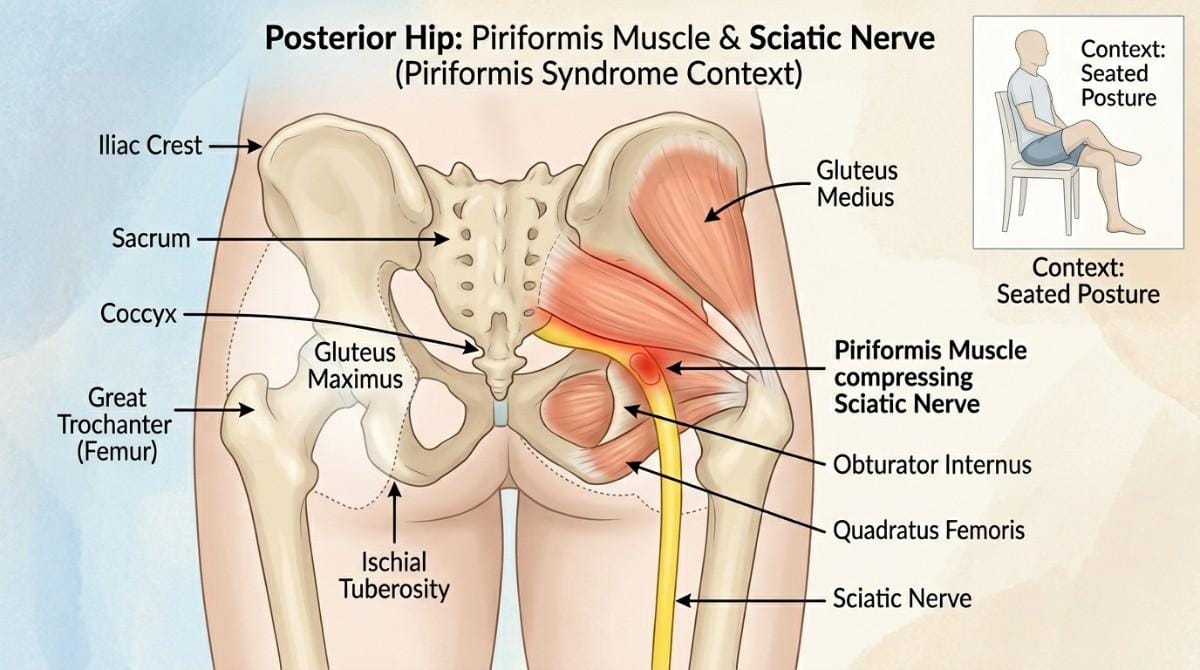
Sciatica in desk workers is irritation of the sciatic nerve caused by prolonged sitting, a tightened piriformis muscle, and weakened glutes, producing pain that travels from the buttock down the leg.
Sitting presses your weight onto the buttock, right over the nerve. Over hours, the piriformis (a deep buttock muscle sitting on top of the nerve) shortens and squeezes. The glutes go quiet, so the area loses support.
If you are still unsure whether sitting is the trigger, the mechanism is broken down in whether you can get sciatica from sitting too much. Stretching is how you fight back during the day.
Do Stretches Actually Help Sciatica?
Yes, for the common desk-worker pattern. When sciatica comes from a tight piriformis and stiff hips, targeted stretching can ease the pressure on the nerve.
But there is a rule: stretch gently. Sciatica is a nerve issue, and forcing a stretch can irritate the nerve instead of calming it.
🔑 Key Insight: With sciatica, less is more. A gentle stretch held calmly does more than an aggressive one that makes your leg buzz. If it shoots, ease off.
For the seating side of the equation, pair these moves with the setup in how to sit without flaring sciatica.
| Stretch type | What it targets | Where to do it |
|---|---|---|
| Figure-4 (seated, standing, lying) | Piriformis over the nerve | Desk, standing, home ✅ |
| Sciatic nerve glide | The nerve itself | At your desk ✅ |
| Hip flexor stretch | Front of the hip | Standing by the desk ✅ |
| Glute activation | Support muscles | Anywhere ✅ |
| Gentle spinal twist | Lower back mobility | At your desk ✅ |
Pick one seated stretch and do it every time you finish a meeting. Backed AI can remind you so the habit builds itself.
Best Sciatica Stretches for Desk Workers (Quick List)
Organized by where you can do them. Start gently, breathe, and stop if pain sharply increases.
At your desk (in normal clothes)
- Seated figure-4. Cross one ankle over the opposite knee, sit tall, hinge forward slightly. Releases the piriformis. Hold 30 seconds per side.
- Sciatic nerve glide. Sit tall, slowly straighten one leg and flex the foot, then lower. Gently mobilizes the nerve. 10 slow, easy reps per side.
- Seated spinal twist. Sit tall, rotate gently toward one side using the chair for support. Eases lower back tension. Hold 20 seconds per side.
Standing by your desk
- Standing figure-4. Cross one ankle over the opposite knee and sit back into a mini squat, holding the desk. A deeper piriformis release. Hold 30 seconds per side.
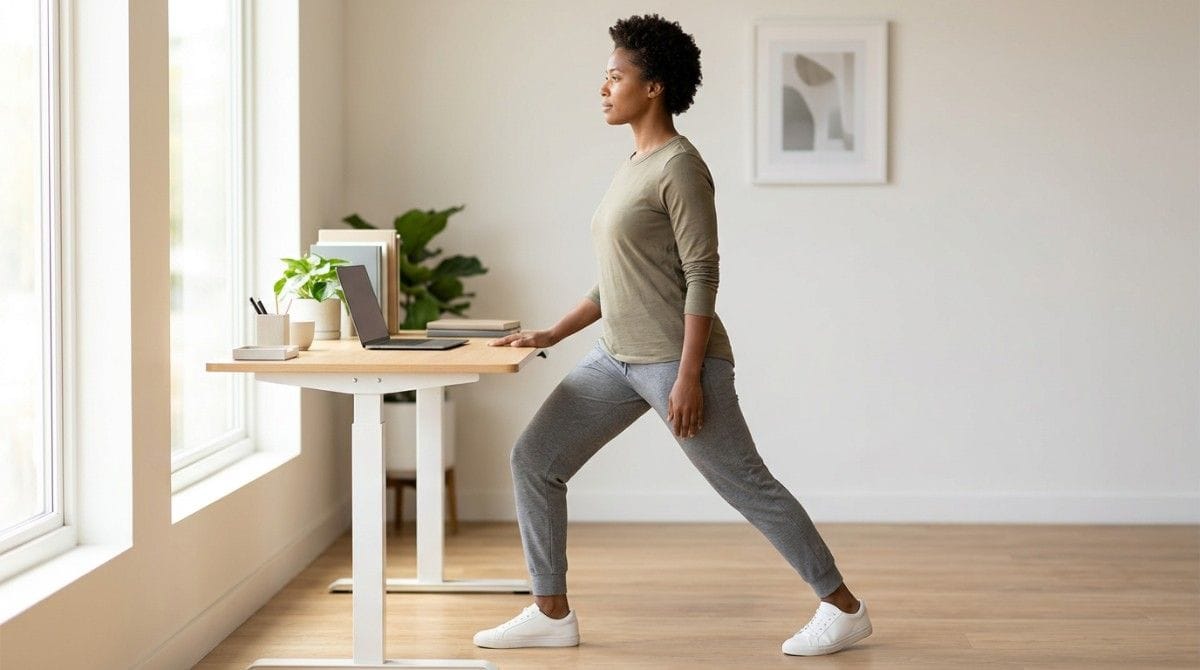
- Standing hip flexor stretch. Step one foot back and ease the hip forward. Loosens the front of the hip. 30 seconds per side.
- Standing glute squeeze. Squeeze both glutes for 5 seconds, release. Reactivates support muscles. 8 reps.
At home for a deeper release
- Lying figure-4 (supine pigeon). On your back, cross one ankle over the knee and draw the thigh gently toward you. The classic deep piriformis stretch. Hold 30 seconds per side.
- Single knee-to-chest. Lying down, draw one knee gently toward the chest. Eases buttock and lower back tension. Hold 30 seconds per side.
Physiotherapists often recommend leading with the piriformis and nerve work, then adding glute strength, because releasing without rebuilding support tends to let the pain return.


How to Build Them Into Your Workday
Posture specialists suggest spreading small doses through the day rather than one long session. Here is a simple structure.
Morning – Prime. Before you sit down, do one standing figure-4 and a glute squeeze to wake the hips.
Every hour – Release. Pick one desk stretch from the list. Rotate which one so you cover the piriformis, the nerve, and the spine across the day.
Midday – Reset. Stand for a hip flexor stretch and a short walk. Pair it with the glute work in glute activation exercises after sitting all day so the hips stop leaning on the nerve.
Evening – Decompress. Do the lying figure-4 and knee-to-chest on the floor for a deeper release.
This layered approach usually brings noticeable relief within 1 to 2 weeks, with fuller calm over 4 to 8 weeks. If your hips feel chronically locked, the deeper pattern is covered in the tight hips and lower back pain connection.
If remembering all this feels like another job, Backed AI scans your posture and builds the routine and reminders around your actual pattern, so you just follow along.
Mistakes That Make Sciatica Stretches Backfire
Stretching helps, but a few common errors can make sciatica worse.
- Forcing the stretch. Pushing into shooting pain irritates the nerve. Keep it gentle.
- Aggressive hamstring stretches. Hard hamstring stretching can tension the sciatic nerve. Go easy here.
- Stretching only, never strengthening. Without glute support, the relief is temporary.
- Holding your breath. Tension blocks the release. Breathe slowly throughout.
- Doing it once a day. Sitting repeats all day, so your stretches should too.
A good companion is a broader daily reset like the 15-minute posture routine for desk workers, which keeps the whole chain mobile, not just the hips.
When Stretching Isn't Enough
Stretching helps most desk-worker sciatica. But some cases need a professional. See a doctor if:
- Pain is severe, constant, or steadily worsening.
- You have leg weakness, numbness, or "foot drop."
- You lose bladder or bowel control (seek urgent care).
- Symptoms began after a fall or sudden injury.
- There is no improvement after 6 to 8 weeks of consistent effort.
These can point to a structural cause like a herniated disc or stenosis, which needs imaging and clinical care, not stretching alone.
Research & Expert Insight
Research in musculoskeletal rehab points to a few consistent themes.
- Piriformis matters. Posture specialists frequently identify a tight piriformis as a common, non-structural driver of sciatic-type pain in people who sit a lot.
- Gentle wins. Studies on nerve mobilization suggest gentle, controlled movement calms nerve-related pain better than aggressive stretching.
- Movement beats rest. Gentle activity is repeatedly linked with better short-term relief for sciatic-type pain than strict rest.
The pattern is steady: release the muscle, mobilize the nerve gently, support it with strength, and keep moving.
Final Takeaway
The best sciatica stretches for desk workers are not complicated. They are the piriformis releases, gentle nerve glides, and hip openers you can do at your desk, repeated through the day. Add glute strength so the relief sticks. Keep every stretch gentle, because with a nerve, calm beats force. Do this consistently and most desk workers feel real relief within a few weeks.
The routine is simple. The win is in doing a little, often.
Why Most Sciatica Routines Fail
People bookmark a stretch list, do it twice, and quietly stop. Here is why generic routines fall short:
- No personalization. Your sciatica may be piriformis-driven, hip-driven, or posture-driven. A generic list treats everyone the same.
- No form feedback. A figure-4 done wrong can miss the nerve or aggravate it.
- No progression. The same stretch at the same intensity stops working after week one.
- No consistency system. Sitting repeats 8 hours a day. Random stretching cannot keep up.
A Smarter Way to Stretch and Recover
Backed AI is built for this exact gap. Instead of guessing, you get a plan shaped around your body.
- 📸 AI posture scan spots your specific imbalance using your phone camera.
- 🎯 Personalized program targets your piriformis, hips, and glutes, not a one-size-fits-all list.
- 🔔 Habit reminders prompt you to stretch before a long sitting block turns into a flare.
The longer the seated pattern locks in, the more consistency it takes to undo. Starting now is the easiest version of the fix.
Download Backed AI and start correcting your posture today. 💙
FAQ
What are the best sciatica stretches for desk workers? The most effective are the seated and lying figure-4 for the piriformis, gentle sciatic nerve glides, standing hip flexor stretches, and glute activation. Most can be done at your desk.
How often should desk workers stretch for sciatica? Little and often works best. Aim for one short stretch every hour you sit, plus a deeper session in the evening.
Can stretching make sciatica worse? It can if you force it. Aggressive stretching or hard hamstring stretches can irritate the nerve. Keep every stretch gentle and stop before sharp pain.
How long until sciatica stretches start working? Most desk workers notice relief within 1 to 2 weeks of consistent, gentle stretching, with fuller improvement over 4 to 8 weeks.
Do I need to strengthen as well as stretch? Yes. Stretching releases the piriformis, but glute strength gives the nerve lasting support. Combining both prevents the pain from returning.