Sitting vs Standing With Sciatica: Which Is Worse (and Why It Depends)
Neither sitting nor standing is universally worse for sciatica. ⚖️ It depends on what is irritating your sciatic nerve. For many people sitting flares it, for some standing does, and for almost everyone, gentle walking helps more than holding either position too long.
The real fix is not picking a side. It is learning which position calms your nerve and changing position often.
TL;DR
- 🦵 Sciatica is leg-dominant pain that runs from the buttock down the leg.
- 🪑 Sitting often flares disc-related sciatica, especially when slouched.
- 🧍 Standing can flare other patterns and tighten the hips and glutes.
- 🚶 Walking and frequent movement usually beat holding any one position.
- 🔁 The best position is the one that eases your specific pain, switched often.
- ⏱️ Change position every 20 to 30 minutes during a flare.
What's the Difference Between Sitting and Standing for Sciatica?
Sciatica is irritation of the sciatic nerve that causes pain, tingling, or numbness from the lower back or buttock down one leg, and sitting and standing each load that nerve in different ways.
Sitting bends the lower spine forward and presses weight onto the buttock, right over the nerve. Standing extends the spine and shifts load onto the hips and lower back instead.
That difference is why two people with sciatica can give opposite answers about what hurts. If you want the full mechanism behind seated flares, start with whether you can get sciatica from sitting too much.
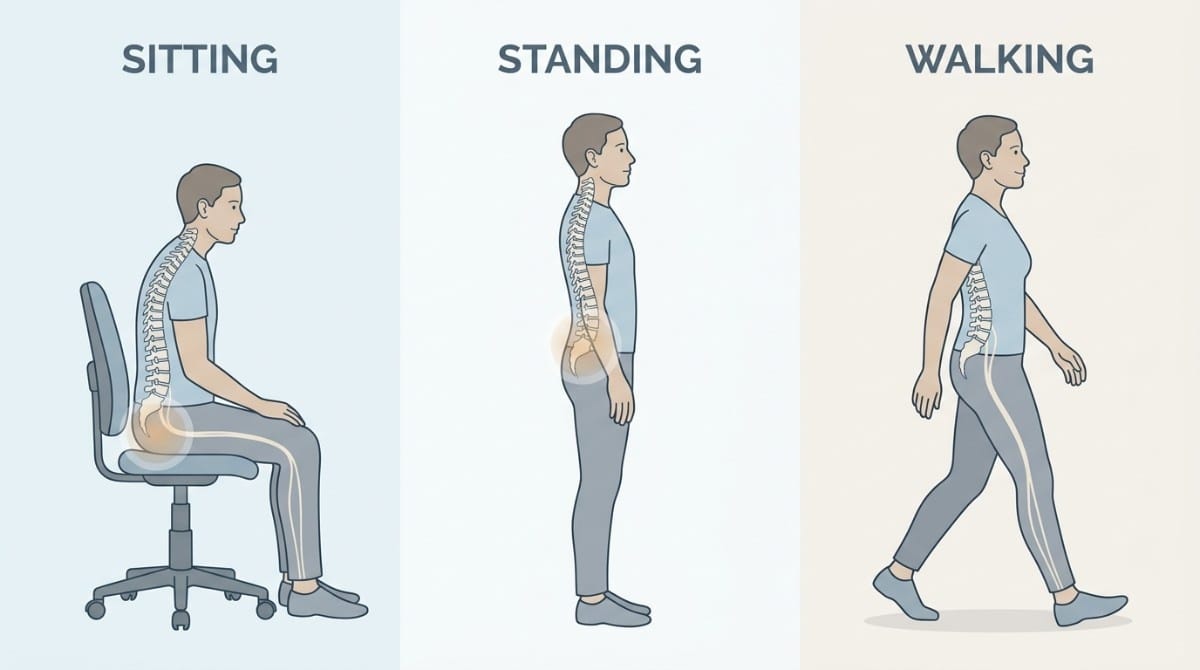
Is Sitting or Standing Worse for Sciatica?
Here is the honest answer: it depends on the pattern behind your sciatica.
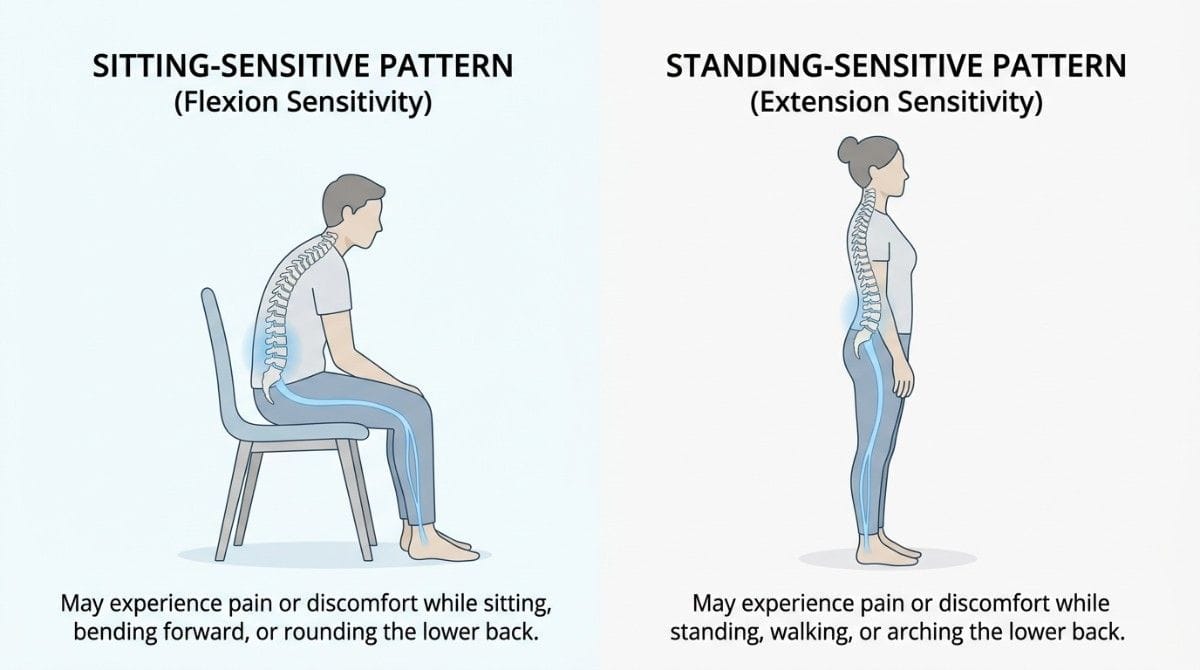
- Worse when sitting. Sciatica linked to disc irritation often flares with forward-bending positions, and sitting is the most forward-bent position of the day.
- Worse when standing. Some sciatica patterns flare with extension, so long standing and walking on hard floors can feel worse.
- Worse either way if held too long. Any single position, kept for hours, compresses the nerve and tightens the muscles around it.
🔑 Key Insight: Do not ask "is sitting or standing bad?" Ask "which position eases my leg pain, and how fast does the other one bring it back?" Your body's answer is the plan.
If your pain clearly worsens the longer you sit, the seated-flare fixes are covered in how to sit without flaring sciatica.
Sitting vs Standing vs Walking: Quick Comparison
| Position | When it helps | When it hurts | Best used for |
|---|---|---|---|
| Sitting (supported) | Resting briefly, extension-pattern pain | Disc-pattern pain, slouching, long hours | Short, supported breaks ✅ |
| Standing | Disc-pattern pain, breaking up sitting | Extension-pattern pain, hard floors | Switching out of sitting ✅ |
| Walking | Most patterns, restoring circulation | Severe acute flares (keep it gentle) | The default movement reset ✅ |
The general lower-back version of this trade-off is covered in sitting vs standing with lower back pain, but sciatica adds the nerve layer on top.
Quick win: Next flare, test it. Note your leg pain after 20 minutes sitting, then after 5 minutes walking. The gap tells you which way your nerve leans. Backed AI can track these patterns for you over time.
Why Does Standing Sometimes Make Sciatica Worse?
Standing is not automatically the safe choice. A few things can backfire.
- Locked knees and a tucked pelvis flatten the lower back and load the nerve.
- Tight hips and a tight piriformis keep pressing on the nerve even upright. This hip pattern is explained in the tight hips and lower back pain connection.
- Standing still for hours is its own kind of holding. Movement, not posture alone, is what calms the nerve.
So a standing desk is not a cure. It is just a second position to rotate through.
Why Walking Often Beats Both
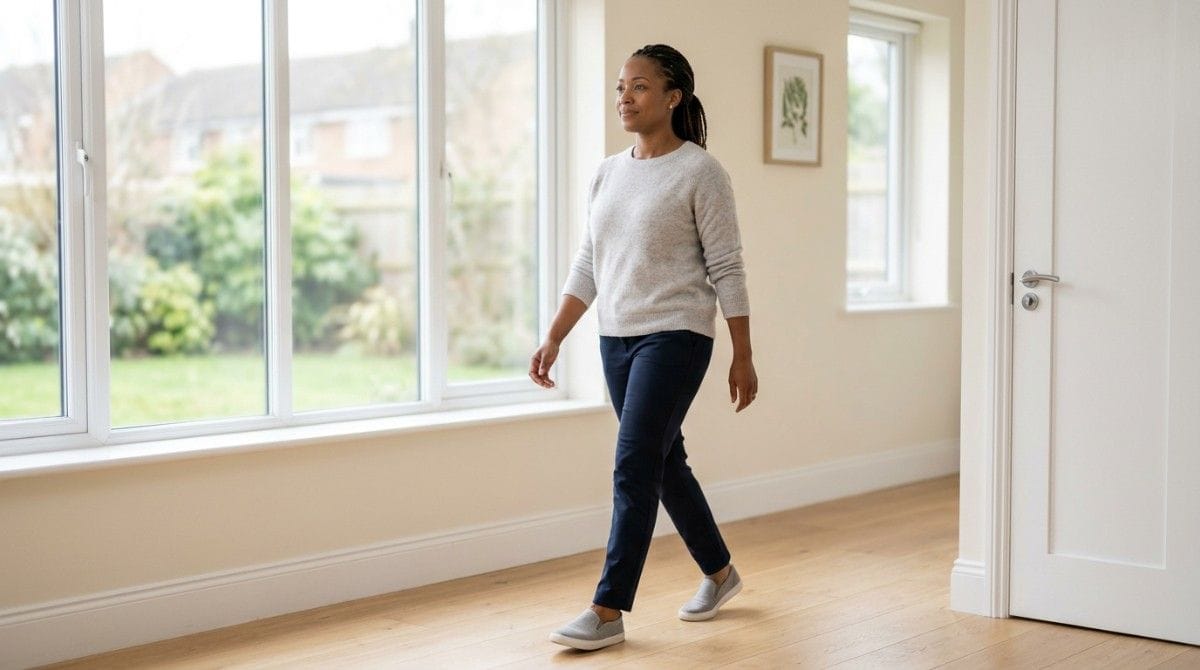
For most sciatica, the winning answer is not a chair or a standing mat. It is gentle, frequent movement.
Walking restores circulation to the nerve, gently mobilizes the hips, and avoids the sustained pressure that both sitting and standing create. Posture specialists often describe motion as the nerve's best friend.
That does not mean marching through a severe flare. It means short, easy walks woven through the day rather than long blocks of stillness.
Best Movements to Break a Sciatica Flare (Quick List)
When either position starts flaring your leg, switch and move. Start gently and stop if pain sharply increases.
- Gentle walk. A 2 to 5 minute easy walk restores circulation and unloads the nerve. The most reliable reset.
- Standing glute squeeze. Squeeze both glutes for 5 seconds, release, repeat 8 times. Reactivates the muscles that support the hip.
- Standing hip flexor stretch. Step one foot back and ease the hip forward. Loosens the front of the hip after sitting. 30 seconds per side.
- Standing pelvic tilt. Roll the pelvis gently forward and back to find neutral. 10 slow reps.
- Seated figure-4. If standing flares you, sit tall, cross one ankle over the knee, lean forward gently. Releases the piriformis. 30 seconds per side.
Physiotherapists often recommend rotating positions on a timer rather than chasing one "perfect" posture, because stillness is the real aggravator.
Step-by-Step: Find Your Best Position
Posture specialists suggest treating this like a short experiment, not a guess.
Step 1 – Test sitting. Note your leg pain after 20 minutes of supported sitting.
Step 2 – Test standing. Note it again after 10 minutes of relaxed standing with soft knees.
Step 3 – Test walking. Note it after a 5 minute gentle walk.
Step 4 – Build your rotation. Lead with whichever eased the pain, use the others in short doses, and add a movement break every 20 to 30 minutes.
Step 5 – Support the nerve. Layer in glute and hip work like the moves in glute activation exercises after sitting all day so no single position has to carry the load.
If mapping this by hand feels fiddly, Backed AI scans your posture and builds the rotation and support routine around your actual pattern, so you stop guessing.
When Switching Positions Isn't Enough
Rotating sit, stand, and walk helps most sciatica. But some cases need a professional. See a doctor if:
- Pain is severe, constant, or steadily worsening.
- You have leg weakness, numbness, or "foot drop."
- You lose bladder or bowel control (seek urgent care).
- Symptoms began after a fall or sudden injury.
- There is no improvement after 6 to 8 weeks of consistent effort.
These can signal a structural cause like a herniated disc or stenosis, which needs imaging and clinical care, not position changes alone.
Research & Expert Insight
Research in musculoskeletal rehab points to a few consistent themes.
- Direction matters. Studies on spinal loading show flexion and extension load the lower back and nearby nerve structures differently, which helps explain why sitting and standing affect people in opposite ways.
- Stillness is the enemy. Occupational health research links prolonged static postures, sitting or standing, with more reported back and nerve symptoms than frequently varied positions.
- Movement helps recovery. Gentle activity is repeatedly associated with better short-term relief for sciatic-type pain than strict rest.
The pattern is steady: the nerve responds to direction, the muscles respond to position, and both respond to movement.
Final Takeaway
So, sitting vs standing with sciatica, which is worse? Whichever one your nerve dislikes, held too long. Sitting flares some patterns, standing flares others, and stillness flares them all. The smartest move is to learn your direction, rotate positions, and let walking be your default reset. Do that consistently and most people feel real relief within a few weeks.
The position debate is a distraction. Movement is the answer.
Why Most Sciatica Advice Fails
People read "sit less" or "stand more," try it for a day, and the flare returns. Here is why generic advice falls short:
- No personalization. Your sciatica may be flexion-sensitive, extension-sensitive, or driven by a tight piriformis. One blanket rule cannot fit all three.
- No pattern tracking. Without noticing what eases your leg pain, you are guessing.
- No progression. A single position swap with no movement plan stops helping fast.
- No consistency system. Sitting and standing repeat all day. Random changes cannot keep up.
A Smarter Way to Manage It
Backed AI is built for this exact problem. Instead of guessing, you get a plan shaped around your body.
- 📸 AI posture scan spots your specific imbalance using your phone camera.
- 🎯 Personalized program targets your hips, glutes, and posture pattern, not a generic rule.
- 🔔 Habit reminders prompt you to switch position and move before the nerve overloads.
The longer a flare pattern locks in, the more consistency it takes to undo. Starting now is the easiest version of the fix.
Download Backed AI and start correcting your posture today. 💙
FAQ
Is sitting or standing worse for sciatica? It depends on your pattern. Sitting often flares disc-related sciatica, while standing can flare other patterns. Holding either too long makes sciatica worse, so rotating positions is best.
Does standing help sciatica? Sometimes. Standing can relieve sciatica that worsens with sitting, but standing still for long periods or with locked knees can flare it. Gentle walking usually helps more.
Is walking good for sciatica? Yes, for most people. Gentle, frequent walking restores circulation and unloads the nerve, which is why it often beats holding any single position.
How often should I change position with sciatica? Aim to switch position and move every 20 to 30 minutes during a flare. Frequent change matters more than finding one perfect posture.
Should I get a standing desk for sciatica? A standing desk can help if sitting flares your pain, but it is not a cure. Use it as a second position to rotate through, alongside regular movement breaks.