Sitting vs Standing With Lower Back Pain: Which Is Actually Worse?
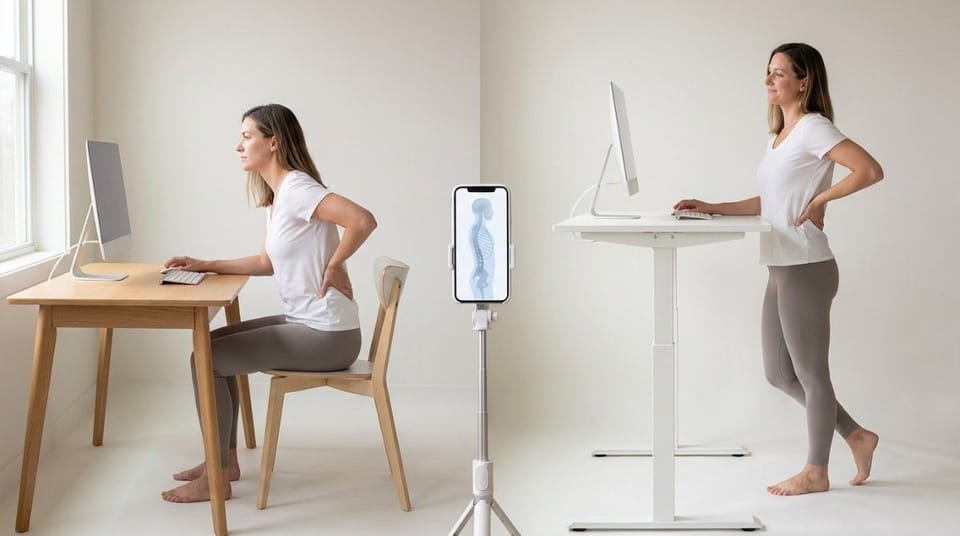
Neither sitting nor standing is universally worse for your lower back. It depends entirely on which structures – discs, muscles, or joints – are driving your pain. Sitting raises disc pressure and shortens hip flexors. Standing fatigues the spinal extensors and demands constant core engagement. The "better" position is the one that matches your specific pain pattern.
Sitting vs standing for lower back pain is a load distribution question: sitting overloads the lumbar discs and posterior structures, while standing overloads the lumbar extensors and posterior chain muscles.
TL;DR
- Sitting raises lumbar disc pressure by roughly 40 to 90 percent compared to standing.
- Standing demands continuous activation of the glutes, core, and spinal extensors.
- If pain eases when you sit, your posterior chain is likely weak.
- If pain eases when you stand, your discs or hip flexors are likely the issue.
- Switching positions every 30 to 45 minutes outperforms staying in either one.
- The real fix is rarely "more of the opposite position" – it is targeted correction.
What Is the Real Difference Between Sitting and Standing Back Pain?
Lower back pain that responds differently to sitting versus standing is a clinical signal. It tells you which part of the lumbar system is under strain.
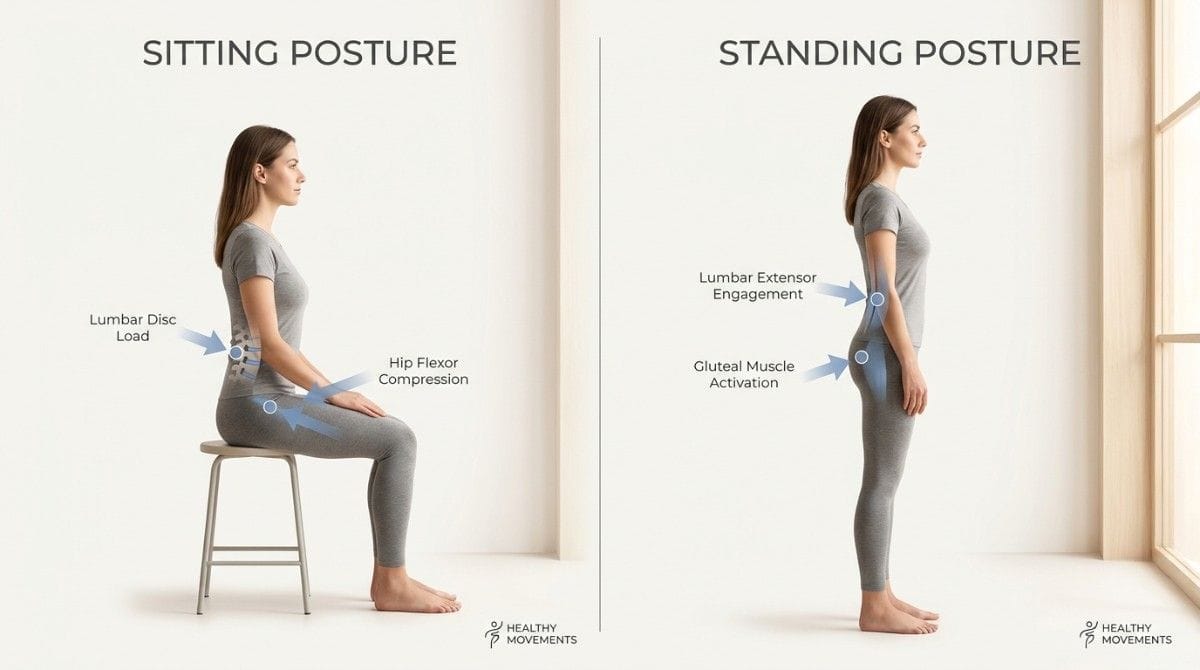
Sitting compresses the front of the spine – the discs, the hip flexors, and the abdominal structures. Standing loads the back of the spine – the erector spinae, the facet joints, and the posterior pelvic muscles.
This is why two people with "the same" lower back pain often have opposite preferences. Their underlying mechanisms are different, even if the pain location feels the same.
For a deeper breakdown of the seated mechanism specifically, the guide on lower back pain from sitting walks through the exact load chain.
How Does Sitting Affect the Lower Back?
Sitting compresses the spine in ways most people underestimate.
1. Increased Disc Pressure
When you sit, the lumbar discs experience 40 to 90 percent more pressure than when you stand. Slouching multiplies this further. Over hours, this reduces disc hydration and creates a deep, dull ache.
2. Shortened Hip Flexors
The hip flexors – especially the psoas – attach directly to the lumbar vertebrae. Prolonged sitting shortens them. They then pull the pelvis into anterior tilt, which over-arches and stresses the lower back.
3. Inhibited Glutes
Sitting puts the glutes in a stretched, switched-off position. When they stop firing, the lumbar muscles take over. This is the pattern explored in our guide on tight hips and lower back pain.
How Does Standing Affect the Lower Back?
Standing puts a different kind of load on the lumbar spine.
1. Continuous Muscle Activation
Standing requires constant low-level work from the erector spinae, glutes, and core. If any of these are weak, the lower back compensates – and fatigues fast.
2. Facet Joint Loading
Prolonged standing, especially with anterior pelvic tilt, compresses the facet joints at the back of the spine. This creates the familiar "deep ache" that worsens the longer you stand.
3. Posterior Chain Demand
The glutes and posterior chain are designed to share the load when you stand. After years of sitting, they often cannot. The lumbar extensors then become the primary support – a role they are not built for.
This pattern is broken down in detail in the guide on why your lower back hurts when standing.
💡 Key Insight: The question is not "sitting or standing?" The question is "which structures are weak, tight, or overloaded in your body?" That answer decides which position is friendlier and which exercises actually help.
Sitting vs Standing: Which Loads Your Lumbar Spine More?
| Factor | Sitting | Standing |
|---|---|---|
| Lumbar disc pressure | High (1.4 to 1.9x standing) | Baseline |
| Hip flexor strain | High (shortened position) | Low (lengthened) |
| Glute activation | Inhibited (switched off) | Engaged (load-bearing) |
| Spinal extensor demand | Low | High (continuous) |
| Facet joint load | Low to moderate | Moderate to high |
| Circulation to discs | Reduced | Improved |
| Energy demand | Low | Moderate |
| Risk in long bouts | Disc and posture decline | Muscle fatigue and joint compression |
The takeaway: neither column is "safe." Both create problems when sustained too long. The healthiest position is the one you are about to change.
Why Does Sitting Hurt Me But Standing Doesn't (Or Vice Versa)?
This is the question most people ask – and the answer is genuinely revealing.
Sitting Hurts, Standing Helps
This usually points to:
- Disc compression sensitivity
- Tight hip flexors pulling the lumbar spine forward
- Poor seated posture or unsupportive chair
- Hours of cumulative seated load
Standing Hurts, Sitting Helps
This usually points to:
- Weak glutes and posterior chain
- Anterior pelvic tilt with lumbar extensor fatigue
- Facet joint irritation
- Flat-foot or imbalanced standing posture
Both Hurt
This usually points to:
- Long-standing postural dysfunction (anterior pelvic tilt or flat back posture)
- Combined disc and muscular involvement
- Possible structural contributor that needs assessment
Physiotherapists often use position-based pain as a quick diagnostic clue. It tells them where to look first.
Best Approach for Each Pain Type (Quick List)
- If sitting is your trigger: Prioritize hip flexor release, glute reactivation, and lumbar decompression. Add movement breaks every 30 to 45 minutes.
- If standing is your trigger: Prioritize glute strengthening, core endurance, and pelvic tilt correction. Build standing tolerance progressively.
- If both are triggers: Address postural alignment first. The position-tolerance comes from rebuilt baseline, not switching back and forth.
- If neither feels safe: Lie down with knees supported, decompress the lumbar spine, then start gentle mobility work. See a clinician if pain persists.
For deeper exercise selection by trigger type, the breakdown of lower back pain for desk workers covers the seated profile, and the standing companion article handles the opposite case.
The Sit-Stand Rotation Framework (Step-by-Step)
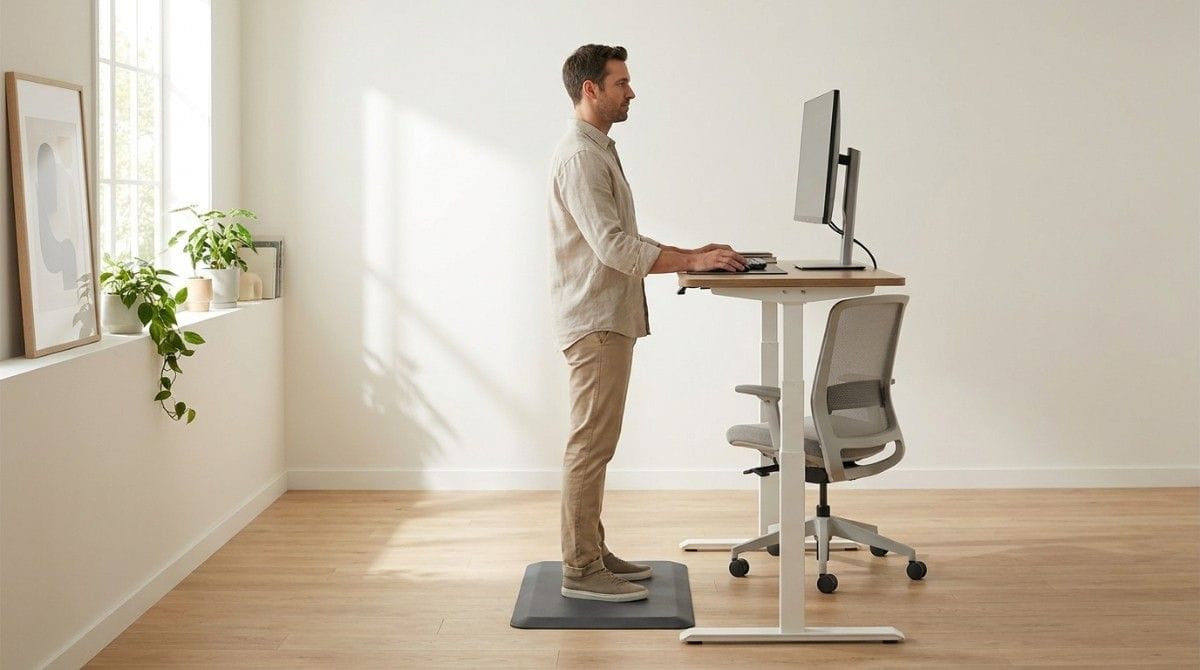
The most reliable answer to "sitting vs standing" is to stop choosing.
| Phase | Action | Duration |
|---|---|---|
| Phase 1 | Sit with good posture and lumbar support | 30 to 45 min |
| Phase 2 | Stand with weight evenly distributed | 15 to 20 min |
| Phase 3 | Move (walk, stretch, hip openers) | 2 to 5 min |
| Phase 4 | Repeat throughout the workday | All day |
Research in occupational health consistently shows that rotation between sitting, standing, and movement produces less back pain than either extreme – even with imperfect ergonomic equipment.
⚡ Mid-article check-in: If you have tried switching between sitting and standing without real improvement, the underlying imbalance pattern is probably the issue – not the position. An AI posture scan can identify which muscle groups need work first. That is exactly what Backed AI was built for.
When This Approach Doesn't Work
Position rotation and corrective exercise resolves most cases of position-dependent lower back pain. But seek medical evaluation if you experience:
- Pain radiating below the knee (possible sciatica or disc involvement)
- Numbness, tingling, or weakness in the legs
- Loss of bladder or bowel control (emergency)
- Pain unaffected by any change in position
- Persistent night pain that disturbs sleep
- Pain following a fall, accident, or trauma
These signs may indicate a structural cause that needs imaging and specialist care.
Research & Expert Insight
Research in musculoskeletal rehab and ergonomics consistently shows three things.
Disc pressure data: Nachemson's classic intradiscal pressure studies and modern follow-ups confirm seated postures load the discs more than standing. Slouching loads them most of all.
Standing tolerance: Occupational health research shows untrained workers fatigue in static standing within 30 to 60 minutes, especially if the posterior chain is weak.
Rotation outperforms either extreme: Trials with sit-stand desk users show pain reduction comes from movement frequency, not from standing alone. Standing all day creates its own problems.
The pattern is consistent. Position alone is not the answer. Movement and balanced strength are.
Final Takeaway
The sitting versus standing question is a trap. Both positions create problems when sustained. Both feel like relief from the other. Neither is the cure.
The real answer is structural: rebuild the muscles that sitting weakens (glutes, core, posterior chain), release the muscles that sitting shortens (hip flexors, hamstrings), and rotate through the day so no single posture dominates.
Most people who follow this approach see measurable improvement in 4 to 8 weeks. The hard part is knowing your specific imbalance pattern – which is where personalization changes everything.
Why Most Sit-Stand Routines Fail
Most people who try to fix position-dependent back pain stall for the same reasons:
- They keep switching positions without fixing the imbalance. The discomfort moves around, but the root pattern stays.
- They follow generic ergonomic advice. Setup matters, but it does not rebuild weak glutes or release tight hip flexors.
- They have no progression plan. Day one and day sixty look identical.
- They cannot see their own posture. Self-correction without feedback rarely works.
Two people with "the same" sit-stand pain almost always need different programs. The pain is generic. The cause is not.
Backed AI: Personalized Posture Correction That Adapts
Backed AI is an AI posture correction app built for this exact problem. It scans your posture from your phone camera, identifies whether your pain is driven by disc compression, hip flexor tightness, glute inhibition, or extensor fatigue – and builds a daily routine that adapts as your body changes.
What you get:
- 🎯 AI posture analysis that pinpoints your exact imbalance, so you stop guessing whether sitting or standing is "worse."
- 📱 Personalized daily routines that target the muscles weakened by your specific pattern, not a generic checklist.
- 🔔 Habit-building reminders that prompt the right movement at the right time – the missing link between knowing and doing.
If you spend hours in either position daily, generic advice will not move the needle. The longer the imbalance locks in, the longer correction takes.
Download Backed AI and start correcting your posture today.
FAQ
Q1: Is sitting or standing worse for lower back pain? Neither is universally worse. Sitting increases lumbar disc pressure by 40 to 90 percent. Standing demands continuous spinal and glute activation. The position that hurts more reflects which structures are weakest or most stressed in your body.
Q2: Why does my lower back feel better when I sit but worse when I stand? This usually points to weak glutes, weak core, or anterior pelvic tilt with lumbar extensor fatigue. Sitting offloads those muscles. The fix is glute and posterior chain strengthening, not avoiding standing.
Q3: Why does standing relieve my lower back pain? Standing decompresses the lumbar discs and restores hip extension. If standing helps, your pain is likely driven by disc pressure or tight hip flexors from prolonged sitting.
Q4: How often should I switch between sitting and standing? Posture specialists suggest a 30 to 45 minute sit, followed by 15 to 20 minutes of standing, with short movement breaks. Rotation reduces back pain more reliably than either extreme alone.
Q5: Do standing desks fix lower back pain? Not on their own. Standing desks can help if your pain is sitting-driven, but standing all day creates its own problems. The benefit comes from rotation, movement, and corrective exercise – not just the desk itself.