Lower Back Pain From Sitting: Why It Happens and How to Fix It
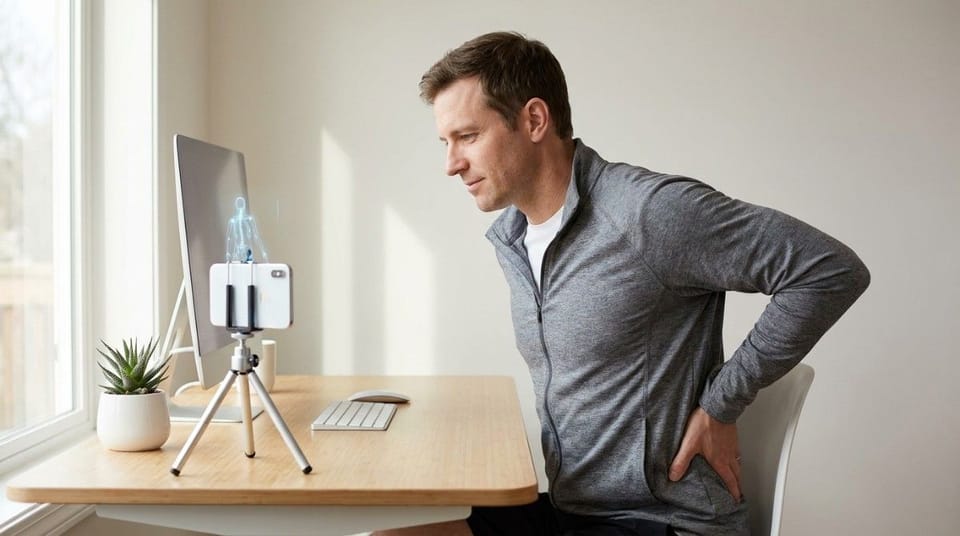
Sitting for long hours puts more pressure on your lumbar spine than standing or lying down, which is why so many desk workers, drivers, and students feel a dull ache or sharp pain in their lower back. The fix is rarely a single stretch. It is a combination of better seated posture, targeted movement breaks, and exercises that rebuild the muscles weakened by prolonged sitting.
Lower back pain from sitting is a postural and mechanical condition where prolonged hip flexion, pelvic tilt, and disc compression overload the lumbar spine, causing pain that worsens the longer you sit.
TL;DR
- Sitting compresses lumbar discs and shortens hip flexors, which silently pulls your lower back out of alignment.
- The pain is usually mechanical, not damage. Most cases respond to posture, mobility, and strength work.
- 30 to 45 minute movement breaks make a measurable difference.
- Stretches alone provide short-term relief. Strengthening glutes and core fixes the cause.
- Personalized routines outperform generic exercise lists.
What Is Lower Back Pain From Sitting?
Lower back pain from sitting is discomfort, stiffness, or aching in the lumbar region that appears or worsens during prolonged seated time. It often improves when you stand, walk, or lie down.
It is one of the most common complaints in adults under 50. Office workers, drivers, students, and remote employees see it most often.
The pain rarely comes from a single injury. It builds up gradually from posture habits, weak supporting muscles, and reduced movement throughout the day. The mechanism behind it ties closely to the patterns covered in our guide on tight hips and lower back pain, which is often the upstream driver of seated pain.
Why Does Sitting Cause Lower Back Pain?
Three mechanisms make sitting unusually hard on the lumbar spine.
1. Increased Disc Pressure
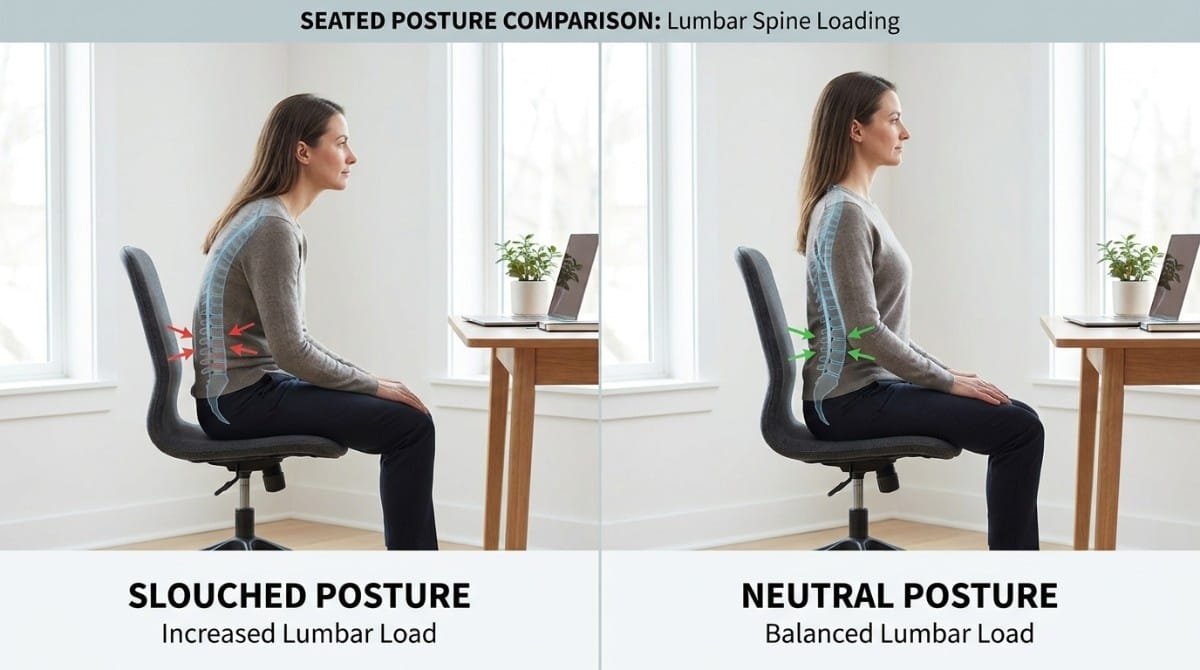
When you sit, the pressure on your lumbar discs rises by 40 to 90 percent compared to standing. Slouching multiplies this further. Over hours, this load reduces disc hydration and creates the familiar dull ache.
2. Shortened Hip Flexors
Your hip flexors – especially the psoas – attach directly to your lumbar vertebrae. After 60+ minutes of sitting, they shorten. They start pulling your pelvis into an anterior tilt, which over-arches and compresses the lower back.
3. Switched-Off Glutes
Sitting puts your glutes in a stretched, inactive position. Over time, they stop firing properly. Posture specialists call this gluteal inhibition. When your glutes do not stabilize your pelvis, your lumbar muscles take over – and they fatigue fast.
💡 Key Insight: Sitting itself is not the villain. Sitting without movement, support, or counter-balancing strength is. The fix is not to never sit. It is to sit better and move more often.
How To Fix Lower Back Pain From Sitting (Step-by-Step Recovery Framework)
| Phase | Focus | Timeframe | Goal |
|---|---|---|---|
| Phase 1 | Pain relief + decompression | Days 1–7 | Reduce inflammation and disc load |
| Phase 2 | Mobility restoration | Weeks 2–3 | Release hip flexors, glutes, hamstrings |
| Phase 3 | Strength rebuild | Weeks 4–6 | Activate glutes, deep core, posterior chain |
| Phase 4 | Posture integration | Weeks 6+ | Carry the corrections into daily seated work |
Most people see noticeable change inside 2 to 4 weeks of consistent practice. Full correction usually takes 6 to 8 weeks. If you have followed a structured plan like the one in our 15-minute posture routine for desk workers, you can layer it directly on top of this framework.
Best Exercises for Lower Back Pain From Sitting (Quick List)
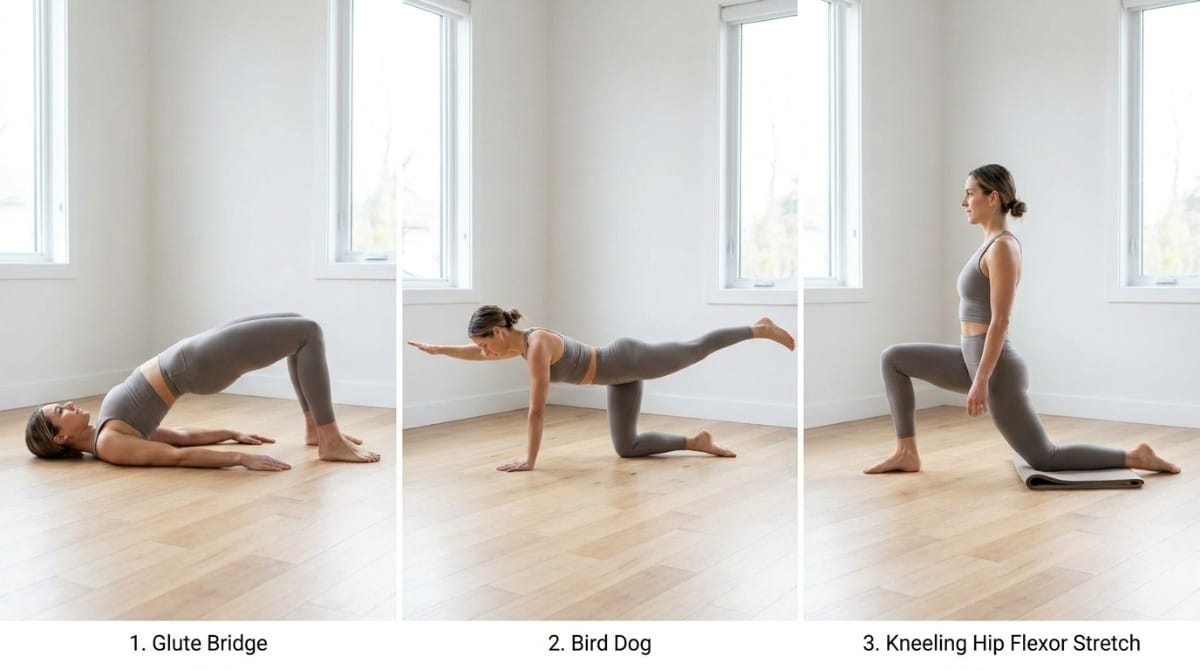
- Kneeling Hip Flexor Stretch – Releases the psoas and rectus femoris that shortened from sitting. Hold 45 seconds per side.
- Glute Bridge – Reactivates inhibited glutes so the lower back stops compensating. 2 sets of 12 reps.
- Cat-Cow – Restores lumbar mobility lost during prolonged hip flexion. 10 slow reps.
- Bird Dog – Builds deep core stability and trains coordinated spinal control. 2 sets of 8 per side.
- Standing Hip Flexor Stretch – A quick mid-workday version of the kneeling stretch. 30 seconds per side.
- Wall Angels – Reverses rounded shoulders that pair with seated lower back pain. 10 slow reps.
- Pelvic Tilts – Teaches your pelvis to find neutral instead of staying tilted forward or backward.
For deeper mobility work that targets the muscles most affected by sitting, the complete guide on relieving a tight lower back walks through each stretch with technique cues.
How To Sit Without Triggering Lower Back Pain
The seated position itself matters as much as the exercises. Most people sit in ways that quietly compress the lumbar spine.
Use this checklist:
- Hips slightly higher than knees. Raise your seat or add a wedge cushion.
- Feet flat on the floor. Use a footrest if needed.
- Lumbar support behind your lower back. Maintain the natural inward curve.
- Shoulders relaxed, ears stacked over shoulders. Avoid the forward head drift.
- Move every 30 to 45 minutes. Even a 60-second stand-and-stretch resets disc pressure.
Physiotherapists often recommend the "20-8-2 rule": for every 30 minutes, spend 20 minutes seated, 8 minutes standing, and 2 minutes moving. It is simple and it works.
⚡ Mid-article check-in: If you are not sure whether your sitting posture is the actual problem – or you have tried generic stretches with little progress – an AI posture scan can identify the exact imbalance pattern driving your pain. That is what Backed AI was built for.
What Happens If You Ignore Lower Back Pain From Sitting?
Untreated, the pattern usually escalates in this order:
- Occasional stiffness after long sitting
- Persistent daily ache by mid-afternoon
- Pain that radiates into the glutes or hips
- Postural drift into anterior pelvic tilt or flat back posture
- Risk of disc herniation, sciatica, or chronic lumbar dysfunction
The earlier you intervene, the easier correction is. Posture specialists note that mechanical lower back pain is highly reversible in the first 6 to 12 months, after which compensations become harder to undo.
Research & Expert Insight
Research in musculoskeletal rehab shows three consistent findings about seated lower back pain.
Disc load: Studies measuring intradiscal pressure (Nachemson and follow-up research) consistently show seated postures load lumbar discs more than standing.
Hip flexor adaptation: Occupational health research links sitting more than 6 hours daily with measurable iliopsoas shortening.
Movement breaks work: Trials in office populations show that short, frequent movement breaks reduce reported back pain more effectively than ergonomic equipment alone.
The pattern is clear. The discs respond to load, the muscles respond to position, and both respond to movement. Equipment helps. Movement and corrective exercise fix it.
When This Approach Doesn't Work
Posture and exercise correction resolves most cases of seated lower back pain. But seek medical evaluation if you experience:
- Pain that radiates down the leg below the knee (possible sciatica or disc involvement)
- Numbness, tingling, or weakness in the legs
- Loss of bladder or bowel control (emergency)
- Pain unaffected by any change in position
- Persistent night pain that wakes you
- Pain following a recent fall, accident, or trauma
These signs may indicate a structural issue (herniated disc, stenosis, fracture) that requires imaging and specialist care – not exercise alone.
Final Takeaway
Lower back pain from sitting is your body's signal that the position has gone unbalanced for too long. The discs are overloaded, the hip flexors are shortened, and the glutes have switched off. The fix is the same pattern in reverse: decompress, mobilize, strengthen, then sit smarter.
Most people see real improvement inside 4 to 8 weeks of consistent, structured practice. The hard part is knowing exactly what to do, in what order, and adjusting as your body changes. That is where personalization matters more than any single stretch.
For a deeper look at why these problems keep returning when only the symptoms are treated, the breakdown on hip flexor pain from sitting explains the full chain reaction. And if you stand a lot at work too, the companion article on why your lower back hurts when standing covers the opposite trigger.
Why Most Exercise Plans Fail (And What Actually Works)
Most people who try to fix sitting-related lower back pain stall for predictable reasons:
- Inconsistency. They start strong, miss a few days, and lose momentum.
- Wrong form. They follow YouTube videos but cannot see what they are doing wrong.
- No progression. They repeat the same beginner routine for months.
- No personalization. They use generic plans built for nobody in particular.
This is why two people with "the same" lower back pain often need entirely different programs. The pain is generic. The cause is not.
Backed AI: A Smarter Way to Fix Sitting-Related Back Pain
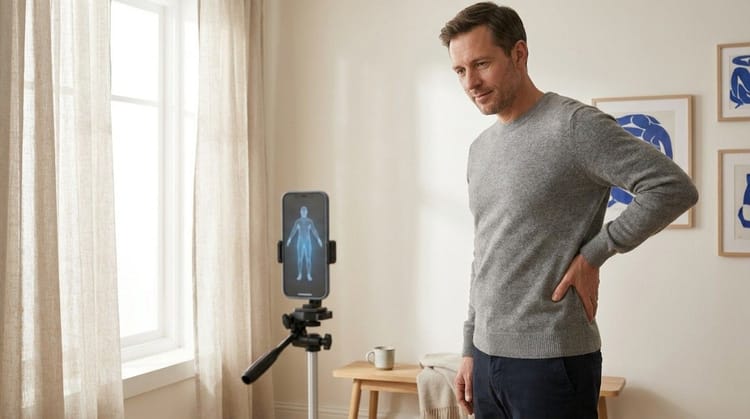
Backed AI is an AI posture correction app built for exactly this problem. It scans your posture from your phone camera, identifies the specific imbalances driving your pain, and builds a daily routine that adapts as you progress.
What you get:
- 🎯 AI posture analysis that pinpoints your exact pelvic tilt, hip flexor tightness, and postural drift – no guesswork.
- 📱 Personalized daily routines that adjust as your body changes, instead of static lists you outgrow in a week.
- 🔔 Habit-building reminders that prompt the right movement at the right time during your seated workday.
If you spend more than four hours a day seated, generic stretches will not be enough. The longer you wait, the deeper the pattern locks in.
Download Backed AI and start correcting your posture today.
FAQ
Q1: Why does sitting cause lower back pain?
Sitting increases pressure on the lumbar discs by 40 to 90 percent compared to standing. It also shortens the hip flexors and switches off the glutes, forcing the lower back to absorb more load. Over hours, this creates the familiar ache.
Q2: How long should I sit before taking a break?
Posture specialists suggest a short movement break every 30 to 45 minutes. Even a 60-second stand-and-stretch resets disc pressure and reduces cumulative strain on the lumbar spine.
Q3: What is the best sitting position for lower back pain?
Sit with your hips slightly higher than your knees, feet flat on the floor, lumbar support behind your lower back, and shoulders stacked over hips. Avoid soft chairs that let your pelvis roll backward.
Q4: Can lower back pain from sitting go away on its own?
Mild cases often improve with movement breaks and better seated posture alone. Persistent pain rarely resolves without addressing the underlying muscle imbalances – tight hip flexors, weak glutes, and a deconditioned core.
Q5: When should I see a doctor for lower back pain from sitting?
See a doctor if pain radiates below the knee, you have numbness or weakness in your legs, pain wakes you at night, or there is no improvement after several weeks of corrective work.