
Lower Back Pain for Desk Workers: Why Sitting Is Wrecking Your Lumbar Spine (And the Daily Fix That Works)

If you sit at a desk for most of the day and your lower back hurts by afternoon, that is not a coincidence. Prolonged sitting is one of the most damaging things you can do to the lumbar spine - and most desk workers are doing it for 8 to 10 hours a day, five days a week, for years.
Lower back pain in desk workers is primarily caused by sustained lumbar compression, hip flexor tightening, and glute inhibition from prolonged sitting - all of which are correctable with a consistent daily movement routine.
TL;DR
- Sitting for long periods compresses the lumbar discs and shuts off the muscles that protect the lower back
- Desk workers are significantly more likely to develop chronic lower back pain than people with active jobs
- The damage is cumulative - it builds over months and years before becoming obviously painful
- The fix is not a new chair - it is targeted movement, postural correction, and daily consistency
- A 10-15 minute daily routine addressing hip flexors, glutes, and lumbar mobility is enough to reverse most desk-related lower back pain
- Backed AI builds this routine around your specific posture pattern - not a generic template
What Is Desk Worker Lower Back Pain?
Desk worker lower back pain is lower lumbar discomfort, stiffness, or aching that develops primarily as a result of prolonged sitting and the postural adaptations the body makes to survive it.
It is not the same as lower back pain from heavy lifting or acute injury. It is slow, accumulated, and structural - the result of the body being held in a position it was never designed to maintain for hours at a time.
Desk worker lower back pain is a musculoskeletal dysfunction driven by sustained lumbar compression, hip flexor shortening, and posterior chain deactivation - all direct consequences of prolonged sitting.
The average desk worker sits for 9.3 hours per day. The lumbar spine was not designed for this. And the body makes predictable, measurable adaptations to cope - all of which eventually produce pain.
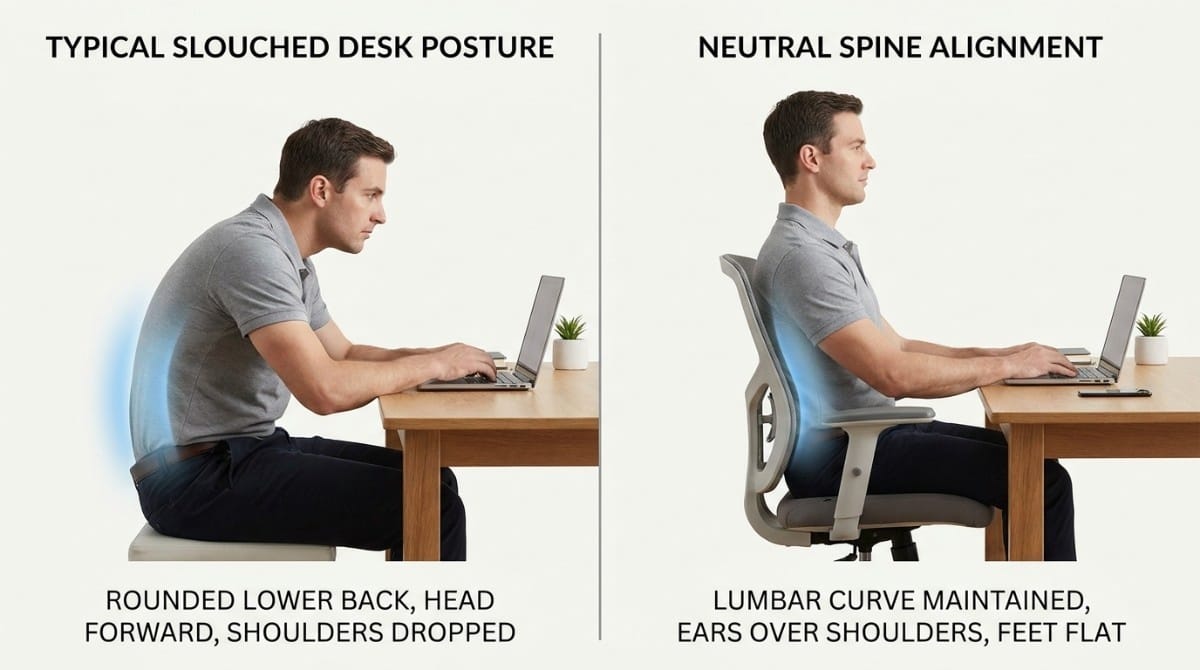
Why Does Sitting Wreck the Lumbar Spine?
Sitting feels passive. But for the lumbar spine, it is anything but.
The Lumbar Compression Problem
When you sit - especially in a slightly forward or rounded position - the lumbar discs are compressed unevenly. The front of the disc is squeezed while the back is stretched. Over hours, this creates sustained mechanical stress at L4-L5 and L5-S1: the two most commonly affected segments in lower back pain.
Intradiscal pressure measurements show that sitting produces approximately 40% more disc pressure than standing in a neutral position. Slouched sitting increases this further.
Do this for 9 hours a day, five days a week, for several years - and the cumulative disc stress is enormous.
The Hip Flexor Shortening Problem
When the hips are held at 90 degrees for extended periods, the hip flexors - particularly the iliopsoas - adaptively shorten. Tight hip flexors then pull the pelvis forward into anterior pelvic tilt, increasing the lumbar curve and compressing the facet joints of the lower spine.
This is one of the most consistent findings in desk workers with lower back pain. The hip flexors are the silent driver that most people never address.
Our full guide to tight hip flexors and lower back pain explains this mechanism in detail - and why stretching the lower back without addressing the hip flexors rarely produces lasting results.
The Glute Inhibition Problem
The glutes are the primary stabilisers of the pelvis and lumbar spine. When you sit for extended periods, the glutes are lengthened, compressed, and effectively switched off.
This is known as gluteal amnesia - a term used by physiotherapists to describe the loss of glute activation that occurs with prolonged sitting. When the glutes stop firing, the lower back muscles compensate, taking on load they were not designed to carry continuously.
This compensation is what produces the characteristic lower back fatigue that desk workers feel by mid-afternoon.
The Core Deactivation Problem
The deep core muscles - particularly the transversus abdominis and multifidus - provide essential stability to the lumbar spine. In an upright, active posture, these muscles are continuously engaged at low levels.
In sustained sitting, particularly with a forward-leaning or rounded posture, these muscles disengage. The lumbar spine loses its dynamic stabilisation and relies increasingly on passive structures - ligaments and discs - to bear load.
Passive structures are not designed for continuous loading. Over time, this produces the chronic aching stiffness that desk workers recognise as their baseline state.
💡 Key Insight: Desk-related lower back pain is not caused by one bad posture moment. It is caused by thousands of hours of cumulative compression, deactivation, and compensation - building silently before becoming obviously painful.
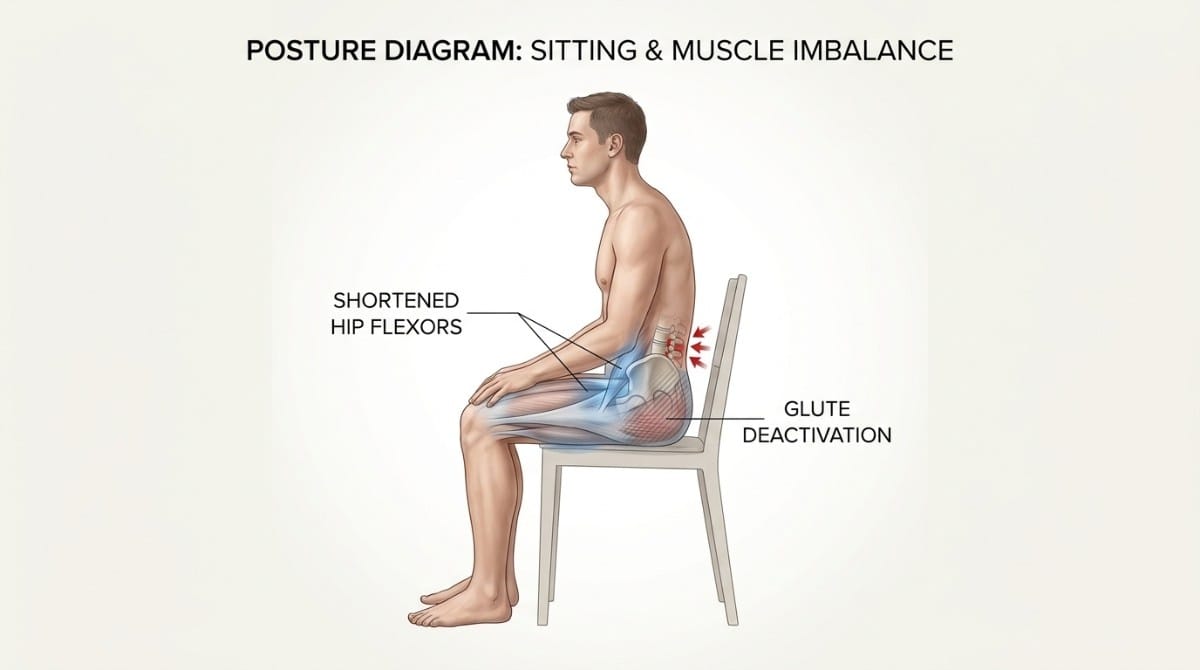
How Desk Worker Lower Back Pain Develops Over Time
Most desk workers don't develop severe lower back pain overnight. It follows a predictable progression.
Most desk workers seeking help are already at Stage 2 or 3. The good news: Stages 1-3 are fully reversible with a consistent, targeted approach.
The Desk Worker's Daily Fix: A 12-Minute Lower Back Routine
This routine addresses all four mechanisms driving desk-related lower back pain. It can be done at home - before work, during lunch, or after your desk day.
Target: 12 minutes daily, 5-7 days per week.
🔵 Block 1 - Hip Flexor Release (3 minutes)
1. Kneeling Hip Flexor Lunge Stretch From a low lunge, shift weight forward gently until you feel a stretch at the front of the rear hip. Hold 45 seconds each side. This directly addresses the iliopsoas shortening driving anterior pelvic tilt.
2. Supine Figure-4 Piriformis Stretch Lie on your back. Cross one ankle over the opposite knee, gently press the knee away. Hold 30 seconds each side. Releases the deep hip rotators that tighten with prolonged sitting.
🔵 Block 2 - Lumbar Mobilisation (3 minutes)
3. Cat-Cow On hands and knees, alternate between arching and rounding the back. 15 slow, controlled reps. Restores lumbar mobility and hydrates the discs after sustained compression.
4. Child's Pose Hold 45-60 seconds. Decompresses the entire lumbar spine and stretches the lumbar erectors that have been working overtime all day.
🔵 Block 3 - Glute Activation (3 minutes)
5. Glute Bridge Lie on your back, feet flat. Squeeze the glutes and lift the hips. Hold 2 seconds at the top, lower slowly. 15 reps. This is the single most important exercise for reversing gluteal amnesia in desk workers.
6. Side-Lying Clamshell Lie on your side, knees bent. Keep feet together and rotate the top knee upward. 15 reps each side. Activates the glute medius - critical for pelvic stability.
🔵 Block 4 - Core Stabilisation (3 minutes)
7. Dead Bug Lie on your back, arms and legs raised. Lower alternate arm and leg toward the floor without arching the lower back. 10 reps each side. Trains deep core stability without spinal compression.
8. Pelvic Tilt Lie on your back, feet flat. Gently flatten your lower back into the floor by contracting your abs. Hold 5 seconds, release. 15 reps. Directly corrects anterior pelvic tilt.

The Movement Breaks Strategy
Exercise alone is not sufficient if you return to 9 hours of unbroken sitting afterward. Movement breaks are a non-negotiable part of desk worker lower back pain management.
Physiotherapists often recommend the 30:5 rule for desk workers: for every 30 minutes of sitting, take a 5-minute standing or movement break.
Practical movement breaks for desk workers:
- Standing hip flexor stretch - hold the desk for balance, one foot back, gentle lunge position for 30 seconds each side
- Doorway chest opener - arms on doorframe, step through gently to open the chest and reset thoracic posture
- 10 standing glute squeezes - can be done without leaving the desk area
- Seated pelvic tilt - flatten the lower back into the chair back, hold 5 seconds, release. 10 reps
- Standing cat-cow - hands on knees, alternate arching and rounding. 10 reps
These breaks don't need to be formal exercise. They just need to interrupt the compression cycle before it compounds.
For desk-specific posture correction exercises that can be done without leaving your workstation, our guide to posture exercises for desk workers has a complete 15-minute routine built around this principle.
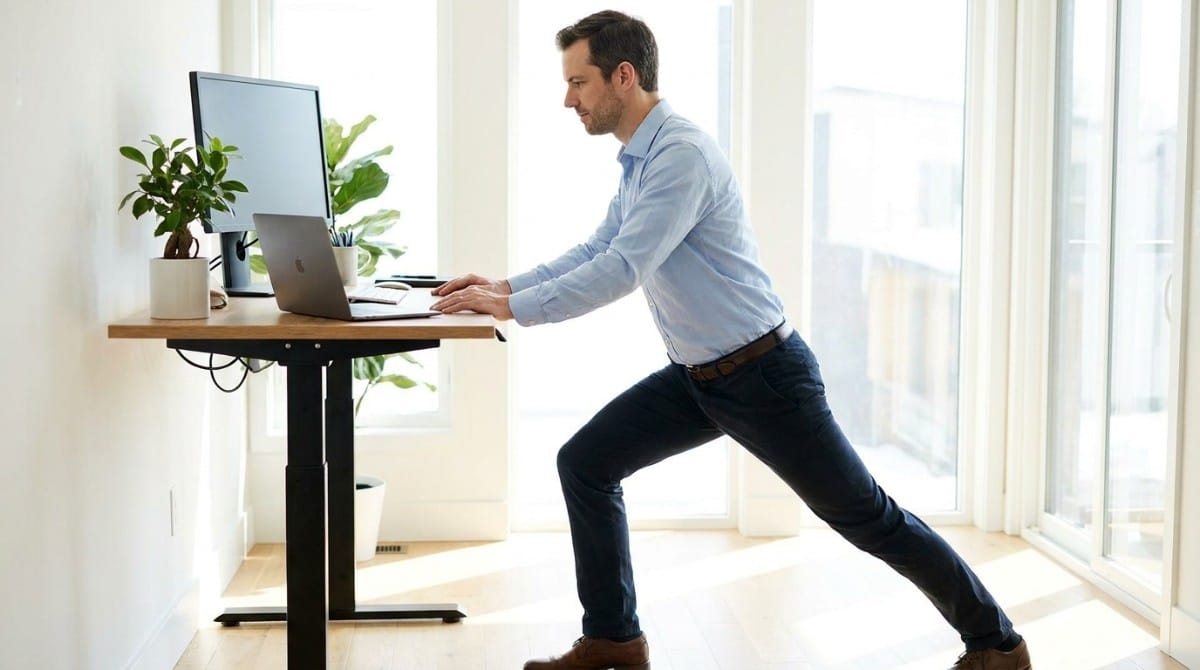
Ergonomics: What Actually Helps (And What Doesn't)
Desk workers are often sold the idea that the right chair or standing desk will fix their lower back pain. This is partially true - and mostly overstated.
What genuinely helps:
- Chair seat height - thighs parallel to the floor, feet flat. Prevents hip flexor shortening
- Lumbar support - positioned at the natural inward curve of the lower back (not the mid-back)
- Monitor height - top of screen at eye level prevents forward head posture cascading into thoracic and lumbar compensation
- Keyboard and mouse position - elbows at 90 degrees, wrists neutral. Reduces upper body tension that loads the spine
What is overrated without movement:
- Standing desks - standing for long periods produces its own lumbar problems if posture is poor. The benefit is in alternating between sitting and standing, not in standing all day
- Expensive ergonomic chairs - a better chair reduces stress slightly. It does not address hip flexor tightening, glute inhibition, or core deactivation. Movement is irreplaceable
- Lumbar cushions - useful as a short-term adjunct, not a solution
The most ergonomically correct position is your next one. Variation matters more than perfection.
Why This Won't Work Without Consistency
The daily routine above is effective. But it only works if it's done consistently.
One session relieves pain for a day. Two weeks of daily sessions begins to reverse the underlying dysfunction. Six weeks of consistent practice creates measurable postural change.
The challenge for desk workers is not knowledge - it's consistency. After a long workday, starting a 12-minute routine requires activation energy most people don't have in reserve.
This is why having a structured system with daily reminders matters more than knowing the perfect exercise. As we explored in our article on why you keep ignoring your back pain, the barrier to recovery is almost never about knowing what to do - it's about the system that keeps you doing it.
Step-by-Step Recovery Framework for Desk Workers
Week 1-2: Establish the baseline
- Complete the 12-minute daily routine once per day
- Implement movement breaks every 30 minutes
- Note pain levels morning vs end-of-workday
Week 3-4: Add progression
- Increase glute bridge reps to 20
- Add bird dog (10 reps each side) to the core block
- Check if morning stiffness has reduced - most people notice improvement here first
Week 5-6: Postural integration
- Begin focusing on active sitting posture awareness
- Add thoracic mobility work if upper back stiffness is present
- Assess whether movement breaks are becoming habitual
Week 7 onward: Maintenance mode
- Routine becomes a daily non-negotiable, like brushing teeth
- Pain levels should be significantly reduced
- Focus shifts from pain relief to injury prevention and postural strength
When This Approach Doesn't Work
This framework is designed for mechanical desk-worker lower back pain - the most common type.
Seek professional assessment if:
- Pain is severe (7/10 or above) and not responding to 2-3 weeks of consistent movement
- Pain radiates down one leg, or causes numbness or tingling
- Pain began suddenly after a specific incident rather than gradually
- You have a history of disc herniation or structural spinal issues
For most desk workers, none of these apply. The problem is mechanical, the cause is clear, and the solution is consistent targeted movement.
Research & Expert Insight
- Research in occupational health shows that desk workers who implement structured movement breaks and targeted lumbar exercises reduce lower back pain incidence by up to 59% compared to those who rely on ergonomic adjustments alone
- Physiotherapists often recommend addressing hip flexor tightness and glute activation as the two highest-priority interventions for desk-related lower back pain - ahead of core strengthening
- A 2021 study in Applied Ergonomics found that workers who performed daily targeted lower back exercises reported significantly lower pain scores after 6 weeks compared to those who only improved their workstation setup
- Posture specialists suggest that the most effective intervention for desk worker lower back pain combines movement breaks, targeted daily exercise, and postural awareness - no single element alone is sufficient
Final Takeaway
Desk-related lower back pain is one of the most common and most preventable musculoskeletal problems in modern working life. It develops slowly, compounds silently, and becomes significantly harder to treat the longer it's left unaddressed.
The fix is not a better chair. It is a daily 12-minute routine targeting hip flexors, lumbar mobility, glutes, and core stability - combined with regular movement breaks throughout the workday.
Start this week. Not next month. The recovery arc for desk worker lower back pain - when approached with consistency - is measurable within two weeks and meaningful within six.
For the full breakdown of how lower back pain causes develop and how to identify your specific pattern, see our guide to lower lumbar pain causes and triggers.
Why Most Desk Workers Never Fix Their Lower Back
Most desk workers know their back hurts because of sitting. Most have tried a stretch or two. Most stopped after a few days.
The issue is never motivation - it's structure. After a 9-hour workday, the activation energy required to start a self-directed routine is higher than most people have left.
Why Most Exercise Plans Fail
- No personalisation - the routine doesn't know whether your problem is hip flexor dominance, glute inhibition, or anterior pelvic tilt
- No reminders - easy to skip on a heavy workday
- No progression - the body adapts; without progression, the routine stops working
- No feedback - no way to know if you're actually improving or just going through the motions
Built for Desk Workers Who Need It to Actually Work
Backed AI starts by understanding your specific posture pattern - not by assuming your problem is the same as everyone else's.
- 📱 AI posture scan - identifies your specific lumbar alignment, pelvic position, and postural type in minutes
- 🎯 Personalised daily programme - exercises sequenced and selected for your pattern. If anterior pelvic tilt is your primary driver, your plan targets that. If glute inhibition is the issue, your plan starts there
- ⏰ Daily reminders and habit tracking - the consistency infrastructure that willpower alone cannot sustain after a long workday
- 📈 Progress tracking - see measurable improvement week by week, which reinforces the habit loop
Ten minutes. Your specific posture. A system that keeps you consistent.
Download Backed AI and start correcting your posture today.
FAQ
Q1: Why do desk workers get lower back pain so frequently? Prolonged sitting compresses the lumbar discs, shortens the hip flexors, deactivates the glutes, and disengages the deep core muscles. All four of these effects directly contribute to lower back pain. Most desk workers experience some combination of all four simultaneously.
Q2: Can a standing desk fix lower back pain? Not on its own. Standing desks reduce lumbar disc compression compared to sitting, but standing for long periods with poor posture creates its own problems. The benefit comes from alternating between sitting and standing, not from standing all day. Targeted exercise is still essential.
Q3: How long does it take to see improvement with a daily lower back routine? Most desk workers notice reduced morning stiffness and afternoon aching within 10-14 days of consistent daily practice. Meaningful pain reduction and postural improvement typically emerge within 4-6 weeks.
Q4: What is gluteal amnesia and why does it matter for desk workers? Gluteal amnesia is the loss of glute activation that occurs from prolonged sitting. The glutes are the primary stabilisers of the pelvis and lumbar spine. When they stop firing, the lower back muscles overcompensate, creating the chronic fatigue and aching typical of desk worker lower back pain.
Q5: Is lower back pain from sitting permanent? No. Desk-related lower back pain is almost always mechanical and reversible. With consistent targeted movement - specifically addressing hip flexors, glute activation, lumbar mobility, and core stability - most desk workers achieve significant and sustained pain reduction within 6-8 weeks.