
Why You Keep Ignoring Your Back Pain (And What It's Quietly Costing You)

Most people with lower back pain don't ignore it because they don't care. They ignore it because they're busy, because it comes and goes, and because they're convinced it will eventually sort itself out. It usually doesn't - and the longer the wait, the higher the cost.
Back pain avoidance is a behavioural pattern where people repeatedly delay addressing lower back pain due to normalisation, denial, or a belief that rest alone is sufficient - leading to progressive physical deterioration and longer, more complex recovery.
TL;DR
- Most people wait months or years before addressing back pain - long after the window for easy recovery has passed
- The most common reasons are normalisation, busyness, and fear of what treatment might involve
- Short-term avoidance creates long-term physical consequences: compensation injuries, chronic pain, and reduced mobility
- The psychological cost - mood, sleep, energy - is just as real as the physical cost
- Understanding why you're avoiding it is the first step to actually fixing it
- Backed AI makes starting a recovery programme simple enough that avoidance becomes harder to justify
The Back Pain Paradox
Here's the strange reality of lower back pain: the people who need help most are often the ones who seek it last.
Lower back pain is one of the most common health complaints in the world. And yet the average person waits over 14 months before taking meaningful action - if they take action at all.
They adjust. They compensate. They buy a new chair, try a few stretches for a week, and convince themselves things are getting better.
Sometimes they are. Often they're not. The pain is just quieter for a while before returning louder.
This is the back pain paradox: the condition that most demands consistent attention is the one people are most likely to put off indefinitely.
Why Do People Ignore Lower Back Pain?
Avoidance is rarely a conscious decision. It's a pattern - shaped by psychology, habit, and the way back pain itself tends to present.
1. Normalisation
When pain is present every day, the brain begins treating it as baseline. It stops registering as an alarm and starts feeling like a permanent fixture.
"My back always hurts" becomes a statement of identity rather than a signal to act.
This is one of the most insidious features of chronic lower back pain. The gradual onset - weeks and months of slowly worsening discomfort - means there is rarely a single dramatic moment that forces action. The pain just... accumulates.
2. The "It'll Pass" Belief
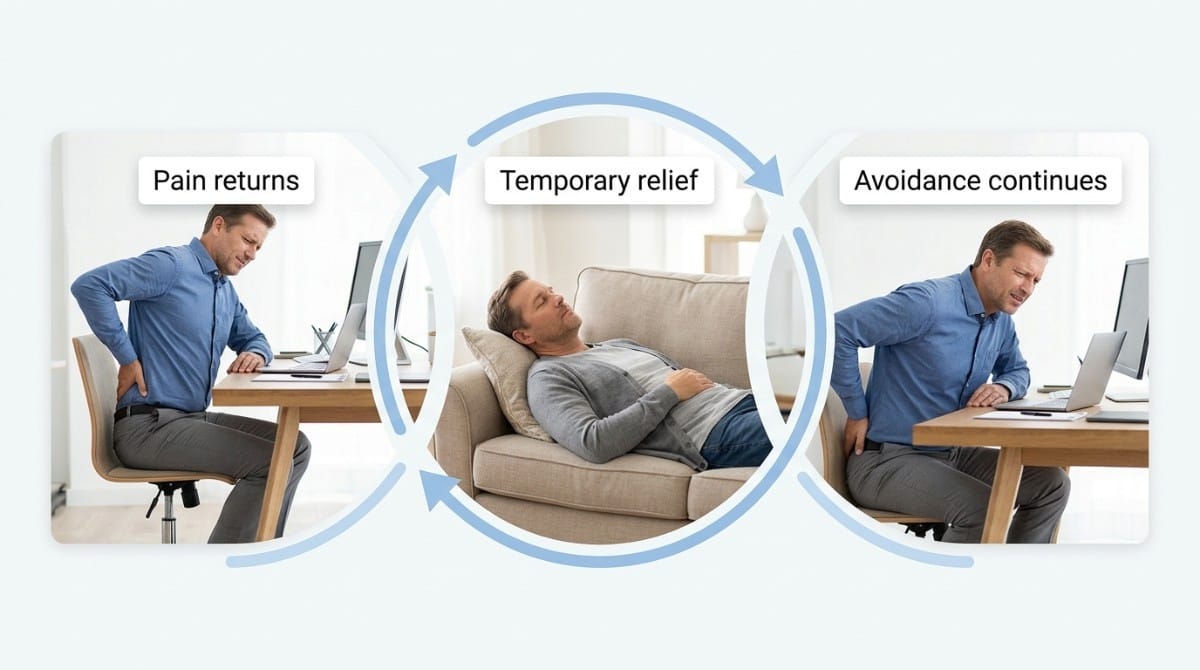
Lower back pain often does ease temporarily. After a rest day, a good night's sleep, or a reduction in physical load, the ache fades.
This creates a false signal: the problem is solved.
But rest treats the symptom, not the cause. The muscle imbalance, postural pattern, or movement habit that created the pain is still present. The relief is borrowed time. As we covered in our guide to why your back pain keeps coming back, this temporary relief cycle is one of the core mechanisms that keeps pain recurring for years.
3. Busyness as Justification
"I'll sort it when things quiet down" is one of the most common reasons people give for not addressing back pain.
The problem: things rarely quiet down. Work deadlines, family commitments, and daily obligations are not temporary inconveniences - they are the structure of adult life.
Waiting for the right moment to fix your back is, for most people, a strategy for never fixing it.
4. Fear of the Process
Some people avoid seeking help not because they think the problem will go away - but because they're afraid of what addressing it might involve.
Fear of being told something is seriously wrong. Fear of expensive treatment. Fear of being told to rest when rest feels impossible. Fear of committing to a programme they might not stick to.
Avoidance, in these cases, is a form of protection. If you don't investigate, you can't receive bad news.
5. Uncertainty About What to Do
Many people genuinely don't know where to start. Physiotherapy feels expensive. YouTube exercises feel overwhelming and inconsistent. The options seem unclear, so inaction becomes the default.
This is the gap that accessible, structured recovery tools exist to close.
What Ignoring Lower Back Pain Actually Costs You
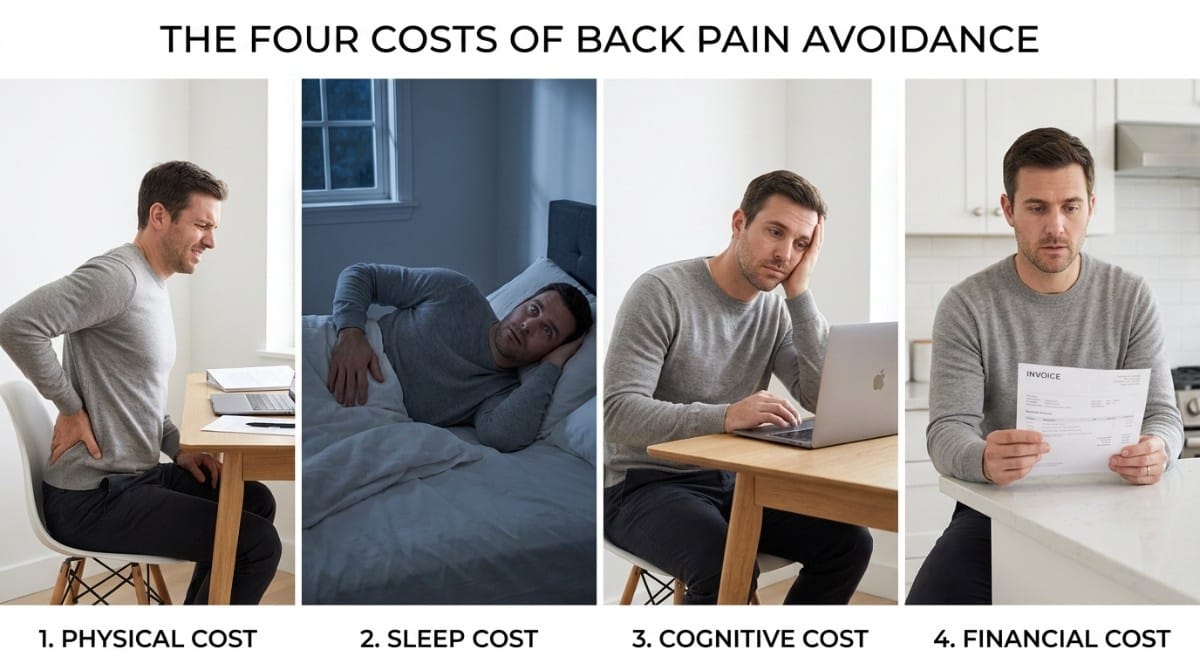
The cost of avoidance is not abstract. It compounds across four distinct dimensions.
🔴 Physical Cost
The lumbar spine is a load-bearing system. When it's not functioning correctly, surrounding muscles, joints, and connective tissue compensate.
These compensation patterns create secondary pain sites - hips, knees, upper back, and neck - that develop independently of the original problem. What starts as a lower lumbar issue becomes a full-body postural dysfunction.
Disc degeneration at L4-L5 and L5-S1 can accelerate when misalignment goes uncorrected for years. Joint surfaces wear unevenly. Nerve pathways become increasingly compressed.
The longer you wait, the more tissue is involved - and the more complex recovery becomes.
Physiotherapists often observe that patients who address lower back pain within the first three months of onset recover significantly faster than those who wait six months or more.
😴 Sleep Cost
Pain disrupts sleep architecture even when it doesn't fully wake you. The brain processes pain signals throughout the night, reducing the proportion of deep, restorative sleep - even if you don't consciously notice.
The result: you wake tired despite adequate sleep hours. Fatigue then makes daytime movement feel harder, which further reduces physical activity, which worsens the back pain.
This is one of the clearest back pain feedback loops - and it operates entirely below the threshold of conscious awareness for most people. Our article on best sleeping positions for lower back pain addresses this cycle directly.
🧠 Cognitive and Mood Cost
Chronic pain - defined as pain lasting more than three months - has well-documented effects on mental health. Research in pain neuroscience consistently shows elevated rates of anxiety, low mood, and reduced cognitive performance in people with persistent lower back pain.
This is not a weakness or an overreaction. It is a physiological response to sustained pain signalling.
The brain allocates significant processing resources to monitoring pain. Fewer resources are available for focus, creativity, and emotional regulation. Over time, chronic back pain quietly erodes quality of life in ways that extend far beyond the physical.
💡 Key Insight: Back pain doesn't stay in your back. Unaddressed for long enough, it reshapes your sleep, your mood, your energy, and your capacity to show up fully in work and relationships.
💸 Financial Cost
Avoidance is not free. It defers cost - it doesn't eliminate it.
A lower back issue addressed early with a structured home programme costs very little. The same issue addressed after 18 months of worsening - now requiring multiple physiotherapy sessions, possible imaging, and extended recovery - costs considerably more.
Add the indirect costs: reduced work performance, sick days, and the growing restriction of activities (sport, travel, exercise) that provide the experiences that make life meaningful.
The Psychology of "Almost Starting"
There's a specific avoidance pattern worth naming: the almost-start.
This is the person who watches a lower back stretching video, follows along for three days, feels slightly better, and stops.
Or the person who books a physio appointment and cancels it when the pain eases that week.
Or the person who downloads a posture app, completes the initial scan, and never opens it again.
Almost-starting feels like action. It temporarily relieves the guilt of avoidance without requiring the commitment of genuine change.
Almost-starting is, in many ways, more expensive than not starting at all - because it creates the illusion of having addressed the problem while leaving the cause intact.
Posture specialists suggest that the difference between people who fix their back pain and those who don't is almost never about effort or intelligence. It's about structure - having a system that makes continuing easier than stopping.
How to Break the Avoidance Pattern
Step 1 - Name what's actually happening
Is it normalisation? Fear? Uncertainty? Busyness? Naming the specific reason you've been avoiding action removes its ambient power.
Most people, when they reflect honestly, can identify exactly which of the five patterns above is driving their avoidance.
Step 2 - Lower the activation energy
The biggest barrier to starting is usually not the exercise itself - it's the friction of beginning. A 10-minute guided daily routine is far more likely to become a habit than a 45-minute self-directed programme.
Make the starting point small enough that avoidance becomes harder to justify than doing it.
Step 3 - Commit to a diagnosis before a solution
Understand your specific pain pattern before choosing an exercise approach. Pain that's worst in the morning has different implications than pain that builds through the afternoon. Our guide to lower lumbar pain causes and triggers walks through exactly how to identify your pattern.
Step 4 - Use a structure that enforces consistency
The single most effective predictor of recovery is not the quality of the first exercise. It is whether you are still doing the programme in week four.
Choose a system - whether that's a physio, an app, or a clear written plan - that provides daily structure and reminders. Willpower is not a sustainable consistency mechanism.
Step 5 - Reframe the time cost
Ten minutes of guided back rehabilitation per day is approximately 1.2% of your waking hours. The argument that there is no time is, on examination, rarely about time.

When This Approach Doesn't Apply
The behavioural framework above is written for people with mechanical lower back pain - the most common type - where avoidance is the primary barrier to recovery.
This does not apply if:
- Your pain is severe (7/10 or above) and unrelated to movement
- You have radiating pain, numbness, or tingling down one or both legs
- Pain began after trauma or a fall
- You have unexplained weight loss alongside back pain
- Pain is significantly worse at night regardless of position
These presentations require professional clinical assessment - not a self-management programme. If any of these apply, see a doctor or physiotherapist before starting any exercise routine.
Research & Expert Insight
- Research in pain neuroscience shows that pain catastrophising - the tendency to anticipate the worst outcome - is one of the strongest predictors of back pain becoming chronic. Early intervention consistently disrupts this pattern
- Physiotherapists often note that the patients with the best outcomes are not those with the least severe pain - they are those who address it earliest and most consistently
- A 2020 study in JAMA Internal Medicine found that people who used structured digital health tools for back pain reported significantly higher adherence to exercise programmes and better long-term outcomes than those who relied on self-directed routines
- Posture specialists suggest that the shift from passive coping (resting, pain medication) to active recovery (targeted exercise and posture correction) is the single most impactful change a person with mechanical back pain can make
What Happens When You Finally Do Start
The recovery arc for mechanical lower back pain - when approached correctly - is more encouraging than most people expect.
Week 1-2: Reduced morning stiffness. Slightly improved range of motion.
Week 3-4: Pain levels begin to measurably decrease. Movement feels less guarded.
Week 6-8: Postural awareness improves. Daily activities feel easier. The back pain that felt permanent starts to feel like a problem being solved.
Week 10-12: For most mechanical cases, significant and sustained pain reduction. Compensation patterns begin to resolve as the root cause is addressed.
The caveat: this trajectory requires consistency. Starting once is not recovery. Starting and continuing is.
For the specific stretches and rehab exercises that form the foundation of this recovery arc, see our lower lumbar pain stretches guide.
Final Takeaway
Lower back pain avoidance is not a character flaw. It's a predictable human response to a gradually worsening problem in a busy life.
But the cost of avoidance is real - physical, psychological, financial, and personal. And it compounds with every month of delay.
The good news: the window for straightforward recovery is open for longer than most people think. It just requires actually climbing through it.
Why Most Exercise Plans Fail
Almost-starting is the norm, not the exception.
The reasons are always the same: the plan is too complicated, there's no daily structure, and the first missed session becomes two, then five, then abandonment.
Generic exercise plans fail not because the exercises are wrong - but because nothing keeps you doing them.
- No reminders - easy to forget on a busy day
- No adaptation - same routine whether you're on day 3 or day 30
- No feedback - no way to know if you're improving
- No personalisation - built for a generic body, not yours
The System That Makes Consistency the Default
Backed AI is built around one core insight: the people who fix their back pain are not more motivated than the people who don't. They have better systems.
- 📱 AI posture scan - identifies your specific lumbar and postural pattern before recommending a single exercise, so the programme is built around your body, not a template
- 🎯 Personalised daily programme - 10-15 minutes, sequenced correctly for your pattern, adapting as you progress
- 📈 Daily reminders and progress tracking - the consistency infrastructure that willpower alone cannot provide
If avoidance has been your pattern so far, the answer isn't more motivation. It's a lower-friction system that meets you where you are and builds the habit automatically.
Ten minutes a day. A programme built for your body. A tracking system that shows you it's working.
Download Backed AI and start correcting your posture today.
FAQ
Q1: Why do people ignore lower back pain for so long?
The most common reasons are normalisation (daily pain stops feeling like an alarm), the belief that rest will solve it, busyness, fear of diagnosis, and uncertainty about what to do. None of these are conscious decisions - they are predictable behavioural patterns that most people with chronic lower back pain experience.
Q2: What happens to lower back pain if you ignore it?
Ignored mechanical lower back pain typically progresses. Surrounding muscles develop compensation patterns, creating secondary pain in the hips, knees, and upper back. Sleep and mood are affected by persistent pain signalling. Recovery becomes more complex and time-consuming the longer action is delayed.
Q3: How long is too long to wait before addressing lower back pain?
Physiotherapists generally recommend addressing lower back pain within the first three months of onset for the fastest recovery trajectory. Pain lasting more than three months is clinically defined as chronic and typically requires a more structured, longer-term approach.
Q4: Is lower back pain avoidance a psychological issue?
It has strong psychological components - particularly normalisation, fear avoidance, and low self-efficacy around exercise. But it is not a mental health condition. Understanding the behavioural pattern is usually sufficient to begin dismantling it.
Q5: What's the easiest way to actually start addressing lower back pain?
Lower the activation energy. Start with a 10-minute guided daily routine rather than a complex programme. Use an app with reminders to remove the need for willpower. Understand your specific pain pattern before choosing exercises. Consistency over two weeks is far more valuable than perfection for one day.