
Stretches for Dowager's Hump in Seniors: A Safe, Gentle Daily Plan That Actually Works

Dowager's hump in older adults is rarely "just stiffness." It is the slow result of decades of forward posture, thinning bone density, and weakened postural muscles. The good news: gentle, daily stretching can soften the hump, ease neck tension, and restore noticeable height, even in your 60s, 70s, and 80s.
This guide gives you a safe, age-appropriate stretch routine specifically designed for seniors, with clear modifications, what to avoid, and how to know it is working.
🧠 TL;DR
- Dowager's hump in seniors is usually postural, but bone-density and structural factors matter more with age.
- Daily gentle stretching of the chest, upper back, and deep neck muscles softens the hump over time.
- 8–10 minutes a day, 5 days a week, is enough to see change in 6–8 weeks.
- Avoid forced neck bending, ballistic movements, or anything that causes sharp pain or dizziness.
- Many seniors get the best results doing stretches seated, not on the floor.
- Always clear new exercise routines with a doctor if you have osteoporosis, recent fractures, or balance issues.
- Pair stretching with daily walking and gentle strengthening for the most lasting result.
What Is a Dowager's Hump in Seniors?
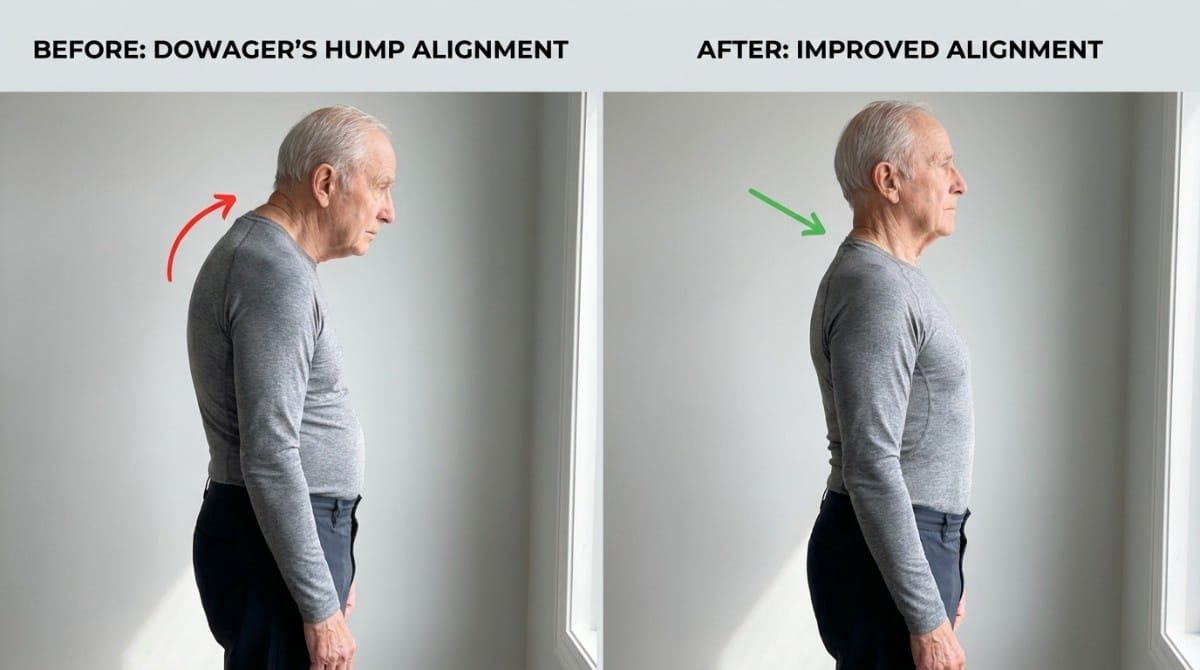
A dowager's hump in older adults is a forward rounding at the base of the neck and upper back caused by long-term postural changes, weakened postural muscles, thoracic stiffness, and in some cases age-related changes in spinal bone density.
In younger adults, the hump is almost always postural. In seniors, it is often postural plus structural, meaning soft tissue, muscle weakness, and skeletal changes all contribute. That distinction matters because it changes how aggressively you should stretch.
The Backed AI explainer on what a dowager's hump actually is covers the medical background in more detail.
Why Does a Dowager's Hump Form More in Seniors?
Three age-related factors stack together:
- Postural memory. Decades of forward sitting, reading, sewing, and screen use shape the spine.
- Weakened postural muscles. Upper back muscles atrophy without regular use.
- Bone-density changes. In some seniors, mild compression in the upper thoracic vertebrae increases natural curvature.
This is why dowager's hump is more common in women past menopause, but it appears in men too. Posture specialists suggest that gentle, consistent mobility work can address the postural and muscular drivers, even when the structural component cannot be fully reversed.
💡 Key Insight: Stretching cannot reverse vertebral compression or significant bone changes, but it can dramatically improve the postural and soft-tissue drivers, often producing visible improvements in height, comfort, and alignment.
Safety First: When to Stretch and When to Pause
A short safety checklist before you start:
- ✅ Cleared by your doctor if you have osteoporosis, low bone density, or a history of fractures
- ✅ Stable footing and a firm chair available
- ✅ No sharp pain, dizziness, or numbness during movement
- ❌ Avoid forced neck bending, especially backward
- ❌ Avoid bouncing or "popping" the neck
- ❌ Stop immediately if you feel light-headed or any sharp pain
If you have known osteoporosis, prefer seated stretches over lying flat and avoid any movement that rounds the spine forward strongly (no toe-touches, no deep forward folds).
Best Stretches for Dowager's Hump in Seniors (Quick List) 🧘♀️
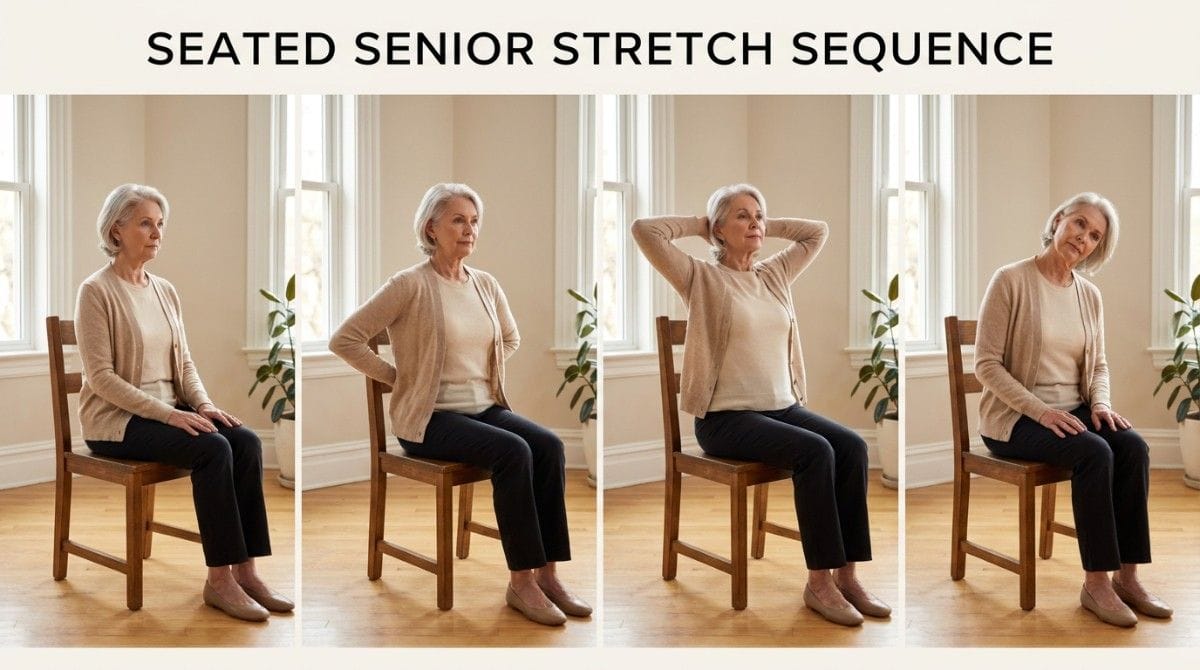
A senior-friendly sequence designed for safety and consistency:
- Seated chin tucks – Gently retract the chin straight back. Resets cervical alignment without strain.
- Seated chest opener – Hands clasped behind a chair back, gentle squeeze of the shoulder blades. Opens tight pecs.
- Seated thoracic extension – Hands behind head, soft upward arch of the upper back over the chair.
- Gentle upper trap stretch – Tilt the ear toward the shoulder, no force. Releases side-neck tension.
- Standing wall posture reset – Heels, hips, upper back, and head touching a wall. Resets full alignment.
- Slow shoulder rolls – 10 backward rolls. Mobilizes the shoulder girdle.
- Chin-to-chest gentle hold – Brief, controlled forward hold. Lengthens the back of the neck.
Total: about 8–10 minutes. Done daily, this is enough input to soften the postural drivers of a dowager's hump.
How To Build a Safe Daily Routine (Step-by-Step Recovery Framework)
A gentle progression designed for older adults:
The principle is simple: start small, build slowly, never force. Many seniors who follow a similar gradual progression in safe posture exercises for seniors see meaningful change within two months.
Common Stretching Mistakes Seniors Should Avoid 🚫
- Stretching only when sore. Daily small input changes tissue better than occasional long sessions.
- Forcing the neck backward. Hyperextension is risky for older spines.
- Holding breath during stretches. Always breathe slow and steady.
- Trying floor exercises if balance is poor. Use a chair or wall instead.
- Comparing progress to younger adults. Senior tissue responds, just on a longer timeline.
What Happens If You Don't Stretch Regularly?
The hump deepens, neck tension builds, and height continues to slowly decrease. Beyond appearance, untreated dowager's hump in seniors often contributes to:
- Chronic neck and shoulder tension
- Reduced lung capacity from compressed ribcage
- Difficulty looking up or driving safely
- Loss of confidence and reduced upright walking
The earlier the daily routine starts, the better the outcome. Even modest input slows progression.
When This Approach Doesn't Work
Stretching is highly effective for the postural component of dowager's hump in seniors. It is not enough on its own when:
- The hump is from significant vertebral compression fractures
- Severe osteoporosis has changed spinal architecture
- The hump appeared rapidly without lifestyle change
- There is associated arm numbness, weakness, or balance loss
In those cases, see a clinician first. For most seniors, however, the postural and soft-tissue drivers respond well to gentle daily mobility, especially when paired with light upper-back strengthening and consistent walking.
Research & Expert Insight 🔬
Research in musculoskeletal rehab shows that older adults who maintain regular thoracic mobility and chest opening exercises preserve better cervical alignment and report less neck and upper back pain than peers who do not. Physiotherapists often recommend seated routines for seniors because they reduce fall risk while still delivering the mobility input needed to address dowager's hump. The key finding across studies is consistency: short daily sessions outperform longer, occasional ones.
Lifestyle Habits That Multiply Your Results
A few simple daily habits that support the stretching routine:
- Walk daily, even if only 10–15 minutes. Movement supports spinal health.
- Sit upright during meals and reading.
- Use a single supportive pillow at night, not two stacked.
- Read with the book or device raised, not flat on your lap.
- Consider light upper-back strengthening twice a week, with a doctor's guidance.
If you want personalized guidance designed for older adults, Backed AI scans your posture using your phone camera and builds a gentle routine tuned to your specific alignment, removing the guesswork that makes most seniors abandon stretching plans.
Final Takeaway
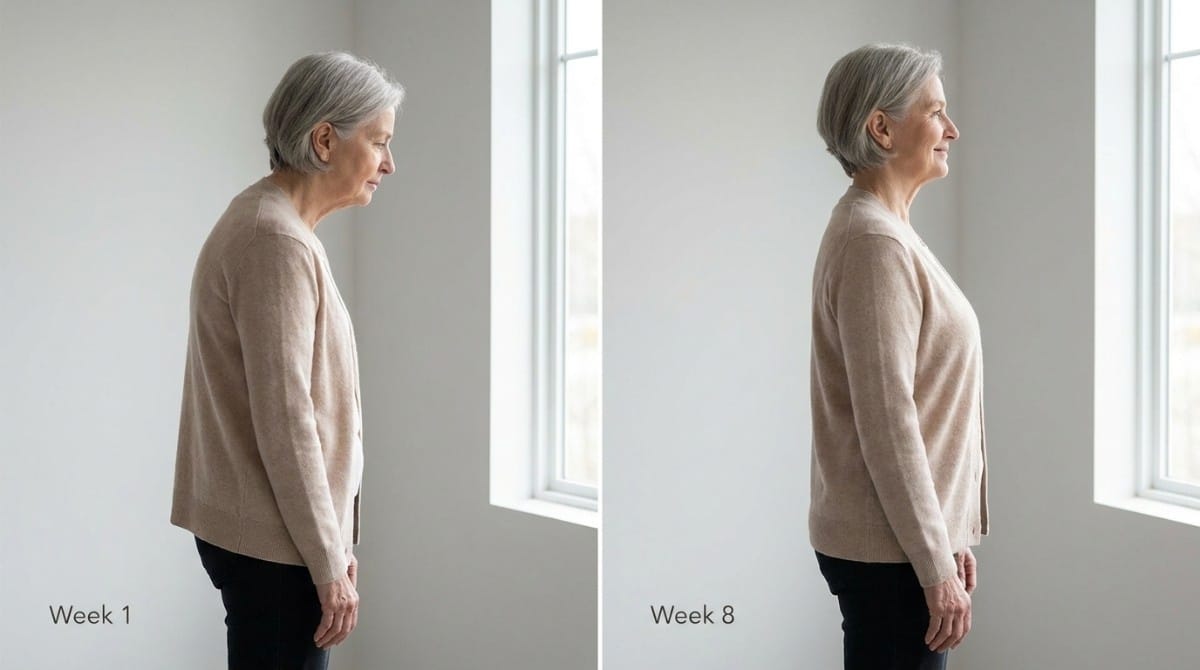
Dowager's hump in seniors responds to gentle, consistent, age-appropriate stretching. The combination of seated chest openers, chin tucks, thoracic mobility, and a daily wall posture reset addresses the postural and soft-tissue drivers of the hump. With 8–10 minutes a day, 5 days a week, most older adults notice less neck tension within two weeks and visible posture improvement at six to eight weeks.
The goal is not to look 30 again. It is to stand a little taller, breathe a little deeper, and move through the day with less stiffness. That is fully within reach at any age.
Why Most Stretching Plans Fail Seniors
Many older adults start a generic routine, find it too aggressive or too vague, and quietly stop. The reasons repeat:
- No personalization. A one-size-fits-all routine ignores age, mobility, and bone-density needs.
- No form feedback. Seniors often compensate without knowing, undoing the benefit.
- No safe progression. Plans either stay too easy or jump too hard.
- No habit support. Without reminders, daily practice slips away.
A Smarter Way to Address Dowager's Hump
Backed AI was built to close that gap. It scans your posture using your phone camera, identifies which drivers of dowager's hump are dominant in your body, and builds a gentle, age-appropriate routine you can do seated or standing, at home, in your own time.
What you get:
- 📱 Personalized stretch routines based on your actual posture scan, not a generic template
- 🎯 AI form guidance so each gentle stretch hits the right tissue safely
- 📈 Progress tracking that shows visible alignment changes over weeks of consistent practice
It is calm, structured, and designed for sustainable daily use, especially for older adults who want a reliable system without the complexity.
👉 Download Backed AI and start gently correcting your posture today
FAQ
Q1. Can stretching really reduce a dowager's hump in seniors?
Yes, when the hump is mostly postural. Gentle daily stretching of the chest, upper back, and neck softens the soft-tissue drivers and improves alignment, even in your 70s and 80s. Structural changes from osteoporosis cannot be reversed by stretching alone.
Q2. How long until older adults see results?
Most seniors notice less neck stiffness within one to two weeks and visible posture improvement at six to eight weeks of consistent daily practice.
Q3. Are floor stretches safe for seniors?
For many older adults, seated and standing stretches are safer and just as effective. Floor exercises are fine if balance and getting up and down are not concerns.
Q4. Can someone with osteoporosis do these stretches?
Often yes, but with caution. Seniors with osteoporosis should avoid forward bending and forced movements, and should clear new routines with a doctor first.
Q5. What is the single best stretch for dowager's hump in seniors?
A seated chest opener with a gentle shoulder-blade squeeze. It directly counters the rounded-shoulder pattern that drives the hump and is safe for nearly all older adults.