
Core Strength Exercises for Back Pain: The Deep-Muscle Routine That Actually Holds

If your lower back keeps aching, the fix is usually not more stretching. It is building the deep muscles that hold your spine steady. The right core strength exercises for back pain train those stabilizers so your back stops absorbing load it was never meant to carry. 💪
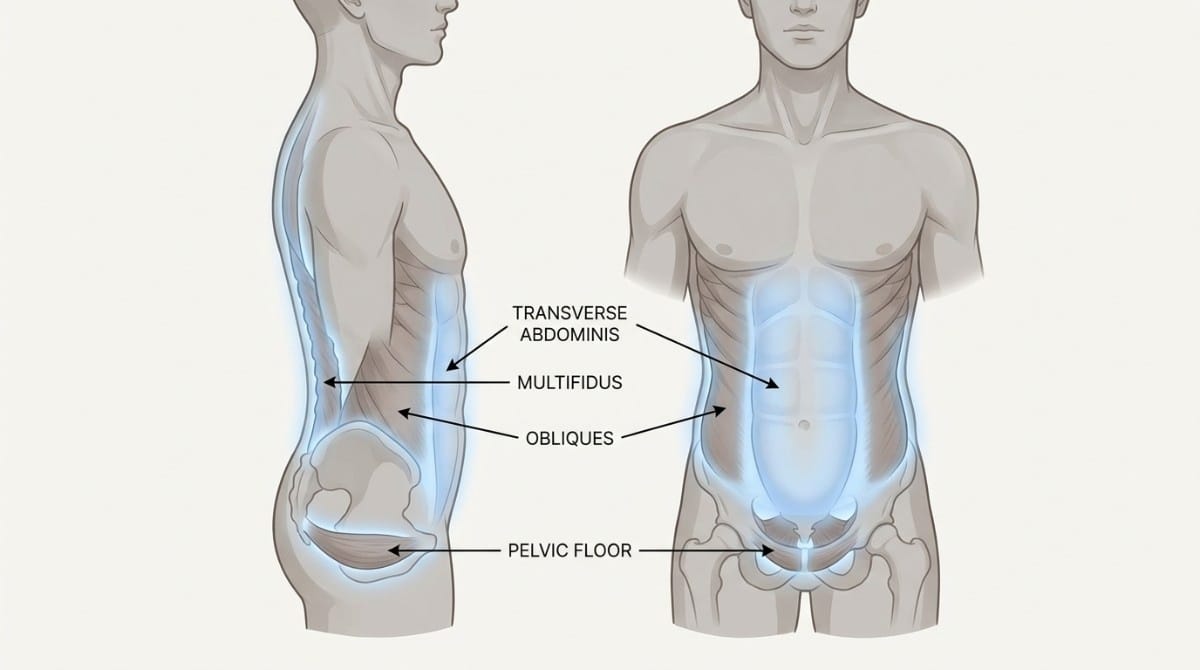
Core strength exercises for back pain are targeted movements that train the deep stabilizing muscles of your trunk – the transverse abdominis, multifidus, obliques, and pelvic floor – to support your spine and reduce strain on the lower back.
TL;DR
- A weak core forces your lower back to compensate, which is a common driver of everyday pain.
- The best exercises build stability, not crunch volume. Think bird dog, dead bug, glute bridge, and planks.
- Skip sit-ups and weighted twists during a flare. They load the spine you are trying to protect.
- Consistency beats intensity. 15 minutes, 3 to 4 times a week is enough.
- Most people stall because of wrong form and no progression, not lack of effort.
- Strengthening pairs best with mobility work and better daily sitting habits.
- Expect measurable change in 4 to 8 weeks of steady practice.
What Is a Weak Core (and Why Does It Cause Back Pain)?
Your "core" is not just your abs. It is a corset of muscles wrapping your abdomen, lower back, hips, and pelvic floor that braces your spine during every movement.
When that corset is weak, your spine loses its support system. Small daily loads like bending, sitting, and lifting get transferred to passive structures like discs and ligaments. That is when the dull ache sets in.
This is why core strength exercises for back pain work. They rebuild the muscles that should be doing the stabilizing, so your lower back can stop overworking. If your tightness is being driven by hours at a desk, the pattern in lower back pain from sitting explains the exact chain of events behind it.
Why Does Strengthening Your Core Reduce Back Pain?
A strong core acts like internal scaffolding. When the deep muscles fire correctly, they create intra-abdominal pressure that braces the spine before you move.
Posture specialists suggest that stability training reduces the micro-movements that irritate the lower back over time. Stronger stabilizers also mean your glutes and abs share the load, instead of dumping it all on your lumbar spine.
The goal is control, not crunches. You are teaching your trunk to stay quiet and solid while your arms and legs move.
🔑 Key Insight: Research in musculoskeletal rehab shows that core stability exercises, which keep the spine neutral, tend to outperform traditional ab exercises like sit-ups for reducing chronic lower back pain. Endurance and control matter more than how many reps you can grind out.
Best Core Exercises for Back Pain (Quick List)
These are the highest-value movements, ordered from gentlest to most demanding. Master form before adding reps.
- Pelvic Tilt – The starting point. Teaches you to find and hold a neutral spine and gently wake up the deep core.
- Dead Bug – Builds deep core control while your back stays pressed flat and safe. Excellent for beginners.
- Bird Dog – Strengthens the multifidus and trains anti-rotation stability, the kind your spine needs daily.
- Glute Bridge – Activates the glutes and posterior chain so your lower back stops compensating for sleepy hips.
- Forearm Plank – Trains anti-extension endurance with a neutral spine. Start on knees if needed.
- Side Plank (Modified) – Targets the obliques and QL, the lateral stabilizers that prevent side-to-side sway.
- Pallof Press (band) – An anti-rotation press that protects the spine from twisting forces. Add once basics feel easy.

How To Do the Four Foundational Movements
Keep every rep slow and controlled. Quality is the entire point.
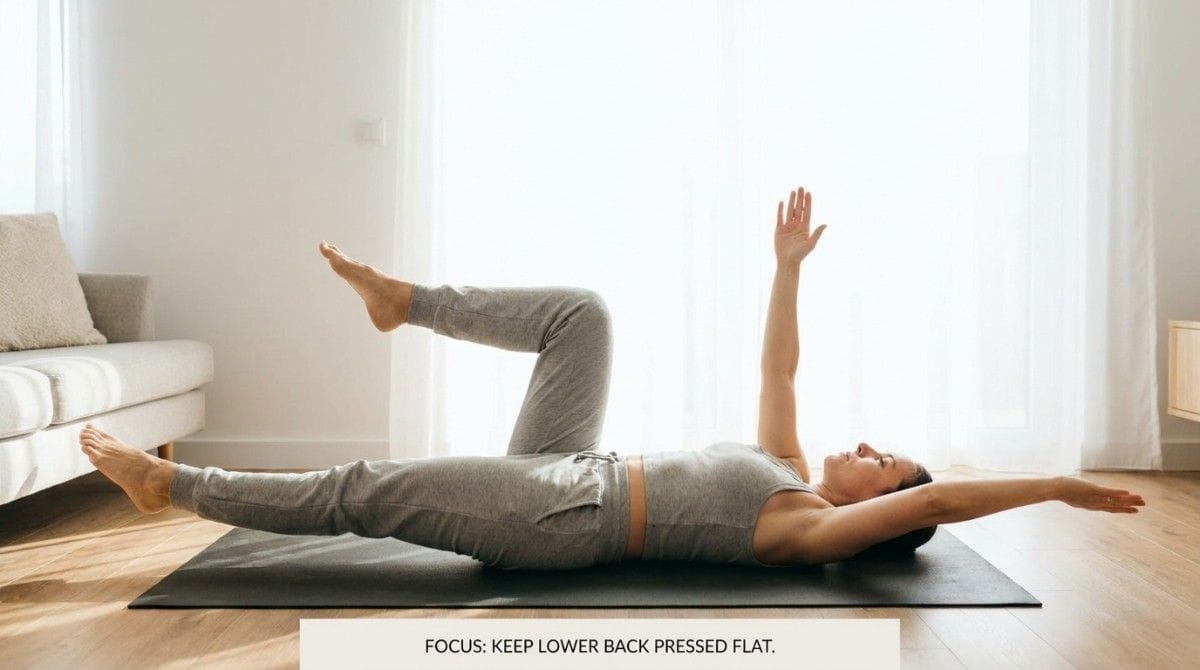
Dead Bug: Lie on your back, arms reaching to the ceiling, knees bent at 90 degrees. Press your lower back into the floor. Slowly lower your right arm and left leg, then return and switch. Do 8 to 10 per side.
Glute Bridge: Lie on your back, knees bent, feet flat. Tighten your core and lift your hips until shoulders, hips, and knees form a line. Hold briefly, lower slowly. Aim for 2 to 3 sets of 12.
Bird Dog: From hands and knees, brace your core. Extend the opposite arm and leg, keeping hips square. Hold 2 seconds, then switch. 8 to 12 per side.
Forearm Plank: Elbows under shoulders, body in a straight line, glutes and core engaged. Hold 20 to 40 seconds. Drop to your knees if your hips sag.
If you want to pair these with gentle release work between sessions, the routine in stretches for a tight lower back complements strengthening without overloading the spine.
Do This, Not That: Core Exercises for Back Pain
Not every "ab" move is back-friendly. Here is the swap that protects your spine.
| Skip During Pain ❌ | Do Instead ✅ | Why It Matters |
|---|---|---|
| Sit-ups / crunches | Dead bug | Repeated spinal flexion can aggravate discs |
| Russian twists (weighted) | Pallof press | Anti-rotation protects the spine instead of twisting it |
| Toe-touches / good-mornings (loaded) | Glute bridge | Builds posterior chain without bending under load |
| Full plank when hips sag | Knee plank | Keeps a neutral spine so the lower back stays safe |
| Leg raises (straight, both legs) | Bird dog | Trains stability without straining the lumbar spine |

A quick word before you commit 👇
Knowing the exercises is the easy part. Doing the right ones for your body, with correct form, consistently for weeks, is where almost everyone falls off. That gap is exactly what Backed AI was built to close, by scanning your posture and turning these movements into a plan that actually fits you.
Step-by-Step Recovery Framework
A simple progression that builds without flare-ups.
Weeks 1 to 2 – Activation. Pelvic tilts, dead bug, glute bridge. 3 sessions a week. Focus only on form and feeling the right muscles work.
Weeks 3 to 4 – Stability. Add bird dog and knee plank. Increase to 3 sets. Start noticing whether daily sitting feels easier.
Weeks 5 to 6 – Load. Progress to full plank and side plank. Add the Pallof press if you have a band. Pair with a 5-minute mobility warm-up.
Week 7+ – Maintenance. Three solid sessions a week. Adjust based on where you still feel tightness, and keep monitoring posture during daily life.
This sits naturally alongside the broader plan in bodyweight back exercises for posture and pain relief, which adds posterior-chain work to your core base.
When This Approach Doesn't Work
Core training is powerful, but it is not a cure-all.
It will not help much if your pain is structural and misdiagnosed. For example, exercises for anterior pelvic tilt can worsen a flat back posture, so getting the pattern right matters before you load it.
It also will not fix nerve-driven pain on its own. If pain shoots down one leg or comes with tingling or numbness, that points toward something like sciatica, not a weak core.
🚩 See a professional if you have sharp or worsening pain, pain that radiates down a leg, numbness, weakness, or any loss of bladder or bowel control. Strengthening is not the answer for those signals.
Research & Expert Insight
Physiotherapists often recommend stability-first training over high-rep ab work for back pain. The reasoning is consistent across rehab literature: deep-core endurance and spinal control reduce the repetitive strain that feeds chronic discomfort.
Posture specialists suggest that pairing strengthening with mobility and better sitting habits produces the most durable results. And research in musculoskeletal rehab shows that meaningful, measurable change usually takes 6 to 8 weeks of consistent effort, not a few sessions.
The takeaway is steady, not flashy. The people who recover are the ones who keep showing up.
Final Takeaway
The most effective core strength exercises for back pain are the unglamorous ones: dead bug, bird dog, glute bridge, and planks done with control. They rebuild the deep stabilizers that take pressure off your lower back.
Avoid the moves that load a spine you are trying to protect. Progress gradually, pair strength with mobility, and stay consistent for at least six weeks. That is the formula that holds.
Why Most Exercise Plans Fail
You now have the right exercises. So why do most people still not get better?
- Inconsistency. A routine done once after reading an article never rewires anything.
- Wrong form. Without feedback, most people unknowingly cheat the movement and lose the benefit.
- No progression. Your body adapts. The same plan stops working in a few weeks.
- No personalization. A generic list cannot know whether your issue is weak glutes, anterior pelvic tilt, or tight hip flexors.
A Smarter Way to Strengthen Your Core
Backed AI is an AI posture correction app built to solve exactly these gaps. Instead of handing you a static list, it scans your posture with your phone camera, then builds a corrective plan around your real imbalances.
- 🎯 AI posture analysis that pinpoints your specific weak links, no guesswork.
- 📱 Personalized routines that progress as your body changes, instead of a list you outgrow.
- 🔔 Habit reminders that keep you consistent, which is the part that actually drives results.
Generic YouTube routines treat everyone the same. Backed AI treats you like the specific case you are, and consistency plus the right exercises is what finally moves the needle.
The longer a weak-core pattern goes uncorrected, the deeper it locks in. Download Backed AI and start correcting your posture today. 💙
FAQ
1. What are the best core strength exercises for back pain?
The most effective are stability-based: dead bug, bird dog, glute bridge, and planks. They strengthen the deep muscles that support your spine without straining your lower back.
2. Can core exercises make back pain worse?
They can if you choose the wrong ones or use poor form. Sit-ups, weighted twists, and full planks with sagging hips can aggravate pain. Stick to controlled, neutral-spine movements.
3. How long until core exercises relieve my back pain?
Most people notice improvement within 4 to 8 weeks of consistent practice, around 3 to 4 sessions a week. Form and consistency matter more than intensity.
4. Should I strengthen or stretch for back pain?
Both, but strengthening usually drives lasting change. Stretching relieves tension temporarily, while strength keeps your spine supported between sessions.
5. When should I see a doctor instead of exercising?
See a professional if you have sharp or worsening pain, pain radiating down a leg, numbness, weakness, or any loss of bladder or bowel control.