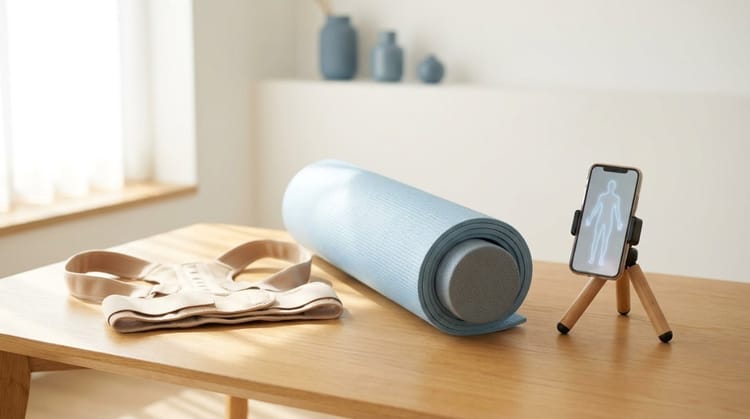
Kyphosis Exercises: The Safe At-Home Routine to Straighten a Hunched Back

The safest way to correct a hunched back is a short daily routine that mobilizes the rib cage and thoracic spine, strengthens the muscles between the shoulder blades, and stretches the chest and hip flexors pulling you forward. Done consistently, most postural kyphosis responds within 6 to 12 weeks. This routine is not a fix for structural kyphosis, like Scheuermann's disease or fracture-related curves, which need a doctor's input first.
TL;DR
- A safe kyphosis routine combines rib cage mobility, thoracic extension, and mid-back strengthening, not stretching alone. 🧘
- Most postural kyphosis responds to short daily sessions rather than occasional long workouts.
- Build the routine in phases: mobilize first, then activate, then strengthen, then integrate into daily life.
- Skip aggressive extension work if you have osteoporosis, a recent fracture, or diagnosed Scheuermann's disease, unless a professional has cleared it.
- Stop and see a doctor if you feel sharp pain, numbness, tingling, or new breathing trouble during any exercise.
- Consistency over 6 to 12 weeks matters more than how hard any single session feels.
Quick Recap: What Is Kyphosis?
Kyphosis is an excessive forward curve in the upper spine that rounds the upper back. If you haven't confirmed whether your curve is postural (correctable) or structural, the full breakdown of causes, signs, and the flexibility self-test in what kyphosis actually is is worth reading first. This guide assumes postural kyphosis and focuses entirely on the exercise routine itself.
Why Do Exercises Help Kyphosis?
Kyphosis usually comes from a specific pattern, not general inactivity: tight chest muscles and tight hip flexors pull the body forward, while the mid-back muscles and deep neck flexors that should hold you upright go weak from underuse. Exercises help because they target both sides of that pattern at once. Stretching alone loosens the tight side but doesn't build the strength to hold a corrected position. Strengthening alone builds muscle but can't lengthen tissue that's already shortened. A real kyphosis routine needs both, done in the right order.
Before loading any extension work, it helps to confirm your thoracic spine actually has room to move. A quick at-home thoracic mobility check takes under five minutes and tells you whether you're ready to start, or whether you should ease in more gradually.

How To Build a Safe Kyphosis Routine
Jumping straight into strengthening exercises on a stiff, rounded spine is one of the most common mistakes people make. A safer approach builds through four phases, each one preparing the body for the next.
| Phase | Focus | Example Moves | How Often |
|---|---|---|---|
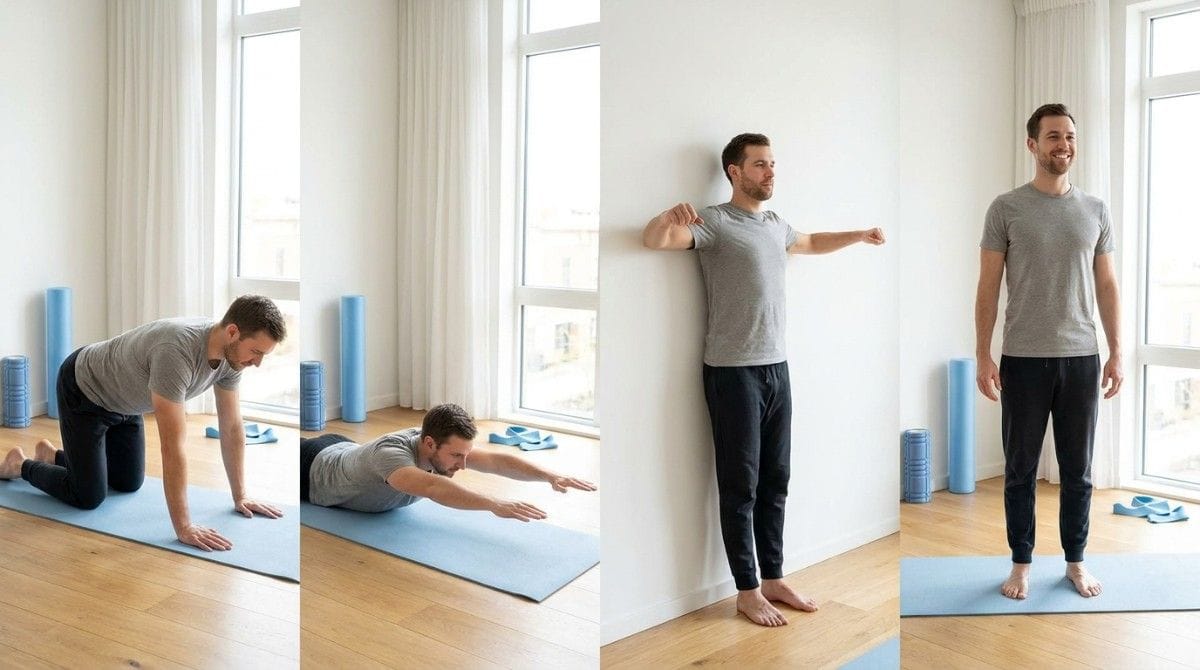
| 1. Mobilize (Weeks 1–2) | Free up the rib cage and thoracic spine | Cat-cow, thread-the-needle, foam roller extension | Daily, 5 to 8 minutes |
| 2. Activate (Weeks 2–4) | Wake up the muscles between the shoulder blades | Prone Y-T-W raises, scapular squeezes | 4 to 5 times a week |
| 3. Strengthen (Weeks 4–8) | Build load tolerance in the upper back | Wall angels, band pull-aparts, face pulls | 3 to 4 times a week |
| 4. Integrate (Week 8+) | Carry the correction into daily posture | Standing posture checks, desk resets | Ongoing daily habit |
If you're unsure whether you're extending far enough without over-arching your lower back to compensate, a camera-based check like the one inside Backed AI can flag the difference in real time, which is harder to judge by feel alone.
When Should You Actually Do These Exercises?
Timing matters more than most people expect. Mobility work (Phase 1) fits best first thing in the morning, since the thoracic spine tends to be at its stiffest right after waking or after a long stretch of sitting. Strengthening moves (Phase 3) work better later in the day, once the body has warmed up. If you sit at a desk, a short mobility break every 60 to 90 minutes does more for a hunched back than one long session in the evening. Weekend athletes and desk workers who travel often skip the routine on busy days, which is fine occasionally, but three or more missed days in a row tends to reset progress back toward week one.
Kyphosis Exercises for Each Phase (Full Breakdown)
- Foam roller thoracic extension. Lie back over a foam roller placed under your shoulder blades, arms relaxed overhead. Let gravity gently extend your upper spine for 8 to 10 slow breaths.
- Doorway chest stretch. Place forearms on a doorframe and step forward until you feel a stretch across the chest. Hold 30 seconds, 3 times per side. A deeper breakdown of chest-opening work is in how to open your chest and improve posture in 10 minutes a day.
- Prone Y-T-W raises. Lying face down, lift your arms into a Y, then a T, then a W shape, 8 reps each, to target different angles of the mid-back.
- Thread-the-needle rotation. From hands and knees, thread one arm under your body, rotating through the thoracic spine, then reverse. 8 reps per side.
- Wall angels. Stand against a wall and slide your arms up and down while keeping your lower back, shoulders, and head in contact with it. The full step-by-step wall angels breakdown covers common form mistakes worth checking. 10 reps.
- Band pull-aparts or face pulls. Using a light resistance band, pull it apart at chest height or up toward your face, squeezing the shoulder blades together. 12 to 15 reps.

What Happens If You Push Too Hard, Too Fast?
Soreness the day after a new exercise is normal. Sharp pain during the movement is not. Pushing straight into heavy extension or strength work before the thoracic spine has enough mobility often irritates the ribs or ribcage joints instead of correcting the curve, which is exactly why the phased approach starts slow. Going too hard, too early also tends to backfire on consistency: people who overdo week one often quit by week three, before the routine has had time to work.
When This Approach Doesn't Work
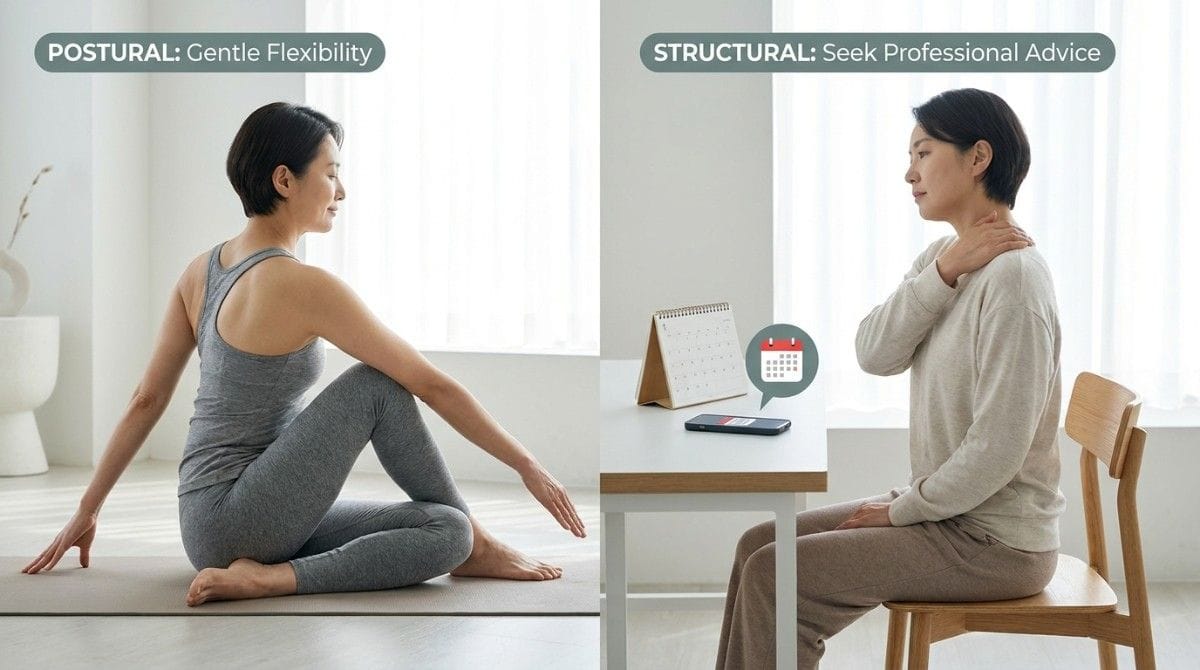
This routine is built for postural kyphosis. It's not appropriate, at least not without medical guidance, if you have diagnosed Scheuermann's disease, osteoporosis, a history of vertebral compression fracture, or a curve that stayed rounded during the flexibility self-test. Stop immediately and see a doctor or spine specialist if you feel sharp or radiating pain, numbness or tingling in your arms or legs, or new difficulty breathing during any exercise. For these cases, bracing or supervised physical therapy usually needs to come first.
Research & Expert Insight
Physiotherapists often start kyphosis programs with mobility before strength, since a stiff thoracic spine limits how much a strengthening exercise can actually change position. Posture specialists suggest short daily sessions over one long weekly workout, since postural muscles respond to frequency more than raw volume. Research in musculoskeletal rehab consistently points to habit consistency, more than any single exercise's difficulty, as the strongest predictor of visible change.
Final Takeaway
Most people notice a visible difference in posture within 6 to 12 weeks of consistent work, following the mobilize, activate, strengthen, integrate sequence above rather than jumping straight to strength exercises. If the honest timeline for posture correction feels slower than you expected, that's normal, not a sign the routine isn't working. The exercises matter less than showing up for them daily.

Why Most Exercise Plans Fail
Most people abandon kyphosis routines within a few weeks, and it's rarely about effort. Generic routines skip the mobility phase and jump straight to strengthening, so progress stalls. Nobody's watching form, so wall angels and Y-raises quietly drift into the wrong range of motion without the person noticing. There's no built-in progression, so the same five exercises get repeated at the same difficulty for months. And without a daily nudge, the habit fades right around the point where the curve would have started to change, which is often why posture fixes don't stick for so many people.
Why Most Exercise Plans Fail Most people abandon kyphosis routines within a few weeks, and it's rarely about effort. Generic routines skip the mobility phase and jump straight to strengthening, so progress stalls. Nobody's watching form, so wall angels and Y-raises quietly drift into the wrong range of motion without the person noticing. There's no built-in progression, so the same five exercises get repeated at the same difficulty for months. And without a daily nudge, the habit fades right around the point where the curve would have started to change.
A Smarter Way to Fix a Hunched Back Backed AI removes the guesswork from a routine like this one. It scans your posture through your phone camera, confirms where your curve actually sits, and adjusts your exercise plan as your mobility and strength improve, instead of leaving you on the same fixed list for months.
- 🎯 Built around your curve. Your program reflects your actual kyphosis pattern instead of a one-size-fits-all list.
- 📊 Form feedback that catches drift. Camera-based checks flag when a wall angel or extension exercise slips out of range, before it becomes a habit.
- 🔔 Daily structure that sticks. Reminders and progress tracking carry you through the phase where most people quietly stop.
A safe kyphosis routine only works if it's actually done, consistently, for weeks. That's the part most people struggle with alone.
Download Backed AI and start correcting your posture today.
FAQ
How often should I do kyphosis exercises? Daily short sessions work better than occasional long ones, especially in the first two to four weeks. Once you move into strengthening, 3 to 5 times a week is usually enough.
Can I fix a hunched back without equipment? Yes. Most of the routine above, cat-cow, thread-the-needle, wall angels, and Y-T-W raises, needs nothing but floor space and a wall. A foam roller helps but isn't required to start.
How long until I see results from kyphosis exercises? Most people notice a visible difference within 6 to 12 weeks of consistent daily or near-daily practice. Postural changes happen gradually, not overnight.
Is it normal to feel sore after starting a kyphosis routine? Mild soreness in the first week or two is normal, especially in the mid-back and chest. Sharp pain, numbness, or tingling during an exercise is not normal and is a sign to stop.
Can kyphosis exercises make things worse? Rarely, but pushing into strength work before your spine has enough mobility can irritate the rib joints or upper back. That's why the phased approach starts with mobility before strengthening.