Why Can't I Fix My Posture? The Real Reason (And How to Finally Stick With It)

If you keep trying to fix your posture and it never holds, the problem is usually not willpower. Posture is a deep habit stored in your muscles and brain, so it resists quick change. Without consistency, feedback, and a plan built for your body, progress stays invisible and motivation fades before results show.
Failing to fix your posture is usually a consistency and feedback problem, not a willpower problem, because the body reverts to old alignment whenever corrective effort is irregular, unguided, or invisible.
TL;DR
- "I can't fix my posture" is almost always a consistency issue, not laziness 🙂
- Posture is a habit stored in muscle and movement memory, so it pushes back
- Invisible early progress kills motivation before visible change arrives
- Generic routines fail because they are not built for your specific imbalance
- Tracking and reminders are the strongest motivation tools available
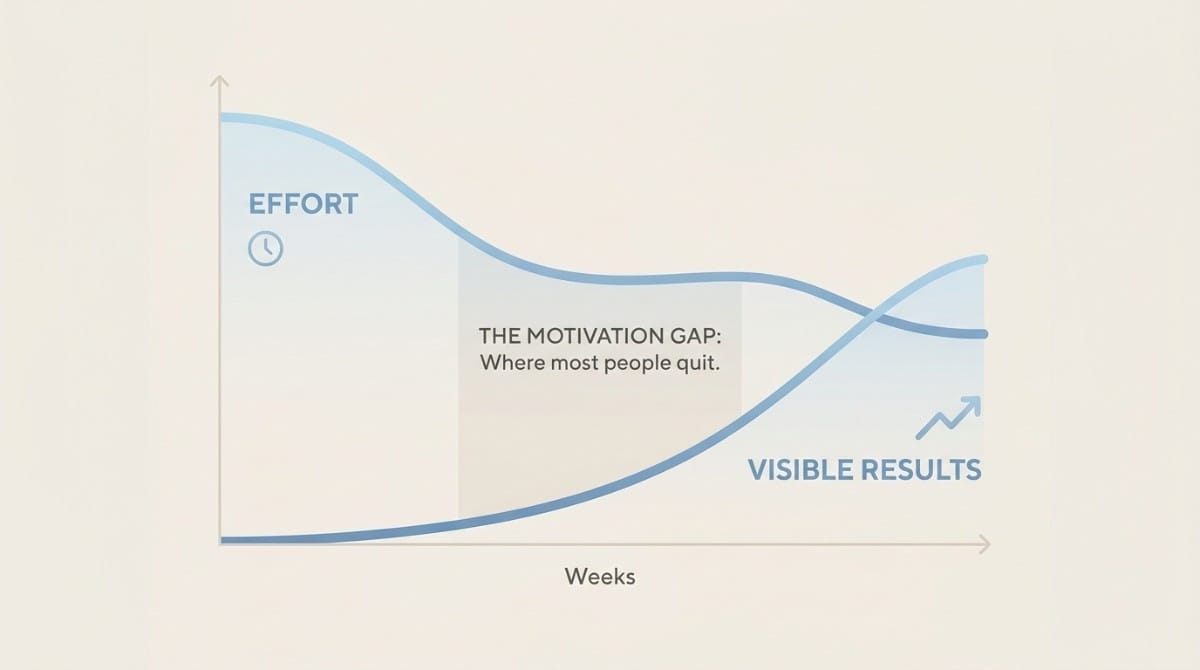
- Most people quit in the gap between effort and visible results
You are not broken, and you are not the exception. You are stuck in a predictable pattern. Let us break it down.
What Does "I Can't Fix My Posture" Really Mean?
When people say they cannot fix their posture, they rarely mean they have never tried. They mean they have tried many times and nothing stuck.
That is a clue. Repeated short attempts that fade are the signature of a habit problem, not an effort problem. Posture correction is a slow retraining of how you sit, stand, and move all day.
This is why understanding the realistic timeline most people underestimate matters so much. Quitting early is the single most common reason posture correction fails.
Your body defaults to the posture you hold most hours of the day. A 10-minute routine cannot outvote 10 hours of slouching unless you also change the small daily moments in between.
Why Can't I Fix My Posture?
Posture lives in two places: your muscles and your brain. Both need repeated reps to change.
Your muscles adapt to the position you hold most, getting tight in some places and weak in others. Your brain stores your default alignment as automatic, so you slump without noticing.
Fixing posture means overwriting both at once. That takes weeks of consistent input, not a burst of motivation. When the effort is irregular, your old pattern always wins because it has years of practice.
Why Does Motivation Fade Before Results Show?
Motivation is highest on day one and lowest around week two. That is also the exact window before visible posture change appears.
So you put in effort, see nothing in the mirror, and your brain quietly decides it is not working. This is the motivation gap, and it traps most people.
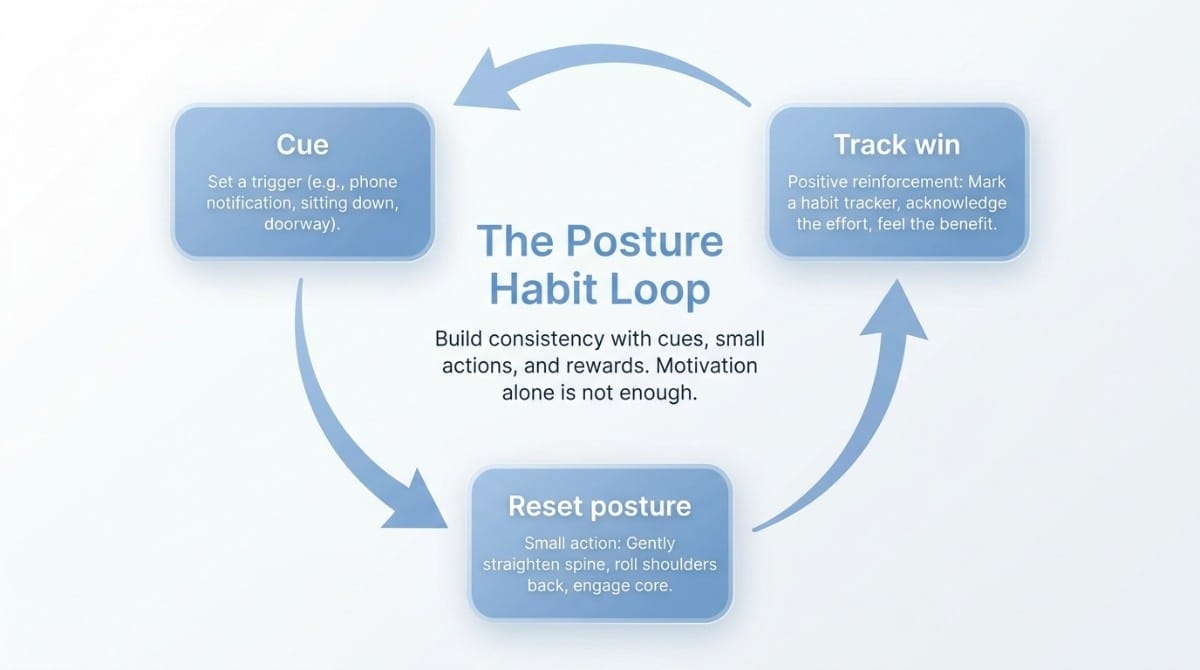
The fix is not more motivation. It is removing the need for motivation by building a system that runs on autopilot.
Why You Can't Fix Your Posture: 6 Real Reasons (Quick List)
Most posture correction failures come down to these patterns. See which ones sound like you.
- Inconsistency. You go hard for a week, then stop. Posture needs daily reps, not occasional sprints.
- No feedback. You cannot see your own alignment, so you do not know if you are improving or doing it wrong.
- Wrong routine for your body. Forward head posture needs different work than anterior pelvic tilt. Generic lists miss your actual imbalance.
- All-or-nothing thinking. You skip one day, feel like you failed, and quit entirely.
- Invisible progress. Early change is felt, not seen, so it does not feel rewarding enough to continue.
- No daily trigger. Nothing reminds you to reset, so the habit never forms.
If three or more apply to you, you do not have a willpower problem. You have a system problem, and systems are fixable.
The Real Reason vs The Fix
Naming the real reason makes the fix obvious.
| What you think the problem is | The real reason | The fix |
|---|---|---|
| "I have no willpower" | No daily trigger or system | Attach posture resets to existing habits |
| "It is not working" | Progress is invisible early on | Track small wins so progress feels real |
| "I keep forgetting" | No reminder loop | Use hourly cues to reset alignment |
| "I do not know if I am right" | No feedback on your form | Get guidance built for your imbalance |
| "I do not have time" | The routine is too big | Start with 5 minutes, not 30 |
What Happens If You Keep Starting Over?
Restarting from zero every few weeks is the most exhausting and least effective approach.
Each restart loses the small gains you built, so you never cross into visible change. It also trains your brain to expect failure, which lowers motivation further next time.
Breaking this loop is less about trying harder and more about the long-term habits that actually stick. Small, repeatable, boring consistency beats intense bursts every time.
Step-by-Step: How to Actually Stay Consistent
This framework fixes the system, not your willpower. It is about building the habit, not the workout.
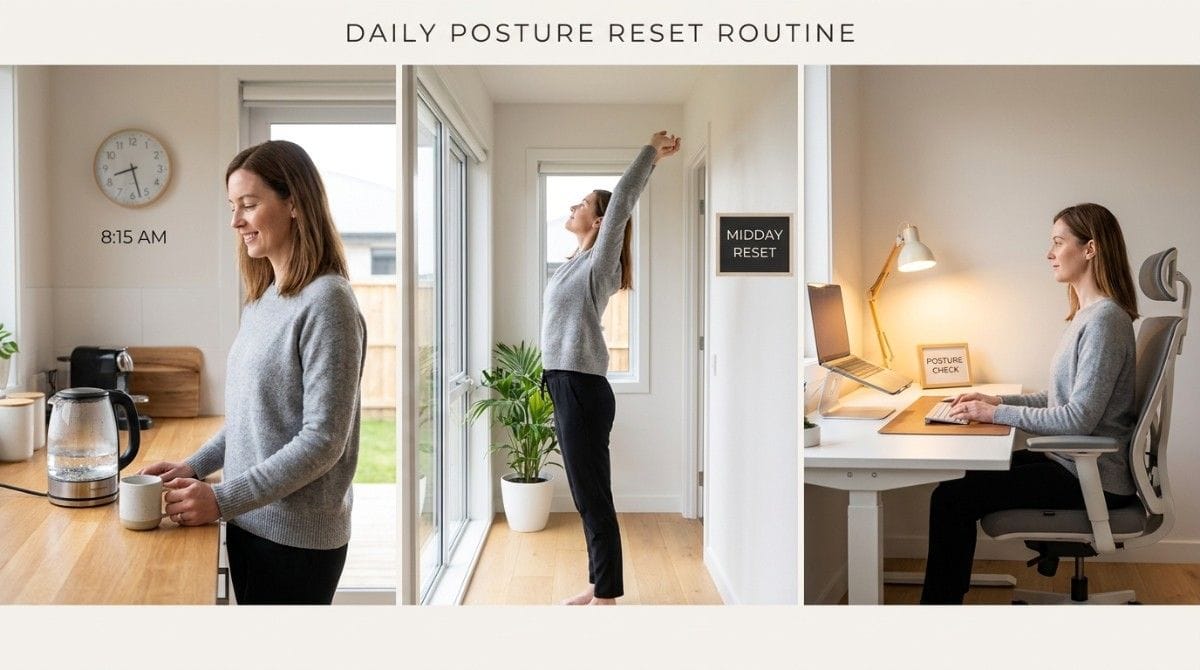
Step 1 – Shrink it. Start with a 5-minute daily reset, not a 30-minute program. Tiny habits survive busy days.
Step 2 – Anchor it. Attach your posture reset to something you already do, like your morning coffee or a lunch break.
Step 3 – Make progress visible. Track each day you do it. Seeing a streak gives your brain the reward that invisible posture change cannot.
Step 4 – Pick the right moves. Use the right corrective exercises for your body so your effort targets your actual imbalance, not a generic list.
Step 5 – Follow a plan, not a vibe. A structured path removes daily decisions. A clear plan like the science-backed 30-day approach keeps you moving when motivation dips.
When Motivation Isn't the Problem
Sometimes the issue is not consistency at all. Posture specialists suggest seeking professional guidance if:
- You have practiced consistently for 8 weeks with zero change
- You feel sharp, radiating, or worsening pain
- You notice numbness, tingling, or weakness in your arms or legs
- You have a diagnosed structural condition such as scoliosis
In these cases, a system alone will not be enough. A clinical assessment comes first.
Research and Expert Insight
Behavior change science backs up the consistency-over-willpower idea.
- Research in habit formation shows new behaviors stick faster when attached to an existing routine and tracked for feedback.
- Posture specialists suggest motor learning, the process of retraining movement, needs 4 to 12 weeks of repetition before alignment feels automatic.
- Physiotherapists often recommend short daily practice over long occasional sessions, since frequency drives lasting change.
The pattern is clear. The people who fix their posture are not the most motivated. They are the most consistent.
Why Most Exercise Plans Fail
People rarely fail posture correction from lack of trying. They fail because the plan has no system around it:
- No reminders, so the habit never forms.
- No feedback, so wrong form goes uncorrected.
- No personalization, so the routine misses your real imbalance.
- No visible progress, so motivation runs out before results appear.
Every one of these is a system gap, not a personal flaw.
The Smarter Way to Fix Your Posture 📱
Backed AI is built to close exactly the gaps that make posture correction fail.
- 🔍 AI posture scan – Point your phone camera at yourself. Backed AI finds your specific imbalance, so you stop guessing.
- 📋 Personalized plan and reminders – You get the right routine plus daily nudges that build the habit for you.
- 📈 Visible progress tracking – Your wins become a streak you can see, which keeps you going through the motivation gap.
You do not need more willpower. You need a system that makes consistency easy. You can also start with the Posture Doctor AI posture check to see where your alignment stands today.
Download Backed AI and start correcting your posture today. → backedapp.com
Final Takeaway
If you cannot fix your posture, you are not lazy and you are not the exception. You are caught in a normal loop: high effort, invisible early progress, fading motivation, and a restart. The way out is not trying harder. It is building a small, anchored, trackable daily habit that runs without motivation. Shrink it, anchor it, track it, and let a system carry you through the gap. That is how posture correction finally sticks.
FAQ
Q1: Why can't I fix my posture no matter what I try?
Usually because effort is irregular and progress is invisible early on, so motivation fades before results show. Consistency and feedback fix this, not more willpower.
Q2: How do I stay motivated to fix my posture?
Stop relying on motivation. Shrink the routine to 5 minutes, anchor it to a daily habit, and track each day so progress feels visible and rewarding.
Q3: Is bad posture a willpower problem?
No. Posture is a habit stored in muscle and movement memory. It changes through consistent daily repetition and feedback, not through motivation alone.
Q4: How long before posture correction starts feeling automatic?
Most people need 4 to 12 weeks of consistent practice before upright alignment feels natural, depending on severity and how often they practice.
Q5: When should I get professional help instead?
If you have trained consistently for 8 weeks with no change, or you have sharp pain, numbness, or a diagnosed structural condition, get a clinical assessment first.