Best AI Posture Correction App: What to Look For (and How to Choose)
The best AI posture correction app scans your posture, builds a plan for your specific imbalance, and keeps you consistent with reminders and progress tracking. For most people, an app that combines AI posture analysis with personalized exercises and habit support corrects posture faster than generic videos.
An AI posture correction app is a mobile tool that uses your phone camera to analyze your posture, identify imbalances, and deliver a personalized corrective exercise and habit plan.
TL;DR
- The best AI posture app = AI scan + personalized plan + consistency tools 🙂
- Look for camera-based posture analysis, not a generic exercise library
- Reminders and progress tracking matter more than exercise variety
- Apps work best for mild to moderate posture issues
- They are not a substitute for clinical care if you have a structural condition
- Backed AI is built around all of these essentials
If you have already decided an app is your path, this guide shows exactly what separates a useful AI posture correction app from a glorified video player.
What Is an AI Posture Correction App?
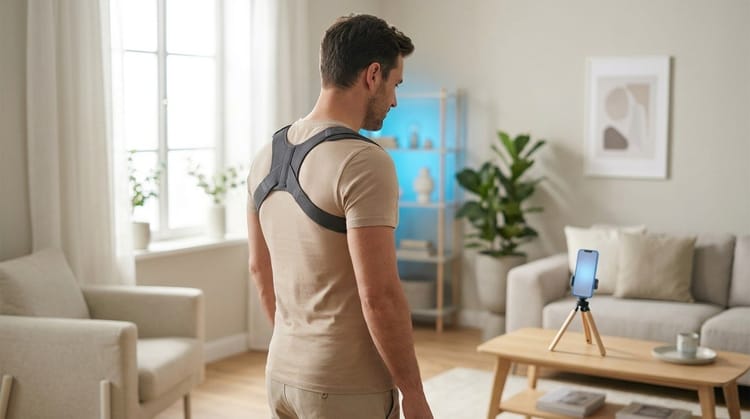
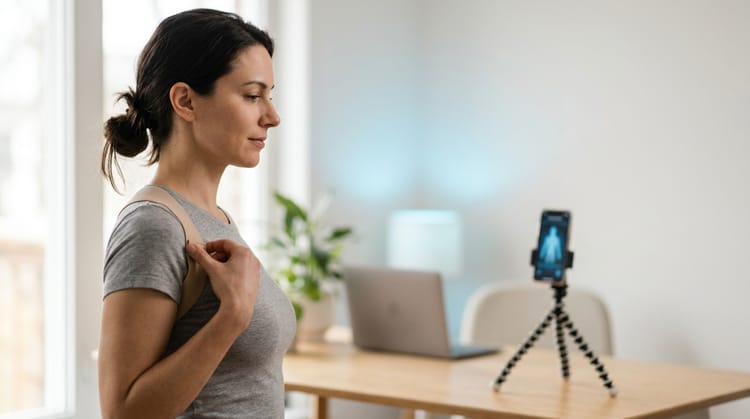
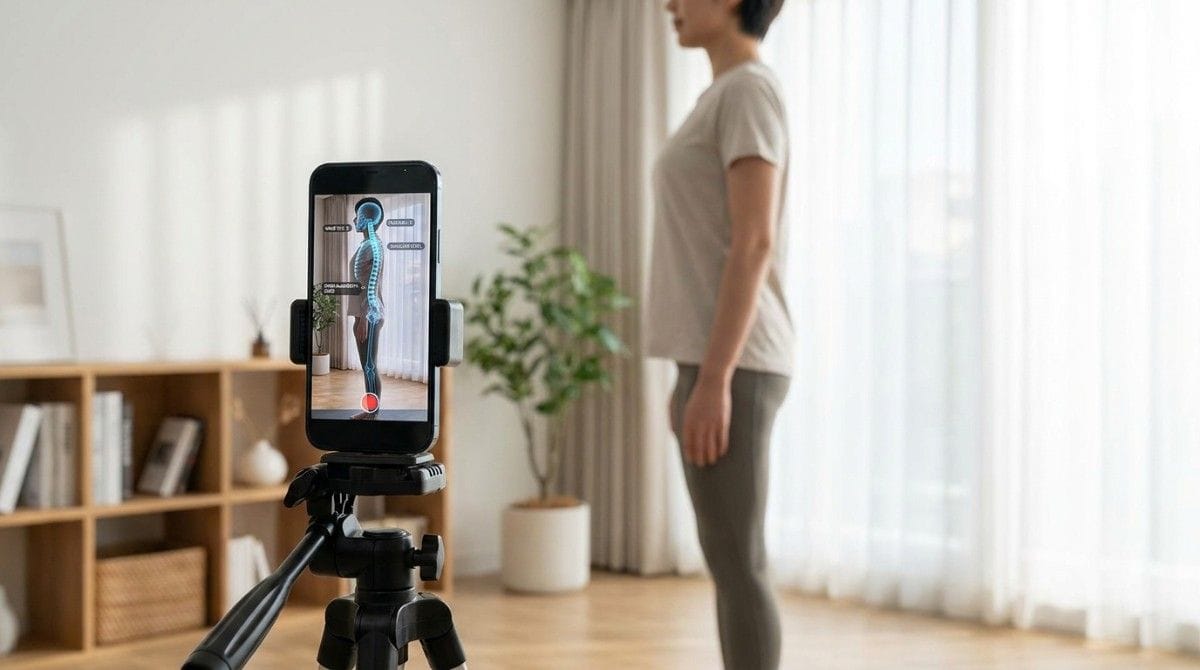
An AI posture correction app turns your phone into a posture coach. Instead of guessing what is wrong, you get an analysis based on a camera scan.
From that scan, the app identifies your specific imbalance, such as forward head posture or rounded shoulders, and builds a routine around it. The best ones also track progress and remind you to practice.
This matters because the biggest reason posture correction fails is the consistency problem that makes most routines collapse. A good app is built to solve that problem, not just hand you more exercises.
The value of an AI posture correction app is not the exercises. Free videos have those. The value is personalization, feedback, and the daily structure that turns effort into a habit.
How Does an AI Posture Correction App Work?
Most quality posture apps follow the same four-step loop.
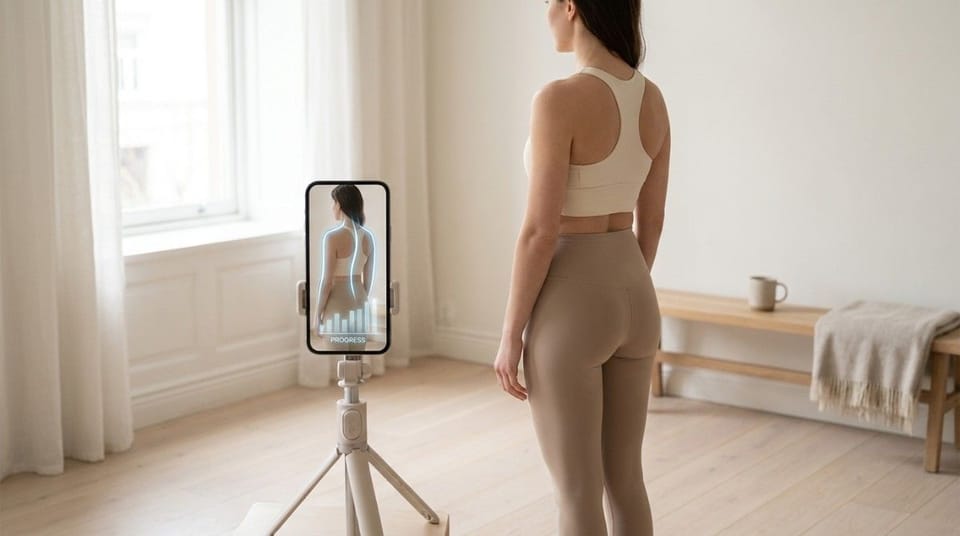
- Scan. You point your phone camera at yourself, and AI analyzes your alignment.
- Diagnose. The app flags your main imbalances, like a forward head or tilted pelvis.
- Personalize. It builds a corrective plan matched to what it found.
- Track and remind. It nudges you daily and shows progress over time.
The scan is what separates an AI posture correction app from a generic fitness app. Without analysis, you are back to guessing.
Why Use an App Instead of Free YouTube Videos?
Free videos are not wrong. They are just not built for you, and they do not keep you accountable.
A random video assumes everyone has the same posture problem. An AI posture app targets yours. More importantly, it solves the follow-through gap that videos cannot.
If you want to weigh the bigger picture first, see how apps compare to physiotherapy and generic routines before committing to any single path.
How to Choose the Best AI Posture Correction App (Quick List)
Use these criteria to judge any posture app, including ours. The best AI posture correction app should check every box.
- Real AI posture analysis. It should scan and assess your alignment, not just play videos. This is the core feature.
- Personalized programs. Your plan should match your specific imbalance, not a one-size-fits-all list.
- Progress tracking. You should see measurable change over time, which keeps motivation alive.
- Habit reminders. Daily nudges build the routine for you, so you do not rely on willpower.
- Clear form guidance. Video demonstrations and cues reduce the risk of reinforcing bad patterns.
- Realistic expectations. A trustworthy app sets honest timelines, not overnight promises.
If an app is missing AI analysis or progress tracking, it is a video library with a subscription, not a posture correction tool.
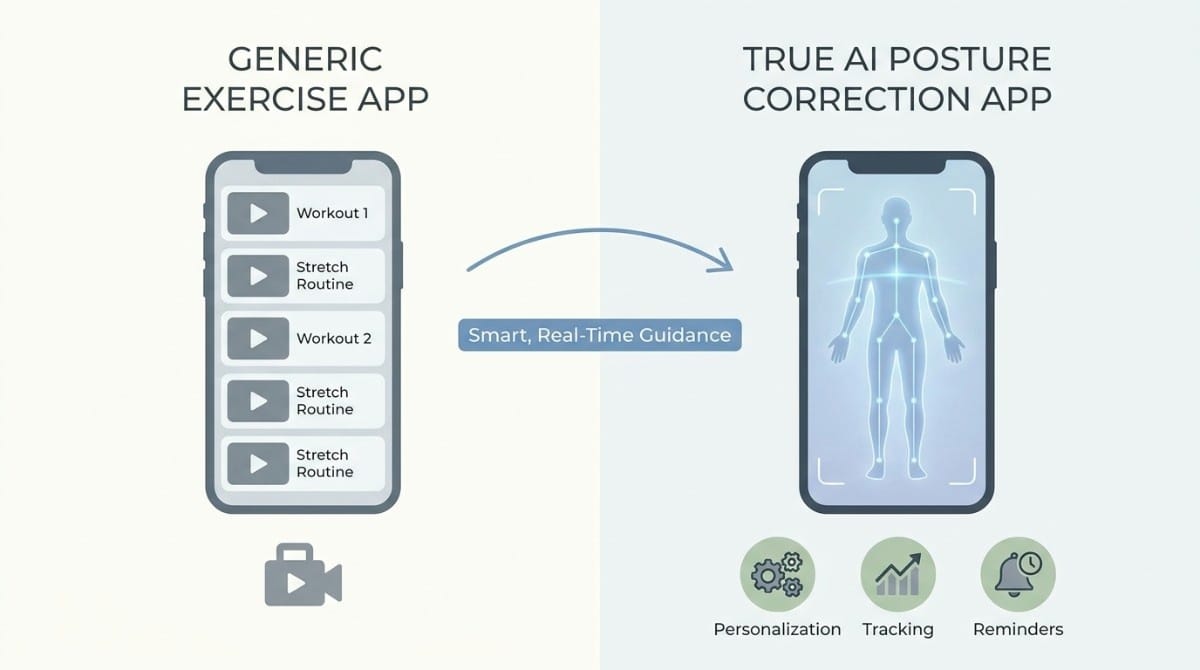
Generic Routine vs AI Posture App
Here is the practical difference between guessing and guided correction.
| Feature | Generic videos | AI posture correction app |
|---|---|---|
| Identifies your imbalance | No | Yes, via camera scan |
| Plan built for your body | No | Yes |
| Tracks progress | No | Yes |
| Daily reminders | No | Yes |
| Form feedback | Limited | Guided |
| Keeps you consistent | Rarely | By design |
The exercises can be identical. The results differ because of personalization and consistency.
What Happens If You Pick the Wrong App?
Choosing a generic app that lacks AI analysis usually leads to the same dead end as free videos.
You do random exercises, cannot tell if they fit your posture, see no tracked progress, and quit. Picking the wrong tool wastes the one thing posture correction needs most: consistent weeks.
This is also why understanding the realistic correction timeline helps. The right app is the one that keeps you going long enough to see change.
Step-by-Step: Getting Started With an AI Posture App
A good posture app should make starting effortless. Here is the typical flow.
Step 1 – Scan your posture. Set your phone up and let the app analyze your alignment. This is your baseline.
Step 2 – Review your imbalances. See what the scan found, such as forward head posture or rounded shoulders.
Step 3 – Start your personalized plan. Follow the short daily routine built for your results, not a generic one.
Step 4 – Track and stay consistent. Use reminders and progress views to keep the streak going. If you also want the raw moves, the corrective exercises themselves are worth understanding.
When an AI Posture App Isn't the Right Choice
An AI posture correction app suits most everyday posture issues. But it is not for everything. Posture specialists suggest seeing a professional first if:
- You have sharp, radiating, or worsening pain
- You feel numbness, tingling, or weakness in your limbs
- You have a diagnosed structural condition such as scoliosis or a disc issue
- You are recovering from spinal surgery without medical clearance
In these cases, an app can support recovery later, but a clinical assessment comes first.
Research and Expert Insight
The case for app-based posture correction rests on consistency, not gimmicks.
- Research in musculoskeletal rehab shows posture change relies on consistent, targeted repetition over weeks.
- Posture specialists suggest personalized programs outperform generic routines because they match the actual imbalance.
- Physiotherapists often recommend tools that build daily adherence, since follow-through, not exercise variety, drives results.
An AI posture correction app earns its place by improving exactly these factors: personalization, feedback, and adherence.
Why Most Exercise Plans Fail
Most posture plans fail for reasons an app is uniquely able to fix:
- No personalization, so the routine misses your real imbalance.
- No feedback, so wrong form goes uncorrected.
- No reminders, so the habit never forms.
- No visible progress, so motivation runs out early.
A generic video cannot solve any of these. A well-built AI posture correction app solves all four.
Why Backed AI Is Built for This 📱
Backed AI was designed around the exact criteria in this guide.
- 🔍 AI posture scan – Point your phone camera at yourself and get a real analysis of your alignment, not a generic plan.
- 📋 Personalized program with reminders – Your routine targets your imbalance, and daily nudges build the habit for you.
- 📈 Progress tracking – See measurable change over time, the feedback loop that keeps you consistent.
It is the difference between hoping you are doing the right thing and knowing you are. Try the Posture Doctor AI posture check to see your alignment in minutes.
Download Backed AI and start correcting your posture today. → backedapp.com
Final Takeaway
The best AI posture correction app is not the one with the most exercises. It is the one that scans your posture, builds a plan for your body, and keeps you consistent long enough to see change. Judge any app by four things: real AI analysis, personalization, progress tracking, and habit reminders. If it nails those, it will work. Backed AI was built around exactly that.
FAQ
Q1: What is the best AI posture correction app?
The best AI posture correction app combines real camera-based posture analysis, a personalized plan, progress tracking, and habit reminders. Backed AI is built around all four.
Q2: Do AI posture correction apps actually work?
Yes, for mild to moderate posture issues. They work because they personalize your plan and keep you consistent, which is what most posture correction efforts lack.
Q3: How does an AI posture app analyze my posture?
You point your phone camera at yourself, and the app uses AI to assess your alignment, flag imbalances like forward head posture, and build a corrective plan.
Q4: Is a posture app better than YouTube videos?
For most people, yes. Videos are generic and offer no accountability. An AI posture app targets your specific imbalance and keeps you consistent.
Q5: When should I see a professional instead of using an app?
If you have sharp pain, numbness, or a diagnosed structural condition, get a clinical assessment first. An app can support recovery afterward.