Thoracic Mobility Exercises for Seniors (A Safe, Low-Impact Routine)

Thoracic mobility exercises for seniors are gentler, chair- and wall-supported versions of standard mid-back mobility drills, adapted for bone density, balance, and joint sensitivity. A safe routine focuses on slow, controlled extension and rotation rather than deep stretching or floor-based positions that risk a fall. This guide walks through exactly which moves to use, how to modify them, and when to check with a doctor first.
TL;DR
- 🪑 Chair-assisted and wall-supported versions are safer starting points than floor-based drills for most seniors.
- 🦴 Aggressive extension should be avoided without medical clearance if osteoporosis or a prior fracture is present.
- ⚖️ Balance-challenging positions, like unsupported quadruped, are easy to modify without losing the benefit.
- ⏱️ 5 to 8 minutes daily is enough. Seniors don't need longer sessions, just consistent ones.
- 🩺 A fall-risk history, vertigo, or recent surgery are reasons to get clearance before starting.
- 📋 The goal is functional range, reaching a shelf, turning to check a mirror, not athletic performance.
What Are Thoracic Mobility Exercises for Seniors?
Thoracic mobility exercises for seniors are age-adapted movements that restore extension, rotation, and flexion in the mid-back, modified with seated, wall, or chair support to reduce fall risk and bone-loading concerns common after 65.
The underlying goal is the same as our general thoracic mobility exercise guide: restore range of motion that sitting and age both erode. What changes for seniors is the delivery, slower pace, more support, and closer attention to bone health and balance. 🧓
If a visible rounded hump, rather than general stiffness, is the main concern, our gentle stretch routine for dowager's hump in seniors is built specifically for that.
Why Does Thoracic Mobility Decline With Age?
Thoracic stiffness isn't unique to older adults, but a few age-related factors make it more pronounced.
- Decades of accumulated sitting and forward-flexed posture compound over time.
- Bone density changes can make the spine more sensitive to aggressive extension.
- General muscle mass decline reduces the strength needed to hold newly gained range of motion.
None of this means mobility work should stop. It means the approach needs to be more deliberate. 🐢
How To Modify Standard Thoracic Drills for Safety
- Swap floor positions for seated ones. Cat-cow becomes a seated spinal wave in a sturdy chair instead of a floor-based quadruped position.
- Add wall or chair-back support to rotation work. One hand stays on a stable surface throughout the movement.
- Reduce range before adding reps. Start with a smaller, comfortable arc and let range grow gradually rather than pushing to end range on day one.
- Slow the tempo. A 3 to 4 second count on each phase of a movement is safer and more controlled than a quick repetition.

What Happens If Seniors Skip Thoracic Mobility Work?
Ignoring thoracic stiffness tends to compound faster later in life than it does for younger adults. 📉
- Reduced independence in daily tasks. Reaching overhead into a cabinet or turning to check a blind spot while driving both depend on thoracic rotation and extension.
- Increased fall risk indirectly. A stiff, rounded upper back shifts the body's center of gravity forward, which physiotherapists often flag as a contributing factor in balance concerns.
- Faster progression toward a pronounced kyphotic curve. Left unaddressed, mild stiffness can become the more visible rounding covered in our dowager's hump guide.
Best Thoracic Mobility Exercises for Seniors (Quick List)
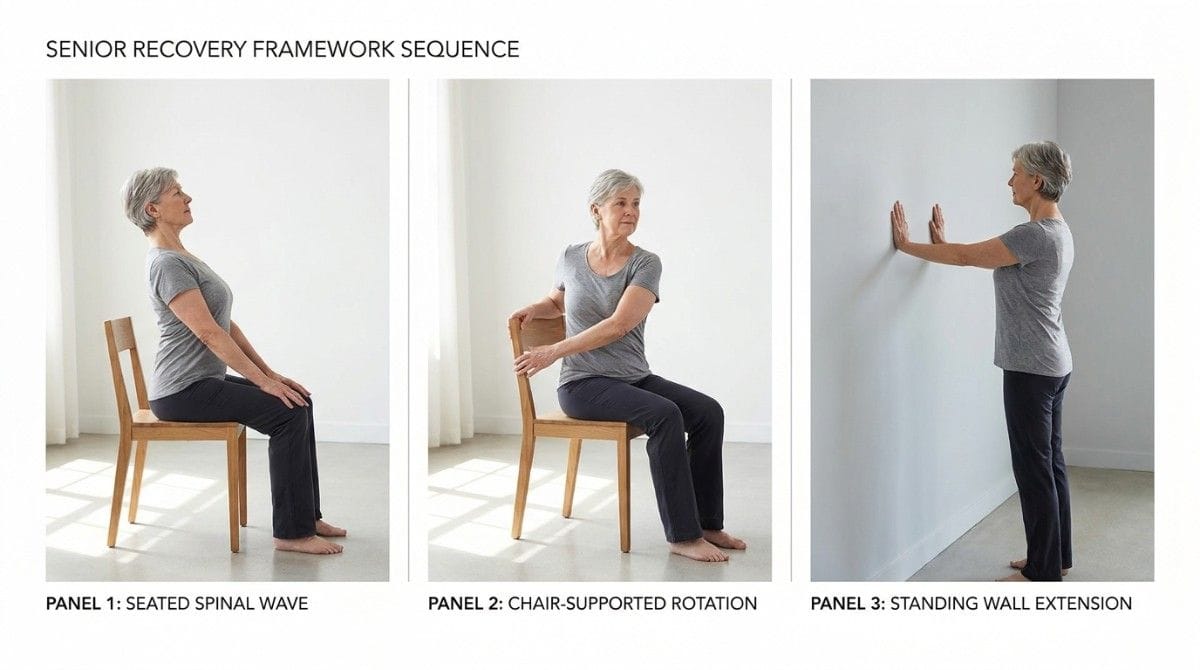
- Seated spinal wave – A chair-based version of cat-cow, rounding and arching the upper back while seated.
- Chair-supported rotation – Rotating the upper body side to side with one hand braced on the chair for stability.
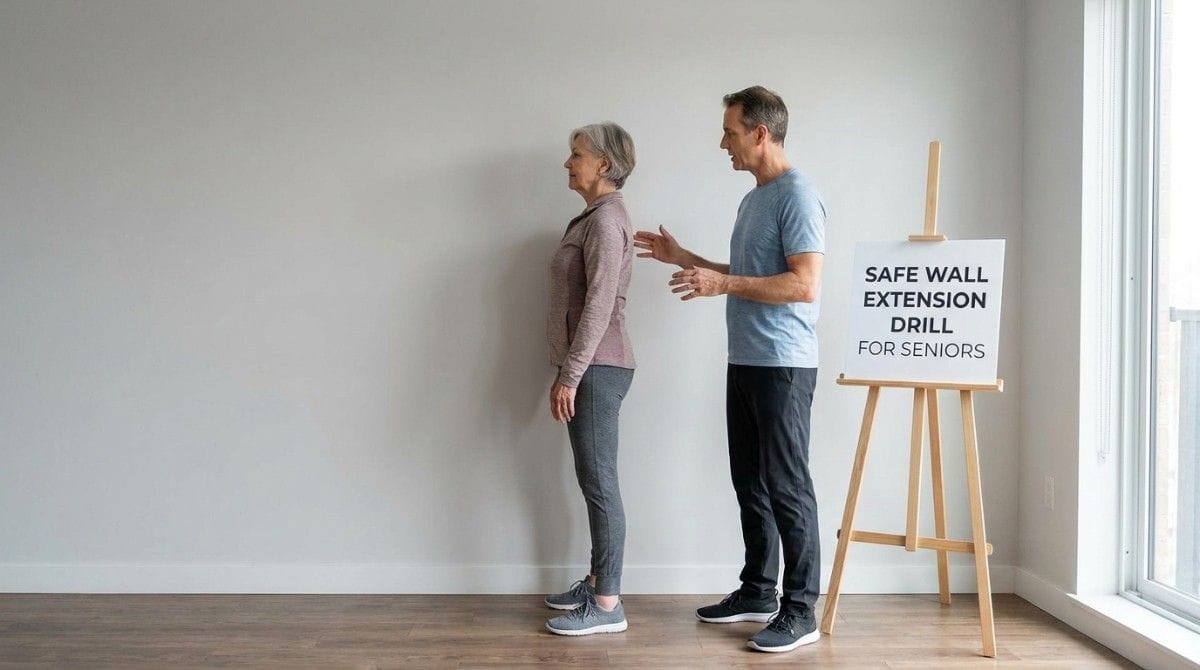
- Wall extension – Standing with the upper back against a wall, gently pressing the mid-back flatter, then releasing.
- Supported thread the needle – Performed kneeling with a stable surface nearby, only for those with good knee and wrist tolerance.
- Standing wall slide – Sliding the arms up a wall while keeping contact, a gentler entry point than a full overhead reach.
- Seated side-reach – A gentle lateral stretch performed from a stable seated position.
Standard vs Senior-Modified Exercise Comparison
| Exercise | Standard Version | Senior Modification | Safety Note |
|---|---|---|---|
| Cat-cow | Floor, quadruped position | Seated spinal wave in a chair | Avoids floor transfers and wrist loading |
| Thoracic rotation | Standing, unsupported | Chair-supported, one hand braced | Reduces fall risk during rotation |
| Foam roller extension | Full-range, lying on the floor | Wall extension instead, or shallow roller range | Reduces bone-loading concern for those with low bone density |
| Thread the needle | Full floor quadruped | Supported or skipped if knee/wrist sensitive | Only appropriate with good joint tolerance |
For a broader senior posture routine beyond just the thoracic spine, our posture exercises for seniors guide covers the full-body picture.
📲 If a caregiver or family member wants visibility into whether a routine is being done safely and consistently, Backed AI's progress tracking gives a simple way to check in without hovering over every session.
Step-by-Step Recovery Framework
Weeks 1 to 2 – Seated only. Seated spinal wave and chair-supported rotation, 5 minutes daily, focusing on comfort over range.
Weeks 3 to 4 – Add standing, wall-supported work. Introduce wall extension and standing wall slides, keeping chair-based moves in the routine.
Weeks 5 and beyond – Gradually expand range. If tolerated well and cleared by a doctor for more, slowly introduce a shallow foam roller extension in place of the wall version.
Key Insight: For seniors, consistency at a smaller range beats pushing for a bigger stretch too soon. Bone and joint tissue adapt more slowly with age, and slow, steady input respects that timeline.
When This Approach Doesn't Work
This routine is built for general age-related stiffness. It is not appropriate in every situation.
- Osteoporosis with a history of vertebral fracture – extension-based movements need explicit medical clearance first.
- Vertigo or dizziness with position changes – rotation and extension drills can aggravate these symptoms and should be assessed by a doctor before starting.
- Recent hip or knee surgery – some positions in this routine may need to be skipped or modified further based on surgical recovery guidelines.
- Uncontrolled balance issues or a recent fall – a supervised session with a physiotherapist is safer than starting a home routine alone.
Research & Expert Insight
Physiotherapists often note that age-related thoracic stiffness responds to the same fundamental principles as younger adults, consistent, gentle input over time, but with a lower starting intensity and a stronger emphasis on support and control.
Research in musculoskeletal rehab shows that posture and thoracic extension are commonly discussed as contributing factors in balance and fall-risk research among older adults, which is part of why maintaining this range of motion carries value beyond comfort alone.
Final Takeaway
Thoracic mobility work doesn't need to stop or slow down with age. It needs a different delivery: seated and wall-supported positions, slower pacing, and closer attention to bone health and balance. A short, consistent daily routine built around these modifications is enough for most seniors to maintain functional range of motion, and where a specific condition like osteoporosis or vertigo is involved, that's the cue to loop in a doctor before starting.
Why Generic Senior Routines Fail
Most exercise handouts given to seniors run into the same problems:
- One-size-fits-all instructions – a printed sheet doesn't account for one senior's osteoporosis versus another's simply being deconditioned.
- No form feedback – without someone watching, it's hard to know if a modified movement is actually being done safely.
- No progression logic – staying on the exact same seated exercises for months means range of motion plateaus early.
- No visibility for family or caregivers – there's often no simple way to confirm a routine is happening consistently or safely.
A Smarter, Safer Way to Build Thoracic Mobility
A generic handout treats every senior the same. Bone density, balance, and joint tolerance are different for everyone, and a routine that ignores that isn't actually personalized.
Backed AI uses a camera-based posture scan to assess current range of motion and build a routine that starts at an appropriate, safe level, then progresses only as consistency and comfort allow.
- 📍 Personalized starting point – begins at a safe range based on your actual posture scan, not a generic printed sheet.
- 🔄 Gradual, trackable progression – increases range only as consistency is demonstrated, rather than assuming everyone advances at the same pace.
- 👀 Progress visibility – gives a simple way to see whether a routine is being followed consistently, useful for the individual and for family checking in.
A safe routine still needs a plan behind it. This gives seniors, and the people supporting them, a way to see that plan working.
Download Backed AI and start correcting your posture today.
FAQ
1. What's the safest thoracic mobility exercise to start with as a senior? The seated spinal wave is typically the gentlest entry point. It requires no floor transfers and no standing balance.
2. Do seniors need a doctor's clearance before starting? Not always, but it's recommended for anyone with osteoporosis, a history of vertebral fracture, vertigo, or a recent fall.
3. How is this different from general posture exercises for seniors? This routine focuses specifically on the thoracic spine's extension, rotation, and flexion. A general posture routine covers a broader range of muscles and joints beyond just the mid-back.
4. Can these exercises help with a dowager's hump? They support general thoracic mobility, but if a visible hump is the main concern, a dedicated routine like our stretches for dowager's hump in seniors is a better direct fit.
5. How often should seniors do thoracic mobility exercises? Daily is ideal, at 5 to 8 minutes per session. Consistency at a lower intensity matters more than occasional longer sessions.