
Thoracic Mobility Exercises After Spinal Fusion (Protecting the Segments Above and Below)

After a spinal fusion, the segments next to the fused level, often in the thoracic spine, take on extra movement demand because the fused level no longer moves. Gentle, surgeon-cleared thoracic mobility work helps those adjacent segments share that load instead of becoming overworked themselves. This guide explains why that matters, what cautious mobility work can look like once cleared, and where this guide ends and your surgical team's guidance begins.
TL;DR
- 🔗 A fused segment stops moving, so the segments directly above and below it absorb more movement demand.
- 🧩 This shift is a recognized long-term consideration after spinal fusion, often called adjacent segment stress.
- 🩺 Timing for any mobility work is set entirely by your surgeon, never by a general guide like this one.
- 🐢 Early work, once cleared, is small-range and gradual, expanding over months, not weeks.
- 🚨 New pain, numbness, or symptoms outside what your surgical team described mean stop and call them, not push through.
- 📋 This article covers the adjacent-segment mobility angle specifically. For general fusion recovery precautions and timelines, see our full recovery guide.
What Is Adjacent Segment Stress After Spinal Fusion?
Adjacent segment stress is the added movement demand placed on the spinal segments directly above and below a fusion, since the fused level itself can no longer move, that movement has to happen somewhere.
This is a well-recognized long-term consideration in spinal fusion care, not a rare complication. It's part of why maintaining mobility elsewhere in the spine, often in the thoracic segments neighboring a lumbar fusion, gets attention well after the initial surgical recovery is complete. 🔗
For the general recovery timeline, precautions, and phased return to activity, our complete guide to exercises after back fusion covers that ground in full. This article picks up a more specific thread: what happens to the segments that keep moving.
Why Does the Thoracic Spine Compensate After a Fusion?
The spine works as a connected chain. When one link in that chain stops moving, the links around it don't just sit idle, they take on more of the total movement.
- A lumbar fusion often shifts extra rotational and bending demand onto the lower thoracic spine.
- A thoracic fusion shifts extra demand onto the segments immediately above or below the fused level.
- Over years, segments that consistently absorb more than their share of movement are more prone to their own wear and stiffness.
None of this means a fusion causes future problems automatically. It means the segments doing extra work benefit from staying mobile and well-conditioned. 🧠
How To Approach Thoracic Mobility Work Safely Post-Fusion
- Get explicit clearance first. Your surgeon or physical therapist determines when adjacent-segment mobility work is appropriate, based on your specific fusion, hardware, and healing progress.
- Start smaller than feels necessary. Early cleared movement is typically a fraction of full range, expanding gradually as healing confirms it's appropriate.
- Separate breathing and gentle movement from loaded mobility work. Diaphragmatic breathing and light scapular movement are often appropriate earlier than active spinal rotation or extension.
- Track symptoms, not just range. New pain, tingling, or a change in sensation matters more than how far you can move.

What Happens If Adjacent Segments Are Never Mobilized?
Leaving the segments next to a fusion completely unaddressed doesn't guarantee a problem, but it removes a layer of protection that's well within a patient's control. 📉
- The segments doing extra work stay stiff, which can make the added movement demand harder on them over time.
- Compensation patterns can spread further, sometimes shifting extra load toward the shoulders or lower back as well.
- Functional tasks become harder to recover fully, since overhead reach and rotation both depend on segments that were never given cleared, gentle mobility input.
Best Thoracic Mobility Approaches After Spinal Fusion (Quick List)
(All items assume explicit clearance from your surgical team. None of these are a substitute for that clearance.)
- Diaphragmatic breathing with gentle chest expansion – Often appropriate earliest, supports rib and thoracic movement without loading the spine directly.
- Scapular retraction (shoulder blade squeezes) – Trains movement around the shoulder blades without significant spinal loading.
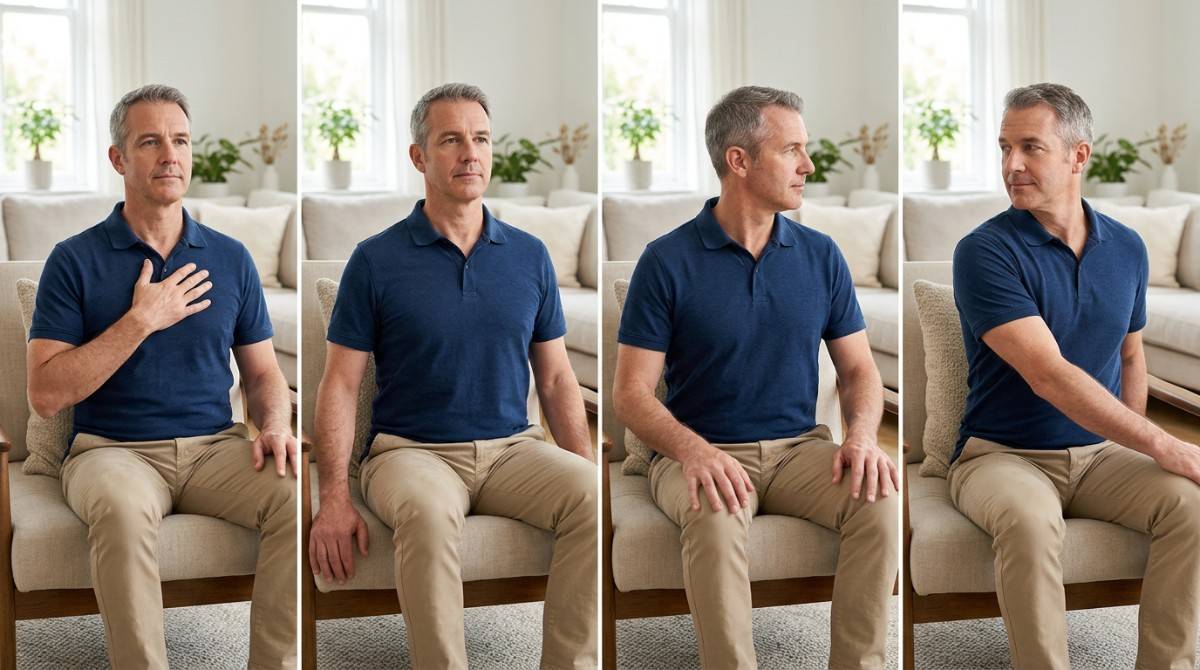
- Small-range seated rotation – Introduced once cleared, kept well within a comfortable, pain-free arc.
- Supported seated cat-cow variation – A gentle, small-range version, adapted based on which segment is fused.
- Wall-supported gentle extension – A very light version of the standard drill, introduced only once appropriate.
- Walking with natural arm swing – A low-risk, functional way to maintain some baseline thoracic rotation during early recovery.
Recovery Stage Comparison
| Stage | Typical Focus | Thoracic Mobility Role |
|---|---|---|
| Early post-op | Surgeon-directed precautions, walking | Breathing and gentle scapular movement only, if cleared |
| Mid recovery | Gradual activity return | Small-range seated rotation and extension, once cleared |
| Later recovery | Return to fuller function | Gradual integration toward general thoracic mobility work |
| Long-term maintenance | Ongoing spine health | Full thoracic mobility routine, once fully cleared |
The exact timing of each stage is set by your surgical team, not by a fixed calendar. Our spinal fusion background guide explains what typically shapes that individualized timeline.
📲 Once you're cleared for general mobility work, Backed AI's camera-based posture scan can help track gentle, gradual progress over time. It supplements your surgeon's guidance and never replaces medical clearance for post-surgical movement.
Step-by-Step Recovery Framework
Stage 1 – Surgeon-directed only. Follow your surgical team's specific precautions exactly. This stage is about healing, not mobility gains.
Stage 2 – Cleared gentle movement. Once your surgeon confirms it's appropriate, small-range seated rotation and supported extension can begin, tracked closely for any change in symptoms.
Stage 3 – Gradual expansion. Range and frequency increase slowly, guided by continued clearance and how the body responds, not by a fixed weekly schedule.
Stage 4 – Integration. Once fully cleared for general activity, the standard thoracic mobility exercise guide and its self-test become appropriate tools for ongoing maintenance.
💡 Key Insight: The goal after a fusion isn't to restore movement at the fused level, that's not the point of the surgery. It's to keep the segments around it healthy enough to carry the extra work they've inherited.
When This Approach Doesn't Work
This guide is educational, not a substitute for your surgical team's specific guidance. Several situations sit entirely outside its scope.
- No explicit clearance yet – if your surgeon hasn't cleared mobility work, nothing here applies until they do.
- New or worsening pain, numbness, or weakness – these need direct communication with your surgical team, not troubleshooting from an article.
- Visible or felt hardware changes – any new clicking, shifting sensation, or deformity is a reason to call your surgeon promptly.
- A recovery timeline that differs from general expectations – every fusion, and every patient's healing, is different. Your surgeon's specific guidance always overrides general information like this.
Research & Expert Insight
Spine specialists commonly discuss adjacent segment stress as a long-term consideration in fusion care, since the biomechanics of a fused spine inherently redistribute movement to the segments nearby.
Research in musculoskeletal rehab shows that maintaining mobility and conditioning in the segments adjacent to a fusion is a commonly recommended part of long-term spine health, once a patient is medically cleared for that kind of activity.
Final Takeaway
A spinal fusion changes how the whole spine shares movement, not just the level that was operated on. The segments next to a fusion, frequently in the thoracic spine, take on extra demand and benefit from staying mobile once cleared to do so. The pace of that process belongs entirely to your surgical team. This guide's role is to explain why the thoracic spine matters in that picture, not to set your timeline.
Why Generic Post-Fusion Routines Fall Short
Generic advice after a spinal fusion tends to miss the same things:
- One-size-fits-all timelines – fusion location, hardware, and individual healing all vary, and a generic schedule ignores that.
- No adjacent-segment framing – most general advice focuses on the fused level's own precautions and skips why the neighboring segments matter long-term.
- No gradual tracking – without a way to see small, steady changes, it's hard to know if cautious progress is actually happening.
- No connection to what comes next – general recovery guides rarely bridge into the ongoing maintenance phase once someone is fully cleared.
A Smarter Way to Track Long-Term Spine Health Post-Fusion
Once cleared for general mobility work, tracking gradual, cautious progress matters more than chasing quick range-of-motion gains.
Backed AI's camera-based posture scan can help track thoracic mobility over time as part of a cleared, ongoing routine, working alongside your surgeon's guidance rather than in place of it.
- 📍 Baseline and progress tracking – shows gradual change over months, appropriate for a post-surgical timeline.
- 🔄 Gentle, gradual programming – built to support cautious progression rather than pushing for fast range-of-motion gains.
- 🩺 A supplement, not a substitute – designed to work alongside medical clearance, never in place of your surgeon's guidance.
For anyone navigating the months and years after a fusion, having a steady, trackable way to support the spine's long-term health matters, once your care team confirms you're ready for it.
Download Backed AI and start correcting your posture today.
FAQ
1. Does thoracic mobility work help after a lumbar fusion, not just a thoracic one? Yes. Adjacent segment stress applies regardless of where the fusion is. A lumbar fusion often shifts extra demand onto the lower thoracic spine specifically.
2. When can I start thoracic mobility exercises after spinal fusion? There's no universal timeline. Your surgeon determines this based on your specific fusion, hardware, and healing progress.
3. Is it normal for the area near my fusion to feel stiff? Some stiffness is common during recovery. Persistent or worsening stiffness, or any new pain, is worth discussing directly with your surgical team.
4. Can I use the general thoracic mobility exercise guide instead of this one? Only once your surgeon has fully cleared you for general activity. Before that point, this article's cautious, staged approach is the more appropriate starting point.
5. What's the difference between this article and the general back fusion recovery guide? The general guide covers overall recovery precautions and timeline for the fused segment itself. This article focuses specifically on why the segments next to the fusion, often thoracic, need their own attention over the long term.