Thoracic Mobility vs Flexibility: What's the Difference and Why It Matters

Thoracic mobility is how freely your mid-back moves through extension, rotation, and flexion. Thoracic flexibility is how far the muscles around it can lengthen under a static stretch. They overlap but aren't the same thing, and training only one while ignoring the other is why so many stretching routines stall out. Here's how to tell which one you're actually missing.
TL;DR
- 🔄 Mobility is about active joint movement. Flexibility is about passive muscle length.
- 🧍 You can be flexible and still have poor mobility, and vice versa.
- 🎯 Most stiff-upper-back complaints are a mobility problem, not a flexibility problem.
- 🧩 Stretching alone often plateaus because it trains flexibility, not the joint's active range.
- ⚖️ A complete routine trains both, but in a specific order.
- 🧠 Knowing which one you're missing changes which exercises are actually worth your time.
What Is the Difference Between Mobility and Flexibility?
Thoracic mobility is your mid-back's active range of motion through extension, rotation, and flexion, while thoracic flexibility is simply how far the surrounding muscles can passively lengthen under a stretch.
Flexibility is a component of mobility, but it's not the whole picture. You can have long, flexible muscles around your spine and still lack the control and joint movement to actually use that length. 🧩
This is exactly why our thoracic mobility exercise guide focuses on active drills like cat-cow and thoracic rotation rather than static holds alone.
Why Does This Distinction Matter for Your Upper Back?
Most people default to stretching when their upper back feels tight. That's a flexibility approach to what is very often a mobility problem.
Here's why the distinction changes your approach:
- A tight-feeling muscle can be a symptom of a joint that isn't moving well, not the actual cause.
- Stretching a muscle that's compensating for a stiff joint can create temporary relief without fixing the underlying restriction.
- Active mobility work retrains the nervous system's control over a movement, which passive stretching doesn't do.
Neither approach is wrong. They just solve different problems. ⚖️
How To Tell Which One You're Actually Missing
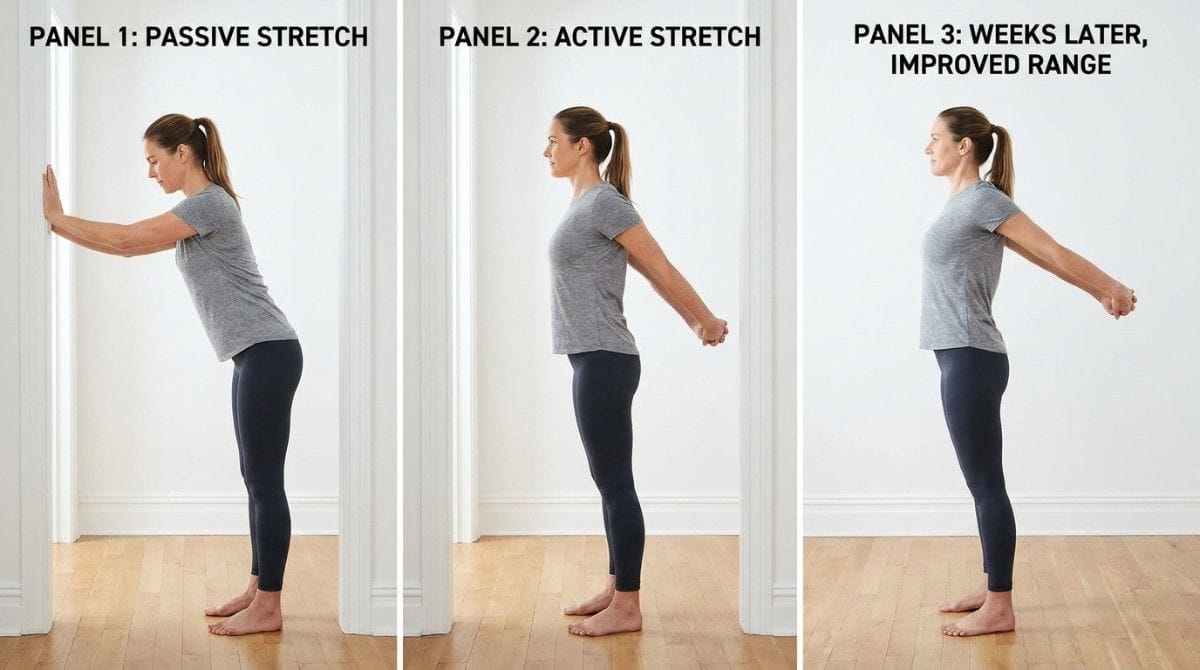
- Try a static stretch first. A doorway pec stretch or a seated side-bend. Note how far you comfortably reach.
- Now try the same range actively, without assistance from a wall or your hands, like a standing thoracic rotation.
- Compare the two. If your active range is noticeably smaller than your passive, stretched range, that gap is your mobility deficit, not a flexibility one.
If you haven't run this comparison yet, our at-home thoracic mobility self-test walks through the exact active-range checks to use here.

What Happens If You Train the Wrong One?
Training only flexibility when you actually have a mobility deficit leads to a familiar pattern. 📉
- Temporary relief that doesn't hold. A good stretch feels great for an hour, then the tightness returns because the joint restriction was never addressed.
- Plateaus despite consistent effort. Weeks of stretching with no real change in posture or overhead reach is a common sign the wrong system was being trained.
- Over-reliance on passive tools. Rolling and stretching daily without active drills means the nervous system never learns to control the new range.
The reverse also happens: training mobility drills without ever addressing genuinely short, tight muscle can leave a hard ceiling on how far that new range of motion can go.
Best Exercises for Thoracic Mobility vs Flexibility (Quick List)
Mobility drills (active, joint-focused):
- Cat-cow – Moves the spine actively through flexion and extension.
- Thread the needle – Actively rotates through the thoracic spine under control.
- Standing thoracic rotation – Trains rotation without any external assistance.
Flexibility stretches (passive, muscle-focused):
- Doorway pec stretch – Passively lengthens the chest muscles that pull shoulders forward.
- Foam roller extension – A passive, gravity-assisted stretch across the mid-back.
- Seated side-bend hold – A static stretch for the muscles along one side of the ribcage.
Thoracic Mobility vs Flexibility Comparison
| Mobility | Flexibility | |
|---|---|---|
| Definition | Active range of motion at a joint | Passive length of a muscle |
| What it measures | Control plus range, together | Range alone |
| How it's trained | Active drills (rotation, cat-cow) | Static stretches, foam rolling |
| Common failure mode | Ignored in favor of stretching alone | Over-relied on, with no active carryover |
| Best for | Fixing compensation patterns | Loosening chronically short muscle |
Step-by-Step: Figuring Out Which One You Need
Step 1 – Test both. Run a passive stretch and an active version of the same movement, as outlined above.
Step 2 – Note the gap. A large gap between passive and active range points to a mobility deficit. A small gap with a genuinely short end-feel points toward flexibility.
Step 3 – Train accordingly. Mobility deficits need active drills first. Flexibility deficits respond to consistent static stretching, ideally paired with the tools compared for thoracic mobility work for a deeper stretch when needed.
Step 4 – Re-test after 3 to 4 weeks. The gap between active and passive range should shrink as mobility improves.
💡 Key Insight: A shrinking gap between your passive and active range, not just "feeling looser," is the clearest sign your routine is actually working.
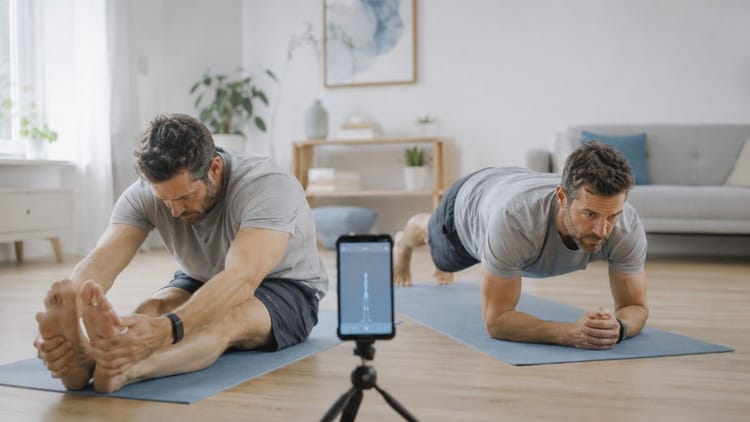
📲 Telling the difference between a mobility gap and a flexibility gap by feel alone is genuinely hard. Backed AI's camera-based posture scan measures your actual active range against your baseline, so you're training the one you actually need instead of guessing.
When This Approach Doesn't Work
The mobility-versus-flexibility distinction is useful, but it isn't the only variable at play.
- Both are significantly restricted. In this case, the order matters less than simply starting somewhere and being consistent.
- Pain drives the stiffness, not tissue length or joint range. If movement triggers sharp or radiating pain, this framework doesn't apply until that's assessed by a professional.
- Structural limitations exist. Scoliosis, prior fracture, or fused segments change what "normal" range even looks like, regardless of the mobility-flexibility split.
- You're already doing both well. If your active and passive ranges are close and comfortable, this distinction isn't your bottleneck. Something else, like strength or habit, likely is.
Research & Expert Insight
Physiotherapists often distinguish between "tissue-based" tightness and "control-based" restriction for exactly this reason. A muscle can lengthen just fine under a stretch and still feel tight during active movement if the nervous system hasn't learned to control that range.
Research in musculoskeletal rehab shows that active mobility training tends to produce more durable, functional range-of-motion gains than static stretching alone, particularly for spinal segments like the thoracic spine that rely on coordinated movement across several joints at once.
Final Takeaway
Mobility and flexibility solve different problems, even though they get used interchangeably. Flexibility is about how far a muscle can passively stretch. Mobility is about whether you can actually control and use that range on your own. Testing the gap between the two tells you which one to prioritize, and closing that gap, not just feeling looser after a stretch, is the real marker of progress.
Why Most Routines Train the Wrong One
Most stiff-upper-back routines default to stretching, for a few predictable reasons:
- Stretching feels immediately satisfying, so it gets prioritized over active drills that feel less dramatic in the moment.
- No one measures the active-passive gap, so the actual deficit, mobility or flexibility, never gets identified.
- Generic routines mix both randomly, without sequencing them based on what the person actually needs first.
- No tracking over time, so it's impossible to tell whether the gap is actually closing.
A Smarter Way to Train the Right One
Guessing between mobility drills and flexibility stretches wastes weeks. Testing tells you which one you actually need.
Backed AI's camera-based posture scan measures your active range of motion against your own baseline, identifies whether your restriction is mobility-based, flexibility-based, or both, and sequences your routine accordingly instead of mixing exercises at random.
- 📍 Objective range measurement – replaces the guesswork of "does this feel tight" with an actual comparison.
- 🔄 Correctly sequenced programming – active mobility work first when that's the real gap, static stretching prioritized when it isn't.
- 📈 Progress tracking over time – shows whether your active-passive gap is actually shrinking, not just whether you feel looser today.
You don't need to guess which one your upper back is missing. A quick scan tells you, and builds the plan around it.
Download Backed AI and start correcting your posture today.
FAQ
1. Is mobility training better than stretching for a stiff upper back? For most sitting-related stiffness, yes. Mobility drills address the joint's active control, which static stretching alone doesn't train.
2. Can you be flexible but still have poor mobility? Yes. It's common to have long, stretchy muscles around a joint that still doesn't move well actively, especially in the thoracic spine.
3. Should I stretch before or after mobility drills? Light stretching as a warm-up is fine. The active mobility work should be the main focus of the session, not an afterthought.
4. How do I know if I need more flexibility work specifically? If your passive stretch range feels genuinely short and tight, with a hard, tissue-based end-feel, that points toward a flexibility gap rather than a control-based mobility one.
5. Can I train both mobility and flexibility in the same routine? Yes, and most complete routines do. The key is sequencing: active mobility work first, static stretching afterward, rather than mixing them without a plan.