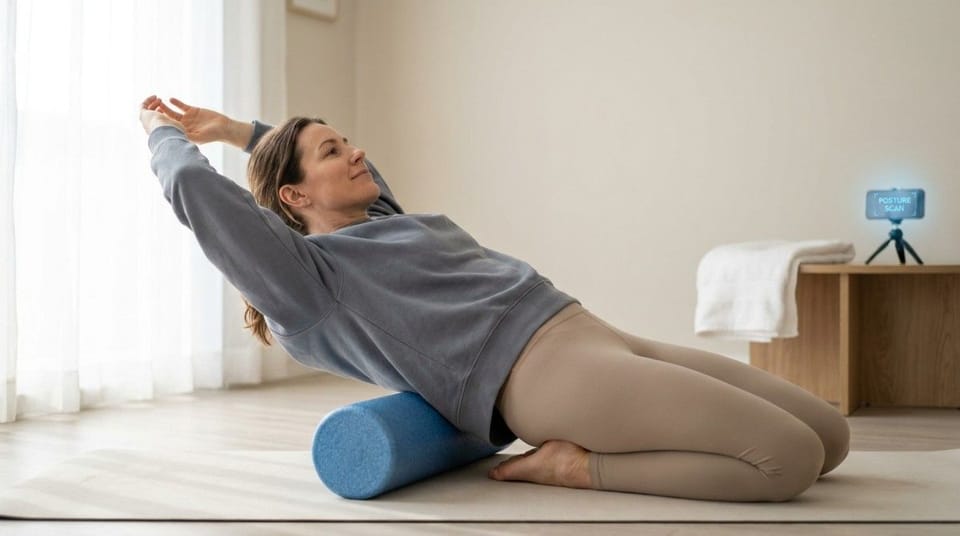
Thoracic mobility exercises for seniors are age-adapted movements that restore extension, rotation, and flexion in the mid-back, modified with seated, wall, or chair support to reduce fall risk and bone-loading concerns common after 65.
Thoracic mobility is your mid-back's active range of motion through extension, rotation, and flexion, while thoracic flexibility is simply how far the surrounding muscles can passively lengthen under a stretch.
Thoracic mobility tools are simple, low-cost props, foam rollers, peanut-shaped massage tools, and mobility sticks, used to apply pressure or leverage to the mid-back so it can move through extension, rotation, and flexion more freely.
A thoracic mobility self-test is a set of simple, unweighted movements used to check how freely your mid-back extends, rotates, and flexes without your lower back or shoulders taking over the movement.
Thoracic mobility is the range of motion available in the mid-back (T1 to T12), specifically its ability to extend, rotate, and flex without the neck or lower back taking over the movement.