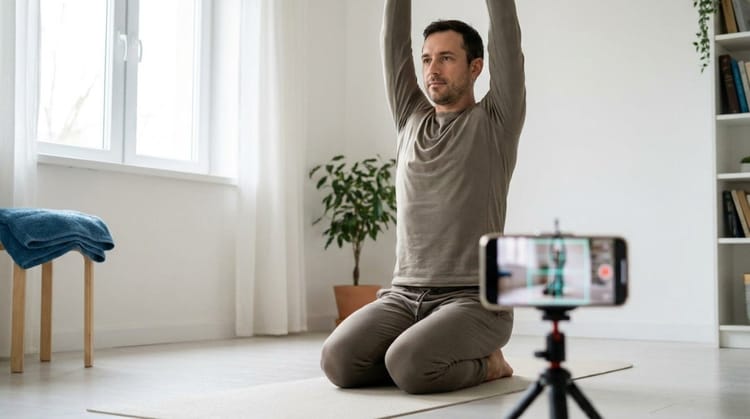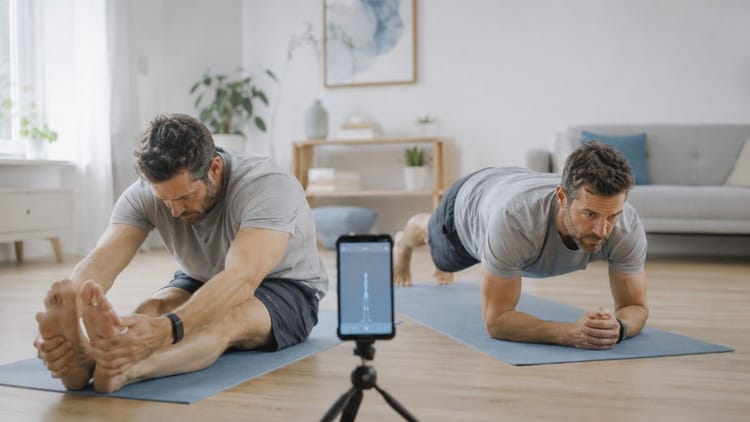
Thoracic Mobility for Golfers and Rotational Athletes (More Rotation, More Power)

Thoracic mobility directly limits how far you can rotate your torso during a golf swing, tennis serve, or throwing motion. More available rotation means more power generated from the trunk instead of borrowed from your lower back or shoulders. This guide covers the exact drills rotational athletes use to build usable rotational range, not just general comfort.
TL;DR
- 🏌️ Thoracic rotation is a major power source in a golf swing, tennis serve, or throw.
- ⚙️ Limited rotation forces the lower back or shoulders to compensate, which drains power and raises injury risk.
- 🔄 Separation between hip and shoulder rotation, a core swing mechanic, depends heavily on thoracic mobility.
- ⚖️ Athletes need even rotation on both sides, not just their dominant swing direction.
- ⏱️ 8 to 10 minutes of rotation drills before a round or practice session primes the movement pattern.
- ⚠️ Sharp pain during rotation is a different problem entirely and needs a professional assessment, not more mobility work.
What Is Thoracic Mobility for Rotational Athletes?
Thoracic mobility for rotational athletes is the mid-back's capacity to rotate independently of the hips and lower back, providing the range needed for a full, powerful swing, serve, or throw.
Every rotational sport relies on a sequence: the hips rotate first, the torso follows and separates from them, then the arms release last. That hip-to-shoulder separation is where a lot of swing power actually comes from, and it's directly limited by how well your thoracic spine rotates. 🎯
When the mid-back can't rotate far enough, the body finds the range somewhere else, usually the lower back or the shoulder joint, neither of which is built to generate power that way.
Why Does Thoracic Rotation Matter for a Golf Swing?
A golf swing, tennis serve, and baseball throw all share the same underlying mechanic: rotate the hips, then separate the shoulders behind them, then release.
- More thoracic rotation means a longer, more efficient backswing without over-rotating the hips.
- Better separation between hips and shoulders is directly tied to swing speed in most coaching models.
- Even rotation on both sides reduces the compensation patterns that show up as inconsistent contact or recurring soreness.
Athletes who only train their dominant rotation direction often build a lopsided range that shows up as asymmetry under load. ⚖️
How To Build Rotational Range for Sports
- Test both directions, not just your swing side. Rotate as far as comfortable to the left and the right, and compare. A meaningful gap is worth addressing directly.
- Train the non-dominant direction with equal volume. Most rotational athletes over-practice their swing-side rotation and under-train the other, which our at-home thoracic mobility self-test can help quantify.
- Prioritize active rotation drills over static stretching before performance. Active mobility work primes the nervous system for the movement pattern, which our mobility vs flexibility breakdown explains in more depth.
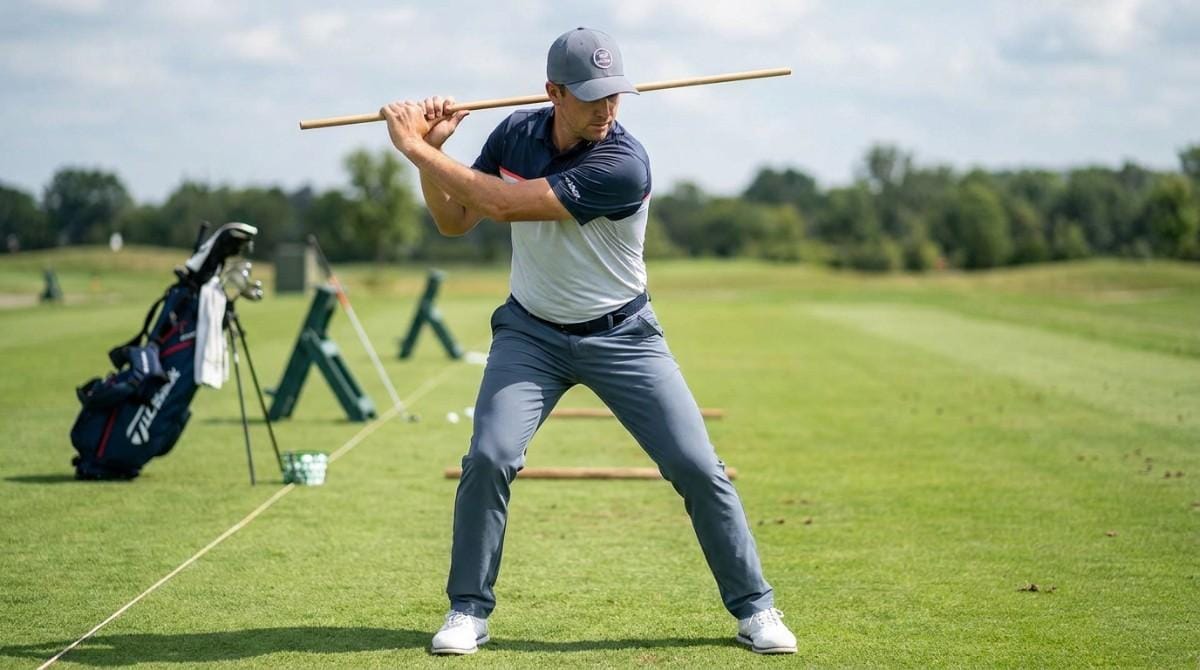
- Use a dowel or club for loaded rotation drills, which trains the pattern under light resistance rather than bodyweight alone.
What Happens If a Rotational Athlete Ignores Thoracic Mobility?
Ignoring thoracic rotation doesn't just cap performance. It tends to redirect stress somewhere else in the body. 📉
- Increased lower back loading during the swing, since the lumbar spine picks up rotation it wasn't designed to handle repeatedly.
- Reduced swing speed and inconsistent contact, as the body compensates for restricted separation with timing adjustments instead of clean mechanics.
- A lopsided rotational pattern, where the dominant swing side stays mobile while the opposite side stiffens further from disuse.
Best Thoracic Mobility Exercises for Golfers and Rotational Athletes (Quick List)
- Standing thoracic rotation with a club or dowel – Trains loaded rotation in an athletic stance, close to the actual movement pattern.
- Seated rotation with a resistance band – Adds controlled resistance through the exact rotational arc used in a swing.
- Split-stance thread the needle – Combines hip stability with thoracic rotation, closer to a real swing sequence than the standard floor version.
- Open book rotation – Builds baseline rotational range on both sides evenly.
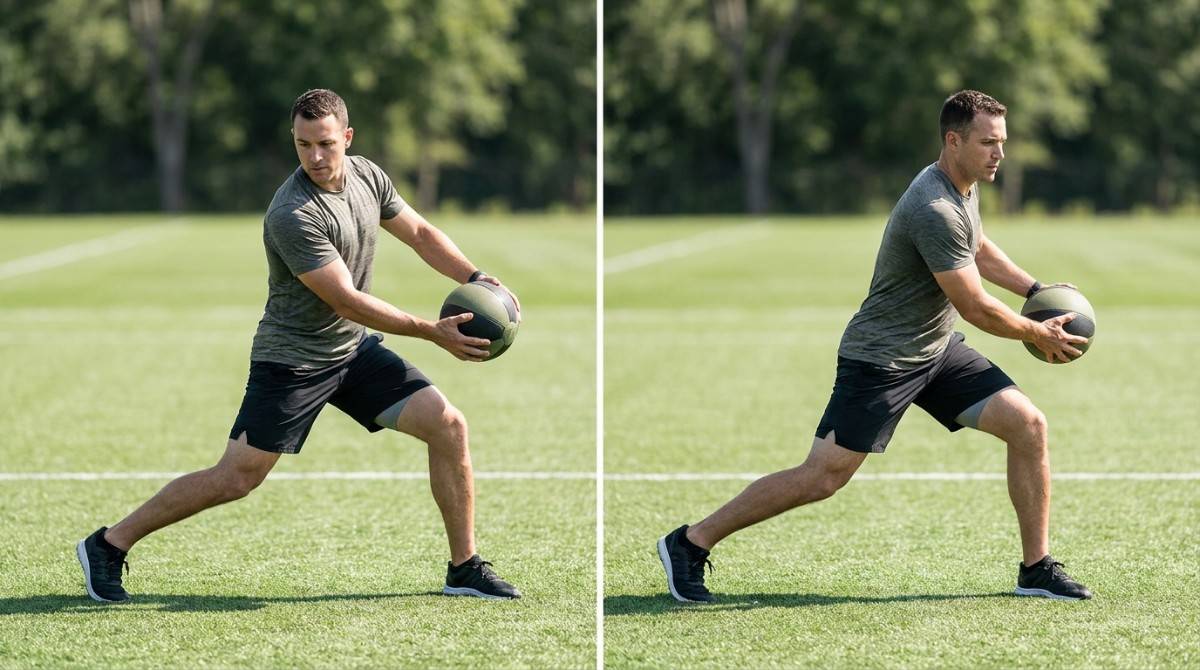
- Standing windmill rotation – A dynamic, full-range drill that mimics the follow-through phase of a swing.
- Half-kneeling chop or lift pattern – Trains rotation with a strength component, bridging mobility and power output.
General Mobility Work vs Sport-Specific Rotation Training
| General Thoracic Mobility | Sport-Specific Rotation Training | |
|---|---|---|
| Primary goal | Comfort, daily function | Power output, injury prevention under load |
| Movement style | Bodyweight, controlled range | Loaded, athletic-stance patterns |
| Symmetry focus | Helpful, not central | Essential, directly tied to performance |
| Best tool | Foam roller, bodyweight | Dowel, club, resistance band |
| Frequency | Daily maintenance | Pre-session priming plus off-season volume |
Athletes who've already built a baseline with our thoracic mobility exercise guide are ready to layer in the loaded, sport-specific versions above.
📲 Asymmetry between your dominant and non-dominant rotation is easy to miss by feel alone. Backed AI's camera-based posture scan can measure the actual gap between sides, which matters more for performance and injury prevention than raw range on your stronger side.
Step-by-Step Recovery Framework
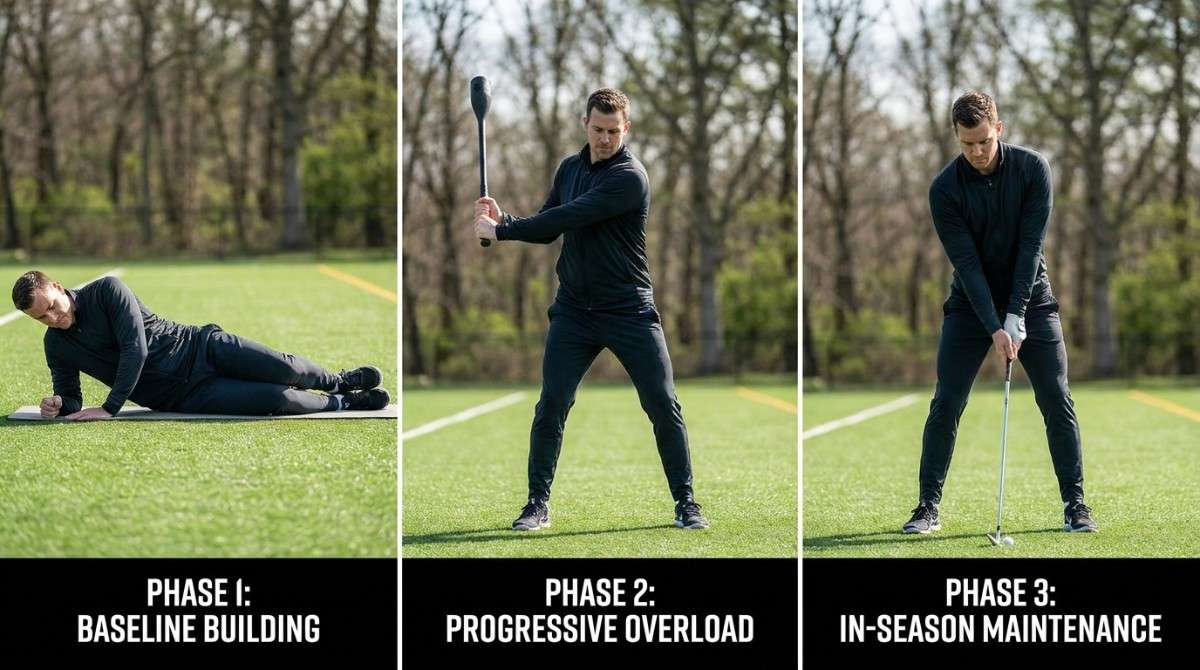
Off-season (weeks 1 to 6) – Build baseline range. Focus on open book rotation, thread the needle, and standing rotation on both sides equally, 8 to 10 minutes daily.
Pre-season (weeks 7 to 10) – Add load. Introduce the dowel or club-loaded rotation drills and resistance band work, layering strength onto the new range.
In-season – Prime, don't overhaul. Use a short 5-minute rotation warm-up before rounds or matches. This isn't the time to chase new range, just to activate what's already been built, ideally alongside a core strength foundation that supports the rotational force being generated.
💡 Key Insight: Symmetry matters more than raw range for performance. An athlete with slightly less total rotation but even range on both sides usually outperforms one with more range but a large side-to-side gap.
When This Approach Doesn't Work
Rotational mobility training helps most athletes with a stiffness- or asymmetry-driven performance plateau. It isn't the right tool for every situation.
- Sharp or catching pain during rotation – this points toward a joint or disc issue that needs a sports medicine assessment, not more mobility volume.
- Recent rib, spine, or shoulder injury – rotational loading needs clearance from a professional before returning to full-range drills.
- Power loss with full, symmetrical rotation already present – if mobility isn't actually restricted, the performance issue likely sits elsewhere, often hip mobility, sequencing, or strength.
- Persistent one-sided pain that mirrors your dominant swing side – this is a pattern worth having assessed rather than training through.
Research & Expert Insight
Posture specialists and performance coaches often point to hip-shoulder separation as one of the more trainable contributors to rotational power, precisely because it depends on tissue and joint mobility rather than fixed anatomy.
Research in musculoskeletal rehab shows that asymmetrical rotational range between dominant and non-dominant sides is a commonly cited factor in overuse patterns among rotational-sport athletes, which is part of why even, bilateral training tends to be recommended over one-sided volume.
Final Takeaway
Thoracic rotation is one of the more trainable, and more overlooked, contributors to power in a golf swing, tennis serve, or throw. Building even range on both sides, then loading that range with sport-specific drills, gives most rotational athletes more usable power and fewer compensation-driven aches than chasing strength or technique changes alone. Where sharp pain or a recent injury is involved, that's the signal to get assessed before training through it.
Why Most Athletes Ignore Thoracic Mobility Until It's a Problem
Rotational athletes tend to notice thoracic mobility only after it's already limiting them, for a few consistent reasons:
- It doesn't hurt until it does. Restricted rotation shows up as compensation first, and pain only shows up after months of that compensation pattern.
- Dominant-side bias. Practice reps build up rotation on the swing side, while the opposite side quietly stiffens from disuse.
- No baseline measurement. Without a way to compare sides, asymmetry stays invisible until it's pronounced enough to affect performance.
- Generic mobility routines aren't sport-specific. A general stretching routine doesn't train the loaded, rotational pattern an actual swing requires.
A Smarter Way to Train Rotational Mobility
Guessing at symmetry from how a swing "feels" misses smaller gaps that still cost power and add injury risk over time.
Backed AI's camera-based posture scan measures your actual rotational range on both sides, flags asymmetry before it becomes a performance or injury issue, and builds a program that trains the pattern your sport actually demands.
- 📍 Bilateral range measurement – identifies the exact gap between your dominant and non-dominant rotation.
- 🔄 Sport-relevant progression – sequences bodyweight range work into loaded, sport-specific drills as range improves.
- 📈 Progress tracking over a season – shows whether asymmetry is closing over the off-season, not just whether your swing feels fine today.
The athletes who stay ahead of this train symmetry before it becomes a problem, not after.
Download Backed AI and start correcting your posture today.
FAQ
1. Does improving thoracic mobility actually increase golf swing speed? It supports it indirectly. More available rotation allows for greater hip-shoulder separation, a mechanic closely tied to swing speed in most coaching models, though technique and strength matter too.
2. Should I train rotation on my non-dominant side if I only play golf right-handed? Yes. Training both sides evenly reduces the asymmetry that contributes to overuse patterns, even though your swing only rotates one direction.
3. How soon before a round should I do rotation drills? A short 5-minute priming session right before play works well. Save longer range-building sessions for off-season or non-competition days.
4. Can thoracic mobility work replace a golf-specific warm-up? It's one part of a complete warm-up, not a replacement for hip mobility, activation, and a few practice swings.
5. What's a sign that my rotation issue isn't actually about mobility? If you already have full, symmetrical rotation and still notice a power or consistency issue, the limiting factor is more likely sequencing, strength, or technique rather than thoracic mobility itself.